Showing posts with label Shunryu Suzuki. Show all posts

19 September, 2025

Six Books I Read This Summer

Short stories! Back in late June I ran across a collection of them by Kelly Link and was struck full in the face with a reminder of my love for the genre. Link's collection Stranger Things Happen is reportedly what Wikipedia contributors label slipstream fiction. I prefer the label "speculative fiction," which might be imprecise but at least isn't as outright douchey as "slipstream." Tomato, tomahto.

Link writes surreal little fairy tales—stories of the afterlife, pretty blonde space invaders, little girls with the power to disappear, spectral dogs, and much else. Oh, but now I'm making her writing sound less uniquely fantastical than it is. Some of it reads like a fever dream. Jonathan Lethem blurbed this book with great enthusiasm. Link clearly has a wonderful imagination and a gift for plainspoken perversion, traits that made Stranger Things Happen a pleasant summer read for this indoor-only weirdo.

I followed her contemporary takes on the age-old form with what I trusted would be a genuine classic of Victorian horror, The King in Yellow, by Robert William Chambers. It features ten stories that I was told all concerned madness and woe. The description says that the stories are linked by a fictional play entitled (what else?) The King in Yellow. I was drawn to this book as much for its purported creepiness as for its renown. Horror icon H.P. Lovecraft said it "really achieves notable heights of cosmic fear." Others obviously agree; The King in Yellow has been referenced in books, on TV, and in songs, videogames, and movies for 130 years.

It does start strongly, with stories of horror, dread, and overall unease, but suddenly lurches, around the halfway point, into four tedious, unrelated tales of French romance. I kept waiting for a connective thread to reveal itself. Neither the fictional play within the novel nor even the color yellow receives additional mention after "The Street of Four Winds." All of this makes me want to ask, "What the hell happened, Chambers?"

Such a promising start. Alas! The King in Yellow: two stars do not recommend.

My introduction to the humorist David Sedaris came from NPR's This American Life. Afterward, I was happy to find his occasional contributions to The New Yorker, after I took a subscription to the magazine. His very funny collection Me Talk Pretty One Day had come out a few years before that, but I didn't read it until this summer. It's pure early Sedaris. We might even go so far as to call it his Temple of Aphaia (a stately marvel of Greece's Early Classical period), except, you know, it's a book not a building, and makes repeated references to taxidermy and methamphetamine use. Hilarious!

No pun intended, but I found Sitting Inside: Buddhist Practice in America's Prisons, by Kobai Scott Whitney, to be an enlightening read. Whitney served a six-month sentence for drug charges, where his previously halfhearted Zen practice blossomed. He's now a spiritual leader in the Tien An tradition. In its array of related topics, his book breaks down the ways that Buddhism works (and sometimes doesn't) in prison's quasi-monastic setting. As Whitney writes in Chapter One, "Discipline, in its external form, is imposed by the very structure of prison, but sitting still in silence is so out of keeping with the chaotic, noisy atmosphere of prison that it takes great courage and cleverness to practice at all."

Whitney covers the history of Buddhism behind bars, from the earliest days of Buddhist prison outreach to the Constitutional battles that practitioners had to win before they were allowed to meditate together. I had no idea, before I read Sitting Inside, that it was a Buddhist whose lawsuit (Cruz v. Beto, in 1977) went to the US Supreme Court and opened the gates to prisoners' religious freedom. This book is intended for imprisoned practitioners, for the volunteers who visit them to teach and assist, and for readers curious about the great effort that prison practice requires.

Shunryu Suzuki's book Branching Streams Flow in the Darkness explores Buddhist practice via the Sandokai, a seventh-century work by Chinese poet Shitou Xiqian, that's become a tool of Zen in the modern world. A lot of contemporary practitioners recite its forty-four lines to remind themselves of the ultimate nature of reality. Suzuki was instrumental in bringing Buddhism (specifically, Zen) to the United States. Branching Streams Flow in the Darkness represents a series of talks he gave in 1970, which his students preserved in transcripts. He speaks digressively and incisively, in ways that are silly and profound. As far as I can tell, it's Zen, through and through—but what do I know? That's why it's called "practice."

Acknowledging ignorance in spiritual matters is all well and good, but feeling a cleverness deficit in other areas can be troubling. I experience mine when confronted with the writing of William Shakespeare. Like most people, I first ran afoul of the Bard's poetry in high school. I don't even remember the play, only that I gave up pretty quickly on his opaque Elizabethan elocution. When my book club elected A Midsummer Night's Dream to be our midsummer read, my first thought was, Well, shit.

I read it, though. We all did. Together. Aloud.

Specifically, I recited the parts of Bottom and Puck (aka Robin Goodfellow), and of the fairy queen, Titania—in a Monty Python–like lady voice. Keith read the lover รก la Scarlett O'Hara, and Danny did silly voices for the fairies the whole way through. No one else hammed it up as much as the three of us did, but everyone managed to have fun with it. Without our silliness to guide me, I doubt I'd have been able to actually follow the play's dialogue and plot, as four interchangeable lovers run afoul of two feuding fairies and proceed to caper around the stage in demonstration of how "the course of true love never did run smooth."

How have I changed in the last thirty-odd years? Only in all ways. I still feel no particular desire to engage with Shakespearean drama on the page, but at least I have an open mind about it. I didn't even dissent when the club voted to start reading Titus Andronicus, come October.

Most recently, I read the curious Dana Spiotta novel Innocents and Others, a book about three women whose lives focus on seeing and being seen. It tells their story in somewhat experimental ways, through both traditional third-person narrative and first person "articles" written by the characters. I love this almost mixed-media style in fiction, and Innocents and Others used it to deliver a deeply satisfying convergence of three seemingly disparate narratives. On the strength of this book alone, I might have to venture deeper into Spiotta's work.

20 June, 2020

Fourteen Books I Spent My Spring Reading


Brace yourself. My reading, these past three months, was intense. Most of it was nonfiction. At one point, though, I started reading Dostoyevsky's The Idiot, which is reportedly among the great Russian novelist's most esteemed works, and passed page 183 before realizing that the book wouldn't move past the sitting room. I love Dostoyevsky's other works — The Brothers Karamazov, Crime and Punishment — but the mannered doings and misunderstandings of prerevolutionary Russia's upper class, which seem to comprise the entirety of The Idiot's plot, reminded me a little of Anna Karenina, a book that tortured me for 800-plus pages. I was not going to live through that again.

Buddhist works, with their often repetitious nature, sometimes plod along, but at least I feel like I'm growing when I read them, rather than just growing moldy.

Consider Paticcasamuppada: Practical Dependent Origination, an interpretation that I can definitely get behind. The Buddhist concept of dependent origination (also called "dependent arising," "interdependency," or any number of variations on this, based on who's translating Paticcasamuppada, a Pali term), refers to the Buddha's realization of the origins of suffering. In this book, Buddhadasa Bhikku cites ancient Pali sutras to boldly dispute the common Buddhist belief that one complete "turning of the wheel," an individual's attainment of enlightenment, takes three lifetimes. In plain English, he argues that reincarnation is a mythical remnant of the Hindu culture amid which Buddhism arose. He writes that this misunderstanding can be traced back to a mistranslation of the Pali word for "birth" that happened two millennia ago, circa 300 CE. To support this theory, Buddhadasa quotes multiple canonical passages attributed to the Buddha, but, really, the argument comes down to this: because Buddhist belief holds that there is no self, inherent being, or soul, what can be said to continue on after bodily death? Buddhadasa suggests that we "die" and are "reborn" with every moment, a marvelous flow of conditions stretching on and on, for as long as we do — you know, life.

The Soto Zen perspective in Grace Schireson's memoir, Naked in the Zendo: Stories of Uptight Zen, Wild-Ass Zen, and Enlightenment Wherever You Are, offered still more for me to enthusiastically engage with. Dr. Schireson's practical anecdotes, spanning her three decades' teaching and seven decades' living, are often deceptively simplistic. Her account of a Japanese teacher and hippie student's interaction at one particular retreat left me awed. Her story of a stray tomcat that terrorized her own feline friends inspired me as a small example of perfect magnanimity. Naked in the Zendo is a thin book that's much, much larger on the inside.

America in the 1960s was just being introduced to Buddhism, and, midway through that decade, Philip Kapleau returned from thirteen years of Zen training in Japan to compile The Three Pillars of Zen: Teaching, Practice, and Enlightenment as an introduction to the practice for Westerners. His book is still considered Zen's most influential English-language text, next to Shunryu Suzuki's Zen Mind, Beginner's Mind (which I really want to read). Kapleau delves into esoterica, including practitioners' self-reported kensho (budding enlightenment) experiences, which Westerners probably ate up because they saw Zen as a mystical practice from an exotic place. Eventually those seekers probably fell away as they learned that Zen is actually a pragmatic, subtle thing quite at odds with their expectations. Alongside transcriptions of once-secret dokusan teacher-student interactions, however, The Three Pillars of Zen does offer sound, detailed practical instructions for developing skillful meditation practice. For all the book's shortcomings, it did answer a lot of my questions. It just raised even more.

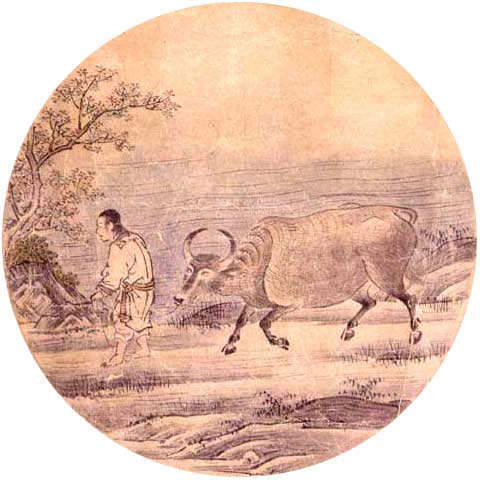
After that, I read Riding the Ox Home: Stages on the Path of Enlightenment — essentially a short picture book by John Daido Loori.


The ten Ox-Herding Pictures (that's Scene Five, above) and their accompanying poems are considered a 500-year-old map to how one develops in Buddhist practice. The ox here is a metaphor for enlightenment. Daido Loori presents his usual clear, concise commentary at each step. The overall effect is inspiring for anyone engaged in Zen practice.

I also appreciated Daido Loori's overview in The Eight Gates of Zen: A Program of Zen Training. This book details the ways of the monks, trainees, and students at Zen Mountain Monestery, which Daido Loori founded and where he taught until his 2009 death. The Eight Gates of Zen addresses Zen practice with the author's typical poetic perspective. I loved his writing, as well as the helpful appendices that included a zazen checklist, lists of liturgies that readers can employ, and a long list of recommended reading organized by level of depth and complexity, so that anyone, from newcomers to more advanced students, can locate suitable material.

The question of why I don't claim M. John Harrison as my favorite SF writer is complicated, and it came up several times as I read his gorgeous little novel Signs of Life, a gift from the kind Constance M., whose acquaintance I'm very glad to have made. (Thanks again, Connie.) Harrison's deep characterization, in works whose prose rivals fine literary novels, sparks an emotional attachment that few other writers are capable of engendering. Signs of Life almost made me weep with its narrator's longing and frustration. That character's difficult, complex friendship with an erratic sociopath, and unrequited love affair with a moon-eyed dreamer seem to doom him from the start, and the book's all the more engaging for this. It bears mentioning, too, that the great majority of Signs of Life reads nothing like sci-fi. There were moments when I wondered how it got labeled as genre fiction at all. The answer comes late, and almost subtly. As for not considering Harrison my favorite, it comes down to pure unfamiliarity. Maybe once I read everything else he's done....

In The Buddha's Dream of Liberation: Freedom, Emptiness, and Awakened Nature, James William Coleman, cofounder of the White Heron Sangha, in San Luis Obispo, California, examines the Samdhinirmocana Sutra, the Sutra of the of the Explanation of the Profound Secrets. This sounds like what cloaked figures in a 1970s Hammer Films production might use in black-magic rituals; it's actually a breakdown of the three turnings of the wheel of dharma, on which Buddhist teachings are based.

The first turning was the Buddha's introduction of the four noble truths (that life has suffering, that the cause of suffering is craving/attachment, that there is a remedy to life's suffering, and that that remedy is the noble eightfold path). The second turning was the Buddha's revelation that he, in fact, had nothing at all to teach anyone. The third turning was the Buddha's clarification of the apparent contradiction between the first and second turnings, by describing awakened (small b) buddha nature, which is the ultimate realization and embodiment of the dharma. Coleman's book, The Buddha's Dream of Liberation, gives a concise, comprehensible, and seemingly comprehensive unpacking of these tricky concepts.

Albert Camus might best be known to college undergrads as that dude who wrote about an Algerian man who's shot dead on the beach for no reason (that novel being his first, The Stranger). The COVID-19 pandemic prompted a slew of noncollegia readers to buy his novel The Plague. I'd already read some Camus in years past, both fiction and non-, and thought this period of social isolation was as good an excuse as any to join the mob — as it was translated by Stuart Gilbert. Other than being a little musty, with outmoded spellings and euphemisms, there's a lot here to identify with. I wrote a little on this subject in an April blog post on prison quarantine, so I won't retread that ground here. Suffice it to say that the novel is quite good, regardless of how one reads it — or in what proximity to a pandemic.

Almost inevitably, I circled back around to John Daido Loori. His Cave of Tigers: The Living Zen Practice of Dharma Combat deepened my understanding of Zen, with transcriptions of real teacher-student encounters at Zen Mountain Monastery. Despite its name, "dharma combat" is a nonviolent encounter in which students face their teacher in public one-on-one exchanges that demonstrate their understanding of Zen. Because they defy dualistic, linear thought, these exchanges might seem confounding, mysterious, profound, or even asinine to an outsider. They struck me as all of those, at different times, but I came away feeling much more aware within my practice.

Plainspoken talks by Charlotte Joko Beck, at the Zen Center of Los Angeles, make up Everyday Zen: Love & Work. Beck's teaching style was straightforward, no-nonsense, and lacking the inscrutable qualities others teachers' lessons often have. She didn't talk much about enlightenment, the precepts, or koans. Instead, she was interested in conveying the essential nature of practice, usually in the form of sitting zazen. As the book's title implies, there are no esoteric teachings here; this is Zen for daily living, because Zen, after all, is daily living.

Zen Training, by the Japanese lay practitioner Katsuki Sekida, answers fundamental questions about the methods and philosophy of Zen, from the physiologies of sitting and breathing, to working with the koan Mu and comprehending the levels and varieties of consciousness. There's even a whole chapter on laughter. Sekida left little out, and his modern approach, while methodical, affords just the right amount of flexibility. This book would kick-start any logical thinker's Zen practice. Quite a bit here also enriches the existing practice of one who lacks a teacher.

After coming to the US in 1959 to teach, Shunryu Suzuki became an influential figure in the development of American Zen Buddhism. His Zen Mind, Beginner's Mind, mentioned above, is considered a cornerstone English-language text on the subject. Branching Streams Flow in the Darkness: Zen Talks on the Sandokai collects his lectures about the 1,200-year-old Chinese poem, the Sandokai, by the great Zen master Sekito Kisen. The wisdom found in the poem earned it the status of Zen scripture. Monasteries around the world regularly chant it, and its final couplet ("I respectfully urge you who study the mystery, / do not pass your days and nights in vain.") is often written on the wooden board that's struck to signal the beginning of group meditation. Meanwhile, Suzuki's affable teachings guide readers through the poem, line by line, to help us understand, and maybe penetrate, its layers of meaning.

Finally, in the mood for some silliness, I picked up the Tom Robbins novel Fierce Invalids Home from Hot Climates. Although I distinctly recall the comic novels Jitterbug Perfume and Even Cowgirls Get the Blues sitting beside brainier fare on my father's bookshelf, I didn't read Robbins until the year before last. I was amused, once I did. And I zipped through the 445 pages of Fierce Invalids Home from Hot Climates this week. It amused me, but I don't necessarily recommend it. Some books are like that. This one's about a degenerate Buddhist ex-CIA "errand boy" who eats his grandmother's parrot while under the effects of a powerful hallucinogenic drug in Peru, ends up wheelchair-bound by a shamanic curse, seduces his underage stepsister, and, on a mission to Iraq for an American gunrunner, falls in love with an excommunicated expatriated middle-age French nun — one hell of a trip, for sure.