"What is the meaning of Bodhidharma coming from the
West?" This question has been posed by Buddhist teachers to students in
the Zen tradition for 1,500 years. It's a koan, a question unanswerable by
intellectual means, designed to short circuit a student's questing mind and
bring them one step closer to the essence of being.
Bodhidharma was the First Patriarch of Ch'an Buddhism
(which we in America call Zen) Buddhism. He was a redhead of royal birth,
either Indian or Iranian, who likely traveled the Silk Road to teach his
"wall-examining" style of Buddhism in Northern China. During the
country's T'ang Dynasty, Buddhist practice typically involved the endless study
of texts and recitation of mantras. Bodhidharma's teachings took a more direct
approach, de-emphasizing intellectualization and focusing instead on seated
meditation. He taught practice over theory.
A short biography makes up part of The Bodhidharma
Anthology: The Earliest Records of Zen, a deceptively small book
containing the world's first writings about Zen's first teacher. Jeffrey L.
Broughton's translation, which I read in April, took a little while to read,
even though I skipped the many appendices. Ironic that a text eschewing
complexity and one's intellectual grasping at Buddha's teachings should be
loaded with scholarly whatnot. Still, this is the stuff of history; I paid it
the attention it deserves.
Translation is such an underappreciated (not to say
invisible) art. Like almost any car part, you usually don't notice it's there
unless it goes bad. Broughton's translation ancient Tibetan and Sanskrit reads
well. The contemporary poet John Ashbery's impactful translation of Arthur
Rimbaud's surreal masterpiece, Illuminations, reads altogether
differently.
Before the ever-generous Emily C. sent me this version of
Illuminations as a gift, it had been on my wish list for years. That
often happens with books recommended by other writers and poets recommend but
no one else understands the relevance of. Rimbaud is truly a poet's poet. We
envy the freedom he found within his chosen forms. Even his life was poetic. He
published his first work at seventeen, after traveling with the older poet Paul
Verlaine to Belgium, where the two had a torrid love affair. Then Verlaine shot
Rimbaud during a quarrel and the young man returned to his family farm to
convalesce. Thereafter, he basically gave up poetry altogether and died, at age
thirty-seven, in the Horn of Africa, done in by a tumor on his knee.
Rimbaud's original French on the facing pages of this
version of Illuminations allows the reader to sit, sounding out bizarre
poems in a language one hardly understands, until, as the poet (via Ashbery)
writes, "A white ray, falling from the top of the sky , wipes out this
little bit of theatricality."
Comparatively, there are books that don't age well, and
Tom Robbins's Jitterbug Perfume is one of them. I remember
several Robbins titles on my dad's bookshelf, when I was a kid – Skinny Legs
and All, Even Cowgirls Get the Blues, Half Asleep in Frog Pajamas.
Their titles alone were sublimely ridiculous; I had no idea what kinds of
stories they foretold. Then I came to prison and decided to see what had so
clearly interested my father. Jitterbug Perfume is the fourth Robbins
book I've read, and it's by far my least favorite.
Basically, Jitterbug Perfume concerns the quest
for eternal youth by a couple of ancient narcissists. One is a former king of a
pre-European tribe; one is an Indian widow from an undescribed mid-level caste.
Along the way, they meet the Greek god Pan, go to prison, narrowly escape being
burned alive by superstitious townsfolk on numerous occasions, become embroiled
in the perfume business, and dress up for Mardi Gras as giant beets. I expected
silliness, but the sexism and casually racist garbage that ran through the
novel didn't pass muster. I finished reading it mostly just to avoid thinking
of myself as a quitter.
Brace yourself. My reading, these past three months, was intense. Most of it was nonfiction. At one point, though, I started reading Dostoyevsky's The Idiot, which is reportedly among the great Russian novelist's most esteemed works, and passed page 183 before realizing that the book wouldn't move past the sitting room. I love Dostoyevsky's other works — The Brothers Karamazov, Crime and Punishment — but the mannered doings and misunderstandings of prerevolutionary Russia's upper class, which seem to comprise the entirety of The Idiot's plot, reminded me a little of Anna Karenina, a book that tortured me for 800-plus pages. I was not going to live through that again.
Buddhist works, with their often repetitious nature, sometimes plod along, but at least I feel like I'm growing when I read them, rather than just growing moldy.
Consider Paticcasamuppada: Practical Dependent Origination, an interpretation that I can definitely get behind. The Buddhist concept of dependent origination (also called "dependent arising," "interdependency," or any number of variations on this, based on who's translating Paticcasamuppada, a Pali term), refers to the Buddha's realization of the origins of suffering. In this book, Buddhadasa Bhikku cites ancient Pali sutras to boldly dispute the common Buddhist belief that one complete "turning of the wheel," an individual's attainment of enlightenment, takes three lifetimes. In plain English, he argues that reincarnation is a mythical remnant of the Hindu culture amid which Buddhism arose. He writes that this misunderstanding can be traced back to a mistranslation of the Pali word for "birth" that happened two millennia ago, circa 300 CE. To support this theory, Buddhadasa quotes multiple canonical passages attributed to the Buddha, but, really, the argument comes down to this: because Buddhist belief holds that there is no self, inherent being, or soul, what can be said to continue on after bodily death? Buddhadasa suggests that we "die" and are "reborn" with every moment, a marvelous flow of conditions stretching on and on, for as long as we do — you know, life.
The Soto Zen perspective in Grace Schireson's memoir, Naked in the Zendo: Stories of Uptight Zen, Wild-Ass Zen, and Enlightenment Wherever You Are, offered still more for me to enthusiastically engage with. Dr. Schireson's practical anecdotes, spanning her three decades' teaching and seven decades' living, are often deceptively simplistic. Her account of a Japanese teacher and hippie student's interaction at one particular retreat left me awed. Her story of a stray tomcat that terrorized her own feline friends inspired me as a small example of perfect magnanimity. Naked in the Zendo is a thin book that's much, much larger on the inside.
America in the 1960s was just being introduced to Buddhism, and, midway through that decade, Philip Kapleau returned from thirteen years of Zen training in Japan to compile The Three Pillars of Zen: Teaching, Practice, and Enlightenment as an introduction to the practice for Westerners. His book is still considered Zen's most influential English-language text, next to Shunryu Suzuki's Zen Mind, Beginner's Mind (which I really want to read). Kapleau delves into esoterica, including practitioners' self-reported kensho (budding enlightenment) experiences, which Westerners probably ate up because they saw Zen as a mystical practice from an exotic place. Eventually those seekers probably fell away as they learned that Zen is actually a pragmatic, subtle thing quite at odds with their expectations. Alongside transcriptions of once-secret dokusan teacher-student interactions, however, The Three Pillars of Zen does offer sound, detailed practical instructions for developing skillful meditation practice. For all the book's shortcomings, it did answer a lot of my questions. It just raised even more.
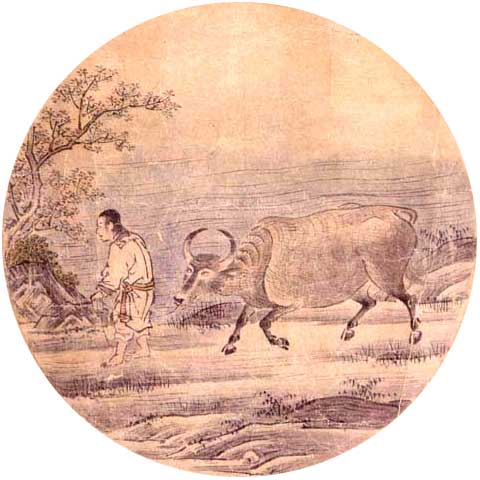
After that, I read Riding the Ox Home: Stages on the Path of Enlightenment — essentially a short picture book by John Daido Loori.
The ten Ox-Herding Pictures (that's Scene Five, above) and their accompanying
poems are considered a 500-year-old map to how one develops in Buddhist
practice. The ox here is a metaphor for enlightenment. Daido Loori presents his
usual clear, concise commentary at each step. The overall effect is inspiring for
anyone engaged in Zen practice.
I also appreciated Daido Loori's overview in The Eight Gates
of Zen: A Program of Zen Training. This book details the
ways of the monks, trainees, and students at Zen Mountain Monestery, which
Daido Loori founded and where he taught until his 2009 death. The
Eight Gates of Zen addresses Zen practice with the author's typical
poetic perspective. I loved his writing, as well as the helpful appendices that
included a zazen checklist, lists of liturgies that readers can employ, and a
long list of recommended reading organized by level of depth and complexity, so
that anyone, from newcomers to more advanced students, can locate suitable
material.
The question of why I don't claim M. John Harrison as my favorite SF writer is complicated, and it came up several times as I read
his gorgeous little novel Signs of Life,
a gift from the kind Constance M., whose acquaintance I'm very glad to have
made. (Thanks again, Connie.) Harrison's deep characterization, in works whose
prose rivals fine literary novels, sparks an emotional attachment that few
other writers are capable of engendering. Signs of Life
almost made me weep with its narrator's longing and frustration. That character's
difficult, complex friendship with an erratic sociopath, and unrequited love
affair with a moon-eyed dreamer seem to doom him from the start, and the book's
all the more engaging for this. It bears mentioning, too, that the great
majority of Signs of Life reads nothing like sci-fi. There
were moments when I wondered how it got labeled as genre fiction at all. The
answer comes late, and almost subtly. As for not considering Harrison my
favorite, it comes down to pure unfamiliarity. Maybe once I read everything
else he's done....
In The Buddha's Dream of Liberation: Freedom, Emptiness, and
Awakened Nature, James William Coleman, cofounder of the
White Heron Sangha, in San Luis Obispo, California, examines the
Samdhinirmocana Sutra, the Sutra of the of the
Explanation of the Profound Secrets. This sounds like what cloaked
figures in a 1970s Hammer Films production might use in black-magic rituals;
it's actually a breakdown of the three turnings of the wheel of dharma, on
which Buddhist teachings are based.
The first turning was the Buddha's introduction of the four noble truths (that
life has suffering, that the cause of suffering is craving/attachment, that
there is a remedy to life's suffering, and that that remedy is the noble
eightfold path). The second turning was the Buddha's revelation that he, in
fact, had nothing at all to teach anyone. The third turning was the Buddha's
clarification of the apparent contradiction between the first and second turnings,
by describing awakened (small b) buddha nature, which is the
ultimate realization and embodiment of the dharma. Coleman's book, The
Buddha's Dream of Liberation, gives a concise, comprehensible, and
seemingly comprehensive unpacking of these tricky concepts.
Albert Camus might best be known to college undergrads as that dude who wrote
about an Algerian man who's shot dead on the beach for no reason (that novel
being his first, The Stranger). The COVID-19 pandemic
prompted a slew of noncollegia readers to buy his novel The
Plague. I'd already read some Camus in years past, both
fiction and non-, and thought this period of social isolation was as good an
excuse as any to join the mob — as it was translated by Stuart
Gilbert. Other than being a little musty, with outmoded spellings and
euphemisms, there's a lot here to identify with. I wrote a little on this
subject in an April blog post on prison quarantine, so I won't retread that ground
here. Suffice it to say that the novel is quite good, regardless of how one
reads it — or in what proximity to a pandemic.
Almost inevitably, I circled back around to John Daido Loori. His
Cave of Tigers: The Living Zen Practice of Dharma
Combat deepened my understanding of Zen, with
transcriptions of real teacher-student encounters at Zen Mountain Monastery. Despite its name, "dharma
combat" is a nonviolent encounter in which students face their teacher in
public one-on-one exchanges that demonstrate their understanding of Zen.
Because they defy dualistic, linear thought, these exchanges might seem
confounding, mysterious, profound, or even asinine to an outsider. They struck
me as all of those, at different times, but I came away feeling much more aware
within my practice.
Plainspoken talks by Charlotte Joko Beck, at the Zen Center of Los Angeles,
make up Everyday Zen: Love & Work. Beck's teaching style was straightforward,
no-nonsense, and lacking the inscrutable qualities others teachers' lessons
often have. She didn't talk much about enlightenment, the precepts, or koans.
Instead, she was interested in conveying the essential nature of practice,
usually in the form of sitting zazen. As the book's title implies, there are no
esoteric teachings here; this is Zen for daily living, because Zen, after all,
is daily living.
Zen Training, by the Japanese lay
practitioner Katsuki Sekida, answers fundamental questions about the methods
and philosophy of Zen, from the physiologies of sitting and breathing, to
working with the koan Mu and comprehending the levels and
varieties of consciousness. There's even a whole chapter on laughter. Sekida
left little out, and his modern approach, while methodical, affords just the
right amount of flexibility. This book would kick-start any logical thinker's
Zen practice. Quite a bit here also enriches the existing practice of one who
lacks a teacher.
After coming to the US in 1959 to teach, Shunryu Suzuki became an influential
figure in the development of American Zen Buddhism. His Zen Mind,
Beginner's Mind, mentioned above, is considered a cornerstone English-language
text on the subject. Branching Streams Flow in the Darkness:
Zen Talks on the Sandokai collects his lectures about the
1,200-year-old Chinese poem, the Sandokai, by the great Zen
master Sekito Kisen. The wisdom found in the poem earned it the status of Zen
scripture. Monasteries around the world regularly chant it, and its final
couplet ("I respectfully urge you who study the mystery, / do not pass
your days and nights in vain.") is often written on the wooden board
that's struck to signal the beginning of group meditation. Meanwhile, Suzuki's
affable teachings guide readers through the poem, line by line, to help us
understand, and maybe penetrate, its layers of meaning.
Finally, in the mood for some silliness, I picked up the Tom
Robbins novel Fierce Invalids Home from Hot
Climates. Although I distinctly recall the comic novels
Jitterbug Perfume and Even Cowgirls Get the
Blues sitting beside brainier fare on my father's bookshelf, I didn't
read Robbins until the year before last. I was amused, once I did. And I zipped
through the 445 pages of Fierce Invalids Home from Hot
Climates this week. It amused me, but I don't necessarily recommend
it. Some books are like that. This one's about a degenerate Buddhist ex-CIA
"errand boy" who eats his grandmother's parrot while under the
effects of a powerful hallucinogenic drug in Peru, ends up wheelchair-bound by
a shamanic curse, seduces his underage stepsister, and, on a mission to Iraq
for an American gunrunner, falls in love with an excommunicated expatriated
middle-age French nun — one hell of a trip, for sure.
Birthday season, perennial bringer of many excellent literary gifts from loved ones and strangers alike, did not leave me without reading material worth crowing about. Sure, I finally got around to the Sherman Alexie collection Blasphemy (shipped to me six months prior, by Tom at Prospero's Books in Kansas City) and Anthony Doerr's magnificent Pulitzer Prize-winning All the Light We Cannot See. But more meaningful were the books sent by the people who care what literature enriches my days.
To wit: ever so thoughtful and generous, Emily C. ordered a trifecta of marvels into my hands. First was Joe Wenderoth's insanely clever (or, perhaps, merely insane) Letters to Wendy's, which includes such gems as
SEPTEMBER 18, 1996
I don't think Wendy's coffee has such a good taste. This is not to say I don't like it. I like it very much. Its poor taste keeps my intentions clear; I drink coffee for the enthusiasm-prod, not the taste. The taste, when it is too pleasant, can distract one from what matters most — the deep writhing jolt. Of course some taste is necessary so the jolt seems, at bottom, inadvertent.
and the poignant
APRIL 4, 1997
One is accused of sensationalism when one focuses on pain. Rightly so when one is using pain to re-create a pre-existing sensation. But in truth pain has never been before, exactly, and its shadow has always concealed its coming fullness. To know this is to haul out the most fundamental question a speaking animal can attempt. The question is not: what is creating pain? The question is: what is pain creating?
Then were the stimulating quasi-realities depicted in the short-story collections Tenth of December, by George Saunders, and Men Without Women, by Haruki Murakami (translated by Philip Gabriel and Theodore Goossen). Both delivered just the type of eccentric, plausibility-agnostic tales I often need in my life.
Following those, I descended into playwright Jeff Jackson's dark, fraught novel Mira Corpora, a gift from the good Lady V., who'd never, ironically, read such a harrowing, nihilistic misadventure of wayward youth herself. Then I moved to Thomas Mann's Death in Venice and Seven Other Stories, translated by H.T. Lowe-Porter — a gift from my mother, who read Mann in the original German long ago enough as to hardly remember his luxurious descriptive power or frank homoeroticism. Discussion followed.
Lana C.'s surprise to me was an Amazon package containing three books from my wish list. Greedily, I propelled myself myself through Still Life with Woodpecker, by Tom Robbins, before year's end. Robbins was one of my father's favorites — and now I finally know why. Fun, philosophical stuff.
2018 finds me with several more promising books on hand, and a few on the list to borrow. I can hardly wait.
For anyone who has ever discovered value in a piece of trash, wondered about the author of a note they found fluttering down the street, or developed an inexplicable crush on the subject of a discarded photograph, the outstanding anthology Requiem for a Paper Bag is now available from fine booksellers everywhere.
Featuring the personal experiences of a diverse assortment of contributors (including Tom Robbins, Dave Eggers, Chuck Klosterman, Jonathan Lethem, Susan Orlean, Miranda July, Jim Carroll, Billy Bragg, Chuck D, Seth Rogen, and many others), these are stories to make you giggle, make you squirm, make you cry — stories, in other words, that are as distinct and as fascinating as their authors. It is not only because the collection includes my story "Trash Night" that I recommend it; Requiem for a Paper Bag really is a fine book you're bound to find worthwhile. Click here to pick up your copy today.