The rain is light but steady as a sergeant escorts me across the loading area behind the intake building. I'm pushing a canvas-sided laundry cart, the kind used by housekeeping staff deep in the bowels of hotels, where no guest ever sees. Sarge, at least, has a hat. Water beads on my bare scalp and trickles down my cheeks.
13 April, 2022
After the Courtroom, the Storage Room
We pass behind dumpsters and storage sheds. He's telling me that today's his
day to work 7-House, but he got a call to run this brief errand. Another guard
is filling in while he's away from the post, he says. It's good for her, he
says. A little rain never hurt anyone, he says. "Anyone," in this
case, meaning "us," meaning "him." The benevolent
lies we tell ourselves to get though the day.
He unlocks the back door to the prison's TCU, where ERDCC houses its would-be
suicides, people recuperating from surgeries, and those at death's door. If
hospitals seem dreary, the dim halls and scuffed linoleum floors of the TCU
makes them look downright cheerful, bringing to mind the afterlife's teal
waiting room in Beetlejuice. So why the hell am I here?
I have to pore over my legal files tomorrow. Since they're too copious and
sensitive to keep in my cell, the property room at one institution or another
has stored them in a reasonably secure location since 2002. As long as I give
one week's advance notice, I can request to access them anytime I need.
At first the documents were just in a fat accordion folder. It was small
enough, I could tuck it away in my footlocker, away from prying eyes. Nothing's
ever truly private in prison, but we cling to the vestiges of personal space
where they appear. Filled with photographs, letters, and personal records, my
footlocker is like a vault that I'd like to think no one visits.
Guards searching my cell over the years have likely skimmed through bits and
pieces of what I keep at hand. I think reading the particulars of prisoners'
cases bores them. Cellmates, on the other hand, are often bored. More than a
few probably constructed for themselves a decent outline of how I came to
prison.
The sergeant leads me through the TCU, past doors with inkjet-printed signs
warning, DO NOT GIVE HOT COFFEE TO OFFENDERS ON SUICIDE WATCH. No nurses
or guards here make eye contact as we pass on another. When we come to the
opposite side of the building, Sarge unlocks the unmarked black door to what
looks like a utility closet. I spot a few cardboard boxes bearing paper labels
of prisoners' names and DOC ID numbers.
"Hang out here a second, Case. I gotta find your stuff," he says
before disappearing. I stand beside the damp laundry cart, debating what to do
with my hands. I hear intermittent thumping from the little room, as if the
sergeant's hurling boxes around just a little too zealously.
It occurs to me: this is an aspect of the legal system that no one sees, the
underbelly of justice. The documents that could be key to determining my fate –
whether I'll ever again eat at a restaurant, sleep in a real bed, travel, make
love, fix a flat tire, peruse a wine list, fall asleep on a couch, surf the Web
– these documents are kept here, in some damp spare room between a padded cell
and a cart with someone's half-eaten soft taco laying on it.
The sergeant slides a navy blue Rubbermaid tote out the door. A square of paper
stuck on the front bears my name. I open the container to count the folders.
They've multiplied over the years. There are seven now. Each court filing I
make, each Sunshine Law or Freedom of Information Act request I submit, each
letter I get from a nonprofit or legal professional – they're all here, indexed
and chronologically organized as best as my circumstances allow.
One of the folders has warped. I pull it out. A trail of confetti follows, a
tiny ticker-tape parade in celebration of my return to legal practice. No, some
pages have just been rodent-eaten. A small yellow piss stain mars the
letterhead of a prominent Kansas City attorney I had to fire, whose letter
expresses indignance at being let go. Obviously, the mouse sided with me in
that matter.
The vaunted halls of justice are made of marble, but this humble mess is the
reality. This is how people who've been wronged by the system get out of
prison: we rifle though old paper and mouse piss, and we review the facts over
and over and over again.
When I get back to the cell with my files, I pour the accumulated rainwater out
of the lid and start to dig. Out of a folder labeled Legal Correspondence
I pull a stack of letters from places with names like the Midwest Innocence
Project, the Center on Wrongful Convictions, and Spence, Moriarty &
Shockey. The first of these is dated November of 2002. It's hard to believe
I've been chasing justice for that long, and longer.
It'll be longer yet before I'm done, but I'm nowhere near giving up. My
fingertips are dry from shuffling paper. My back aches from digging through
this tote. I feel closer to freedom now than I did yesterday, and that's no
small thing.
Labels:
personal observation,
prison,
wrongful conviction
08 April, 2022
What Exactly Do I Do at the Job Where I Do So Much?
Enough questions have come up about my job here at the prison. I thought it was time to review what I do, for those who don't quite follow. Even though my work encompasses such a wide variety of duties that "typical workday" isn't an applicable label, I'll nevertheless try to explain it.
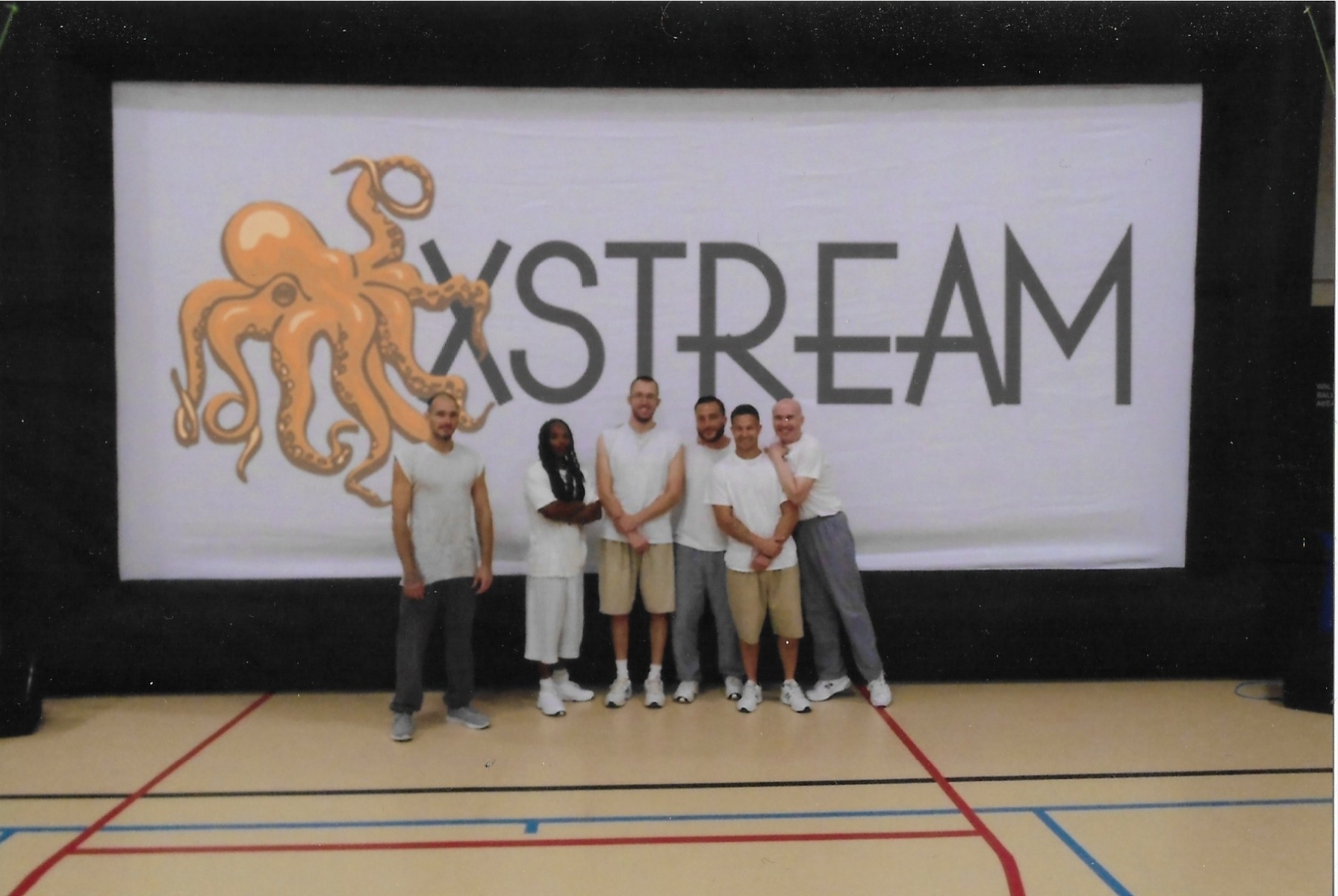
XSTREAM is the name of the prisoner-run media center at Eastern Reception,
Diagnostic & Correctional Center. We're like a little TV station inside the
facility (except we probably do more than your average network employees). From
two small roomfuls of computers and A/V equipment adjacent to the gym, we
broadcast twelve dedicated channels of content for the prison population –
movies, TV series, music videos, in-house video productions, program listings,
and institutional information. From what I understand, XSTREAM pumps out more
content than our equivalent at any other state facility in Missouri.
A database that was developed in-house manages our 12,000-plus hours of video
on a 90-terabyte RAID server. From my desk I program two channels – EXCEL and
The MiX. My coworkers Luke, Jacob, Paul, and Josh each run two of their own.
Twon runs one. The responsibility of the team's newest hires, Danny, Steve, and
Rodney, is to import subtitles into our system for the benefit of
hearing-impaired viewers (a process that XSTREAM recently developed). I
basically pick what seems like a good blend of programs for a given week, then
schedule them to play, each in a twenty-four-hour cycle, with each showtime beginning
on the hour.
We do a bit of videography work. An eight-foot-tall green screen in our studio
serves as a stand-in for the exotic locations where we'd rather be shooting. I
personally produce a weekly music show called The Playlist, starring my
coworker Twon. He looks like a very small Snoop Dogg. Guests from the
population bring a song that they love, we play a sample, and a fifteen to
twenty minutes of conversation with Twon (aka "Twizzo") ensues,
usually spiraling off into deep, fascinating realms. Recent discussions have
covered drug addiction, intergenerational divides, self-esteem, grammatical and
syntactical changes in hip-hop lyrics over the decades, Deaf culture, emotional
regulation, and much more. I've yet to hear one bad word spoken about the show.
Our boss, ERDCC's Recreation Director, also has us writing and producing
serious videos for distribution around the state. The first we did was
"Out Inside," a production about transgender people in prison, meant
to foster understanding by staff and other inmates alike. (Predictably, it
caused a bit of a stir.) Now I'm heading up a suicide-prevention video that
incorporates not just warning signs and "get help" messages but also
proven tactics for fighting depression. Our boss supplied from the Internet any
informational resources that we've asked for – Wikipedia articles, lists of
trans celebrities, studies on the effectiveness of media campaigns, whatever
was called for. We want to be sure to follow only evidence-based practices.
In addition to broadcasting stuff, XSTREAM is designing a software package
called the Offender Management System, which tracks prisoners’ movement within
the facility, based on where they most recently scanned their ID card. I
designed its interface. The beta version has tracked comings and goings from
the gym for the past six months. We're getting ready to expand it to track
basketballs, weight belts, board games, and other recreation equipment that
people can check out. Then we'll move past the confines of the recreation
building. By the end of summer, we expect that the OMS will be operating in the
chapel and programs rooms. Then in the library. After that, probably, in the
dining hall. Then throughout the Missouri DOC.
Less grandly, in the here-and-now, we oversee the Learning Center, where people
can come to watch on-demand educational videos, as well as newly released
movies, at individual viewing stations during their recreation periods.
The Great Courses lectures are
popular. We also host a monthly theater event in the gym, when we set up a
thirty-foot inflatable screen, concert speakers, a popcorn machine, and 100
chairs for qualified attendees to watch the newest big-budget Hollywood
release. It's a good-behavior incentive that people really enjoy. Here's my
team at a recent XSTREAM Theater event.
In short, we're lucky to have a boss who gives us broad latitude for creativity
to flourish. I'm sure he's happy to have such a dedicated crew to help him look
good at what he does. I deeply appreciate that, when giving a tour, he enters
our area announcing, "And here are my nerds." I know I'm phenomenally
grateful to have that freedom to geek out in this otherwise constricting place.
22 March, 2022
Four Books I Spent My Spring Reading
A lifelong bookworm, it's become my pattern in recent years to forego reading in favor of tending to the business of life. Still, somewhere between Buddhist practice, Gavel Club responsibilities, work hours, researching and writing a suicide-prevention video, sleep, essays and blog posts, personal correspondence, and keeping up with the periodicals that I subscribe to, I manage to carve out a little time for reading books of all sorts.
It might be easy to assume that poetry, given its short form, could squeeze in
whenever a busy person like myself could spare five minutes. Maybe they're
right. Maybe I just give poems too much elbow room. When I read a poem, I never
stop after its first read-through. I usually give it three or more reads, two
of them very slow, to peel away the layers and gain a better understanding.
Cultivating the right mood for the experience helps with my comprehension and
appreciation of the work.
Like otherworldly spirits, the poems of Belarusian poet
Valzhynia Mort rose with grim faces
from her recent English collection, Music for the Dead and Resurrected,
to meet me. This was the first poetry collection I'd read in a while. It came
as a gracious gift from Emily C., and it didn't disappoint. Mort writes with
what feels like the collective grief of her family's last three generations.
With this collection she seemingly becomes a poetic planchette that her
ancestors use to spell messages from beyond the grave. Several times Mort (what
a fitting name!) summons the voice of a deceased relative to relate a wartime
anecdote. Her poems read like lived history through a dark lens. While my inept
description makes them sound ghoulish, the poems in Music for the Dead and
Resurrected are in fact hauntingly tender, a beautiful requiem for those
who've gone before.
Poetry elevates and enlarges my life, but sci-fi is one of my truly great
loves. Jeff VanderMeer's Area X:
The Southern Reach Trilogy is sci-fi of the finest sort. A strange
phenomenon has taken over a small region of coastal land in what might be
Florida, exterminating all human life while allowing animals and plants to
flourish. An organization known as the Southern Reach sends in periodic
research missions. Partly because all of them result in death or madness, I was
reminded of H.P. Lovecraft's stories, especially those tying in with his Cthulhu
mythos. Make no mistake, Area X is dark. The jacket copy calls it
"almost unbearably suspenseful," which is 100% true. At many times I
just wanted it to be over – not because it wasn't any good but because
VanderMeer delights the reader with revelations while withholding even more. I
desperately wanted answers; I got some.
My friend and coworker Paul had seen the movie based on Area X's first
book, Annihilation. After I loaned him my copy of the trilogy he
maintained a vision of Natalie Portman as the twelfth mission's biologist until
the story took a particular, very dark turn. "I can't help thinking of her
eyes!" he said, after he read one particularly haunting chapter. We got a
lot of enthusiastic discussions about how crazy effective we found VanderMeer's
storytelling, about terrestrial life forms, and about the absence of attention
to the natural environment in most science fiction.
If sci-fi is one of my greatest loves, fantasy was one of my first. I still
turn to the genre, usually when drudgery stupefies my day-to-day. A couple of
story collections sent from a stranger, Jordan S., served as tonic during a
recent slog. I don't know why you chose these particular books from
my wish list, Jordan, both with their
beastly titles, but thank you.
The first of them was North American Lake Monsters: Stories, by
Nathan Ballingrud. Hulu subscribers might recognize this title
from the credits of a show called Monsterland. I've never seen it. A
positive review from a trusted source attracted me to the book, which turns the
monster story on its head by shifting the focus from creatures to the people
whose lives are affected by them. In the title story a former prisoner finds
himself unable to relate to his edgy thirteen-year-old daughter, especially in
light of her reaction when a huge slimy thing beaches itself on the shore near
their cabin. In "The Monster of Heaven," a couple's rocky married
life slips further into dysfunction when they place a sickly, mute humanoid
creature in their dead son's bedroom. Ballingrud's are basically stories about
human life and its messiness, with the occasional werewolf. I think the
collection's a bit hit-and-miss, but the not-great stories aren't bad and the
good stories are quite good – an overall win.
The other book Jordan sent was Fierce Creatures, a harrowing
collection by Brandon Taylor. While not fantastical in any way, these heavily
physical stories of everyday people occupy significant mental space – that is, psychological
territory – to an almost overwhelming degree. Conversations between lovers,
parents, and family members turn on a dime, and characters' minds rattle and
shudder like a wooden roller coaster. Everyone in Fierce Creatures seems
uncertain, unstable. I'll just say that if Taylor's noteworthy fictions
represent what interactions are like for real-life neurotypical people, I'm
relieved to have the brain that I do.
Labels:
books,
Brandon Taylor,
Jeff VanderMeer,
Nathan Ballingrud,
news,
reading,
reviews,
Valzhynia Mort
Subscribe to:
Posts (Atom)