19 November, 2025
A Proxy Loss
03 October, 2025
Stranger in a Strange Land: A Dream for the Future
25 August, 2025
Another Degree of Infamy
28 March, 2025
As "The Real Killer"'s Third Season Comes to an End, I Have Some Thoughts
07 March, 2025
Vision Quest
22 February, 2024
A New Hope
A motion to undo my wrongful conviction was filed in the Missouri Court of Appeals in December. Katie Moore, the reporter for The Kansas City Star who interviewed me for her article about the filing, wanted to know how it felt to have my case back in court for the first time in thirteen years. Was I hopeful, she wanted to know.
05 December, 2023
Back in Court, Back in the News
Before yesterday, the last media interview I did was with a podcaster, ten years ago, on the subject of my then-newly published book, The Pariah's Syntax (from which this blog takes its name). Then Monday rolled around, and I gave another.
02 September, 2023
Half Life
Not to say that I've dreaded it, but I have not looked forward to today. After this, the balance tips. A younger, more pessimistic version of myself might've offered up a grim little quip in response – something ironic like, "It's all downhill from here." My perspective now is a bit broader than it used to be. Still, by this time tomorrow, and for every day that follows, unless my circumstances drastically change, I will have spent more time in prison than I've spent free.
Forty-four years after my birth, and twenty-two after my wrongful arrest, today marks the midway point between two important dates – a mathematical truth with which I'm finding difficulty coming fully to terms. It seems only logical that someone who's spent the greater part of his adult life imprisoned would be substantially changed (not to say wounded; not to say stunted; not to say irreparably damaged) by the fact, but I'm less concerned with what effects such a long period of imprisonment has wrought than I am with how one should feel about crossing this particular threshold. That distinction is one of immediacy. I have the rest of my life to deal with results, but in the here and the now my mind is reeling with conflicting thoughts.
We humans are pattern-seeking creatures. In the absence of visible order, we endeavor to impose our own. The zodiac, numerology, the I Ching, Libertarianism, psychology, Freemasonry, and other disparate systems represent society's attempts to wrangle reality into a quantifiable order, to make predictable the apparent chaos of our universe. To what extent they succeed can (and will) be argued elsewhere, by someone else. My concern is what to do about 2 September.
Surely this date means something, or should mean something. An anniversary is observed with intent, but this isn't an anniversary. An expiration date serves to predict a product's usability, but I'm not expiring, and neither is my sentence of life without parole. What, then, does 2 September represent? What is its ultimate import, and what is the most healthy way to process something of that significance? And so, uncertainty.
Like California's electrical grid, I've been experiencing rolling periods of inactivity. For several days in a row, at times when I should be most active and alive, I've experienced the greatest strain. Motivation is low. There's a strong desire to sleep more. The tendency is to pessimism. On Wednesday, rather than risk irritation with my coworkers, I chose to take a half day off. I washed some laundry, read forty pages of a sociology text, then sat in meditation, hoping that by setting an intention to befriend, and thereby release, the worry, resentment, and inferiority that arise when I think about 2 September, I might go forward without its weight on my back, no longer moved to be surly and uncommunicative with people because of something I alone feel. I don't know if it helped or not.
Oftentimes, the only way out is through. There's no breath exercise that will blow this insidious feeling away. Like a storm, it probably just has to be weathered. That's cold comfort for a man out in the rain, but it is a truth. Tomorrow I'll wake up and see the world with eyes made new by the myriad subtle changes that happen in every moment, always. There's some solace in that and in the hope that it engenders – that the me who wakes up on 3 September easily finds the path forward and takes his step with grace and dignity.
30 August, 2022
What Future?
Maybes and what-ifs don't get us very far. While its possible to predict, to a limited degree, what'll happen in the next few minutes, at the end of the movie, or in tomorrow's Zoom meeting, what happens next is unknowable. Anxiety and expectation remove us from the here and now, transporting our minds to a realm of fantasy that we call the future. Tomorrow is an obscure subject, even less trustworthy than a dream. Even so, I can't help but let my thoughts run away with me as I prepare to file a habeas corpus petition in the Missouri Court of Appeals.
27 June, 2022
The Difference Between Acceptance and Institutionalization (And Why I Still Want Out of Prison)
13 April, 2022
After the Courtroom, the Storage Room
The rain is light but steady as a sergeant escorts me across the loading area behind the intake building. I'm pushing a canvas-sided laundry cart, the kind used by housekeeping staff deep in the bowels of hotels, where no guest ever sees. Sarge, at least, has a hat. Water beads on my bare scalp and trickles down my cheeks.
03 March, 2022
Not the End
If a mother nurtures her only child's inborn talents by keeping him out of public school and, instead, teaches him herself so his precocious mind can feed as avidly as it wants, on real-world exploration and studious reading alike, how wide will the son's knowledge about life grow?
If a sensitive seven-year-old's pet hermit crab – a creature few might find lovable – dies in its terrarium overnight, what will the ensuing three days' crying jag do to bring the boy closer to grasping life's incomparable preciousness?
If the same youth, a decade on, loses his two closest friends to gunshots, and his father to HIV sixty days later, how fervently will he then believe that life must be lived with urgency, since it could at any point end?
Whatever ideas I had about life by age twenty-two proved largely worthless after the third day of trial, when the judge pronounced my sentence: life without the possibility of parole. In the state of Missouri it means exactly what it sounds like, and it's mandatory in cases of first-degree murder when prosecutors decline to pursue execution. I hadn't killed anyone, and staunchly maintained my innocence, but this was beside the point.
A prodigy, a skilled artist, a gifted writer. By the time I stood in the courtroom that nightmarish morning, I'd been called all these things. Joining the workforce hadn't been my only priority when I tested out of high school my freshman year. My motivations lay elsewhere. Reading science and philosophy texts, coding JavaScript applications in my bedroom, debating political theory at coffeehouses, and frequenting local art gallery openings are not the pastimes of your typical dropout. Up until that day before the judge, everyone – everyone – promised me a bright future, saying I had my whole life ahead of me.
My whole life. Suddenly it felt like a threat.
The initial years in prison were a hell. A nervous condition I developed made my legs itch so fiercely that I often went without sleep. The long stretches of inactivity were punctuated by periods of mortal dread, as I weathered the kind of storms all pretty boys encounter when they first come down.
One night as I sat reading in my cell, a sexual predator barged through the door and grabbed my throat. "Fuck or fight," he hissed into my face. I dropped A Brief History of Time and obliged him with Option B, the first fight of my adult life. I came away with five pink crescents on my neck from his fingernails, but no significant physical wounds.
Arguably, the tedium was more damaging. There are any number of ways to combat boredom, and I tried many of them. Crossword puzzles, drawing, writing letters to friends and my mother, watching TV, making tapes off the radio, playing SCRABBLE with my cellmate, sleeping long, and daydreaming about the reversal of my conviction that just had to be in store were enough to get by on. In the world of prison but not of it, I had no desire to join the drug or gambling circles, which felt beneath me. But my occupations were scarcely different from those, in principle. Everyone in prison is just looking for distraction, ignoring the fact that, even if we succeeded in passing today away, there would still be tomorrow to contend with. And what then? What was the point?
The prison offered programs with names like Cognitive Thinking, Pathways to Change, Impact of Crime on Victims. All were insultingly remedial and lacking even a modicum of interest in participants' improvement. I vowed never to attend one. Surely I could do better on my own.
Job opportunities were scant and, where available, often sad. Paying ones were rarer yet. And working as a line server in the chow hall, scrubbing shower stalls in the housing unit, or handing out sheets on laundry days were simply different meaningless preoccupations. When I took a position in the visiting room, snapping pictures of prisoners as they stood beside their loved ones, my twenty-five-dollar monthly paycheck bought some instant ramen and snack crackers from the canteen, but nothing meaningful or lasting.
Patterns emerged in the pockmarked concrete ceiling above my bunk. My dreams took on unsettling vividness. I dwelled on memories of pleasures now denied. The people I love stared back from the pages of my photo album, untouchable and far, far away. Always something of a masochist, I held tightly to these moments of grief and near-madness. However bittersweet they tasted, they were unequivocally mine. No one could take them away.
The poet John Berryman, writing about the role of suffering in art, said that "the artist is extremely lucky who is presented with the worst possible ordeal which will not actually kill him. At that point, he's in business."
I took my misery and turned it over and over, probing each crevice and raking every point of its topography. Prison, an environment like none I'd previously experienced, threw all distinctions into stark contrast. As an inveterate observer, I couldn't help but hone my perception to a razor sharpness. The edge of it cut through everything: priorities, expectations, delusions, certainties, desires, and all manner of bullshit. Gradually, I flensed away the superfluous, like a butcher removing fat from meat. I wanted to see how lean life could get.
Spartan living became the norm. There was a petulance behind it, admittedly. I thought that this choosing to do without was how I loosened my captors' hold. But mostly the deprivation games were tests, challenges to myself. And to prove that what I wanted and what I needed weren't necessarily one and the same. I quit smoking, cold turkey. I gave up coffee for no other reason than to enjoy it more whenever my abstinence ended. I went on a multi-day fast, to see how long I could go without eating.
Know thyself, says the ancient maxim. Prison offers more opportunity for this than anyone but the most obsessive ruminator might want. By experiencing pain and unease an introspective soul grows. With a deeper knowledge of myself came insights about the world.
I committed almost all of mine to paper.
"How do I know what I think," asks one author, "until I've written it?" Ordering words to articulate thoughts leads to countless minute discoveries. The process is an intellectual delight even when the realizations are less than friendly.
Unlike the Sisyphean effort of time-passing, the rewards of writing endure beyond the here and now. After the process of composition – which is, for me, always meditative – my essays, poems, fictions, and letters find their way into the world and are read. From this comes a sense of accomplishment, and, consequently, one of purpose.
I could say that writing saved me, but oversimplifying my salvation that way would be as fatuous as it would be misleading. I saved myself. Writing is just a facet of who I am, inseparable from the whole. It's the outcome of long years of contemplation and suffering, testament to one man's journey through himself and the world that up to this point has helped shape him. It's also the product of that precocious youth's travels around the globe and his development of an early sense of value and discernment. It's both a distillation and an expansion, a means and an end.
What will tomorrow bring? Will my wrongful conviction be overturned? If it is, what shape might my days take? How easily will I adapt to that brave new world? While these are natural questions to spring to mind, I'm not preoccupied by them, because they're pointless.
As a human being, all I can do is venture to stretch my limits a little each day and maybe help someone else do the same. If I get a tomorrow, I'll do it then, too. Ditto the day after that. Whatever comes, comes.
I've got my whole life ahead of me. It feels like a promise.
21 September, 2021
Ten Years After Filing, My Application for Pardon Gets Shot Down
My hopes were never all that high. Governors, even when they do exercise their clemency privilege, rarely grant pardon. Why undo what the courts – those perfectly fair and just arbiters of truth – have done? Justice had its chance at trial. Still, this form letter on flimsy paper is a major letdown.
13 August, 2021
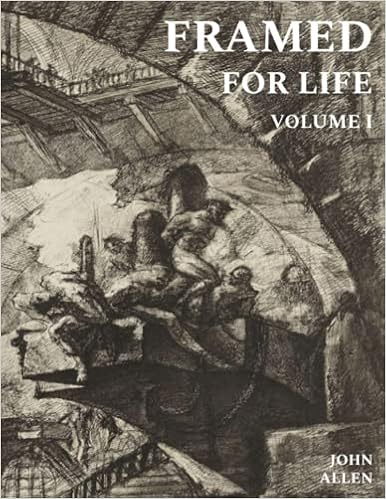
Framed for Life
The latest bit of media about my case came out a few weeks ago – a four-volume book, titled Framed for Life. The author, John Allen, whom I now, in the decade since he published the first book about my case, think of as a good friend, hopes to influence a readership made up of politicians and investigative journalists.
With a scalpel, Allen's
multi-part book dissects my wrongful conviction, showing how Jackson County,
Missouri, prosecutors (now-disgraced Amy McGowan, in particular) committed
fraud on the court in their efforts to convict me of murder. The books not only
expose facts of my trial that were overlooked by virtually everyone, they're
also a scathing indictment of what one judge called Jackson County's
"culture of corruption." Or so I gather; I can't comprehend more than
a few words of them, here and there.
I have copies of the
volumes, generously furnished by the author, and I'm in the process of
reviewing them. The thing is, this is stuff that I've been over and over and
over a hundred times, and can barely assimilate any more. It's as though the
parts of my mind where information about my case, the 1997 death of Anastasia
WitbolsFeugen, is stored have reached maximum capacity. MEMORY FULL,
my brain might as well be saying. I even have a hard time talking about it; it
incites an insidious kind of stress, the physical tells of which are twitchy
eyelids, jaw and neck tension, and the occasional headache.
Nevertheless, I'm
currently picking my way through Volume One of Framed for Life. It's
slow going. This isn't because the book's a mammoth tome (it's actually quite
thin) but because I can only take so much at a stretch before my tolerance hits
its limit and I overload, unable to take in any more about perjury, withheld
documentation, and lies, lies, lies, lies, lies.
It's interesting, if
dismaying, to see old journal entries I made during the year I was held in the
county jail before trial. I can still remember the splintery number-two pencil
dancing uncomfortably in my hand, writing those thoughts in fear but under the
somewhat protective spell of naivete. Those handwritten pages from half a
lifetime ago – those I understand. Their language is unambiguous to me, the
concepts they introduce are familiar in a visceral way.
I wish I could warn
twenty-two-year-old Byron of the pitfalls awaiting him at trial, how stacked
against him the deck is. But I can only sit reading, mute and impotent, as the
travesty plays out on the page. Again.
How many more times will it, I wonder, before this is finally over. It gets so old. Or maybe that's just me, waiting for justice.
11 June, 2021
A Travesty at Twenty
The fact that I am a murderer is well established. You can learn from many sources about my three-day trial, about how a jury of my peers decided that I must be guilty of killing my friend Anastasia WitbolsFeugen, of shooting her in the head just to see what it felt like to end another person's life. Not just any murder, either. Those jurors found me guilty of murder in the first degree – a killing accomplished after some calculation, homicide committed after a period of cool deliberation. Those dozen people on my jury had the power, as all juries do, to define what thereafter is called the truth.
16 February, 2021
The Eighty-Fourth Problem
A friend I've known for more than ten years remarked on the lightening he recently noticed in my overall perspective. He attributed the shift to Buddhism, which I started practicing a couple of years ago. I didn't argue, even though adopting the label "Buddhist" was only a recent formalization of ideals and precepts that evolved from a decades-long chain of life events. I might not have been reading sutras, sitting zazen, or reciting mantras, but practicing mindfulness, mental discipline, and moderation has carried me through twenty years' imprisonment pretty well.
29 January, 2020
The Ohio Risk-Assessment System Doesn't Work on the Innocent
Being called to the housing unit's caseworker's office isn't unusual. Caseworkers in prison wear many hats. Privileged mail, what comes from lawyers or the courts, gets shunted straight to the caseworker offices, to be opened and its contents verified in the presence of the addressee. The caseworkers' duties also include witnessing signatures and fingerprints on the appropriate form when a prisoner sends money from his institutional account – for mail ordering books, buying art supplies, paying court costs, making child support payments, et cetera.
The page this time is not for me to pick up a letter or sign a check but to take a questionnaire.
"Have a seat," the man says as I enter his tiny office. I note the Millennium Falcon poster hiding a couple of square feet of one pitted, gray concrete-block wall. Something tells me I won't get out of here any quicker if I weigh in on the perennial Star Wars debate over whether Han shot first. He squints at the packet of about twenty stapled-together pages in his hands. "This is gonna take us a while."
He tells me that the Missouri Department of Corrections is implementing the Ohio Risk-Assessment System, which the packet concerns, as part of its parole assessments. "Bear with me," he says, slipping his reading glasses on. "You're the first person I'm doing this with."
Parole assessments? Someone must've made a mistake. Because I have a first-degree murder sentence, I'm not eligible for parole. I volunteer what should be obvious: "Um, I've got life without."
He sighs, "Yeah, I know. They're making us do these on everybody."
Pages riffle. Someone recently burned popcorn in the office microwave. It's not even 10 AM; who the hell brunches on popcorn?
"Okay, tell me about your crime."
"What do you mean?" I don't want to be doing this in the first place. The presumption of guilt just adds to its offensive nature.
The caseworker's hand swivels on his wrist, as if he's loosening up for a video game tournament. "Just tell me how the crime took place."
"How much room have you got?"
"Summarize," he says, in a tone that sounds, surprisingly, like one of patience.
I give him the facts: that my girlfriend and I were hanging out with my friend Justin; that we went to pick up another friend, Justin's girlfriend, Anastasia; that Justin and Anastasia had been arguing a lot and resumed arguing the moment we picked her up; that Anastasia got out of the car while we were stopped at an intersection; that I never saw Anastasia again, but that after Justin later left our company he went back to meet her; and that the next morning a sheriff's deputy found Anastasia's body lying in a cemetery, shot in the face.
The caseworker has been scribbling notes in pencil while I talk. At no point does he show surprise, nor particular interest.
"How have you taken responsibility for your crime?"
"It's wasn't my crime, so I haven't."
"Okay...." He scribbles some more, then asks, "What steps have you taken to rehabilitate yourself during your incarceration?"
"I don't know about rehabilitation, since I don't think I was dehabilitated to begin with, but I'm always working to improve myself. I do a lot of writing, reading, mindfulness practice. I'm an analytical person by nature – you know, reflective. I think a lot about the kind of person I want to be in the world. I recently started daily meditation."
He looks up. "No programs?"
I know how remedial the DOC's programs tend to be, designed as they are around getting through to the uneducated, selfish, and hardheaded... when they're properly administered at all. A neighbor once took Anger Management and came back with a sheet of rebuses he said they'd been making the class do for weeks:
Years later, I signed up for a class that might actually teach me something. It didn't. I got a certificate for a class they never finished teaching. (I blogged about the tremendous disappointment of Mindfulness Training in 2015.) So I meet the caseworker's gaze, keeping in mind that he's just doing his job, operating under a particular limited mindset, not deliberately working to offend me, and answer him.
"No programs."
Scribble, scribble.
It goes on like this for a half hour. For years, I've said that I'm almost glad, in a perverted way, not to have a paroleable sentence, since it means I'll never be confronted by a panel of antagonistic board members who think they know the truth and are capable of accurately judging people's character. This ordeal of undergoing the Ohio Risk-Assessment System feels nearly as bad as I always believed seeing the parole board would. Will I have to do this all again next year? Shit, I hope not.
07 January, 2020
New Year, New Start
19 September, 2017
A Freshly Scribbled Personal Poem with Nowhere Else to Go
The words slipped out before their import struck.
Further utterance obstructed, I clutched my face and slumped.
A low groan deeper than any half-assed laugh
Rose as camouflage.
There it is, I thought, cradling my skull.
Embodied gray in one point five kilograms,
Almost four decades a little more tattered
By every peek, reconfigured subtly by the act of reference.
Mutti, did you really used to call me Kleiner Mann,
Or was it someone else who aged me prematurely?
To a lover, once, who declared that mine
Was an old soul, it's true I offered a bag of prunes.
The boy with his slippers and robe, and his
Antiquarian collection of fossils and rocks,
Used to shred bread for ducks at the park.
He had in mind a future as an Egyptologist.
In mummification the brain was the first thing to go
Because ancient Egyptians believed it served no purpose.
Other organs were preserved in jars for the soul's journey.
Anubis, jackal-headed assayist, weighed one's vital baggage.
Immortal at sixteen, I dressed and rimmed my eyes in black,
I kept, as a pet, a rat. Rattus rattus was once deified,
Symbolic to the Egyptians as representing wise judgment and,
Further reading in adulthood reveals, also utter destruction.
* * * * *
08 September, 2017
A Call for Inaction, Following Robert WitbolsFeugen's Indictment
A friend recently called me the least angry person he knew, with the best reason to be angry. Of course this referred to my wrongful conviction for murder and how I move through life without the caustic bitterness that might eat a less levelheaded person alive. Kelly Moffett, the ex-girlfriend whose lie let prosecutors close a pesky three-and-a-half-year-old case, may deserve my hatred for the damage she's done, but I have (I might as well be blunt) nobler ideals. Kelly is mentally ill. The extent of her illness isn't for me to diagnose or discuss here, but it's an irrefutable fact, based on documentation and anecdotal evidence, that she's a sick woman. My belief is that Kelly should have intensive psychiatric treatment on an inpatient basis, as she's a danger to those around her and, as her behavior over the past decades has shown, to herself.
But what's Kelly Moffett got to do with Robert WitbolsFeugen's criminal charges? you ask.
Robert is unquestionably one of the reasons that I'm typing this post in a prison cell. It was Robert who harassed the Jackson County Sheriff's Department to close the case, then, when no immediate results materialized, started pointing the finger at me and my friends, whose goth mien — black clothes and hair, pale skin, makeup, and piercings — made us seem like potential subjects of interest in a case whose principals hung out in cemeteries, coffeehouses, and (maybe most pernicious) video rental stores. It was Robert who invented theories of cultish goings-on, to pique investigators' interest. It was Robert who hounded county and state officials well beyond a job offer from the Jackson County Legislature and the passage of Interim Senate Resolution Number CL3777, which begins, "WHEREAS it is with heavy hearts that the members of the Missouri Senate pause to recognize the life and lifetime achievements of a remarkable young woman, Anastasia Elizabeth WitbolsFeugen of Independence, Missouri." It was Robert who forced authorities into an apparent ethical bind over the case and engineered the political pressure to close the fucking thing ASAP.
I have every reason to want both Kelly Moffett and Robert WitbolsFeugen to suffer the kind of torture that's been inflicted on me because of their actions…but I don't.
I especially don't share the notion that Robert's criminal charges are anything more than a curiosity at this point. There was a lot of scuttlebutt about allegations of child sexual abuse — of neighbor kids, of Robert's own daughters — sparked by statements made during the Sheriff's Department investigation. Any truth in these allegations would slightly bolster the already-established belief that Anastasia was suicidal, the whole week before her death, in that breaking up with Justin Bruton forced her to move back in with the man who may have molested her for years — but this is speculative at best. Besides, the man hasn't even had his pretrial hearing yet, at which the admissible evidence will be discussed in court. With what I'm big enough to admit is my own smug piety, I want everyone who reads this to know that I believe Robert deserves the benefit of the doubt. He crusaded against it for me, but our criminal justice system is based on certain principles, one of which is the presumption of innocence. A person who stands accused of a crime must be considered innocent of that crime unless sufficient evidence is presented by the prosecution to eliminate all reasonable doubt. I believe in this right even more fervently because it was denied me and led to my being imprisoned for the rest of my life simply because I befriended two kids my own age whose problems were beyond their abilities to grow beyond.
Robert WitbolsFeugen is a profoundly damaged human being who's done despicable things. He's also, presumably, innocent. Please, everyone, let the justice system grind its way to a conclusion in this matter without interference. Overemotional activism has led to enough injustice already.