Showing posts with label Anastasia WitbolsFeugen. Show all posts

05 December, 2023

Back in Court, Back in the News

Before yesterday, the last media interview I did was with a podcaster, ten years ago, on the subject of my then-newly published book, The Pariah's Syntax (from which this blog takes its name). Then Monday rolled around, and I gave another.

Kansas City Star journalist Katie Moore got me on the phone to talk about the filing of a long-awaited motion by my lawyers, who've been working on the details of this 130-something-page document for months. In the motion they lay out evidence of the fraud that the Jackson County Prosecutors Office committed in order convict me of a murder that probably never happened, the 1997 death of my friend Anastasia WitbolsFeugen. We show how the state withheld evidence, conspired to falsify documents, suborned perjury, and more – all to close a case that authorities felt had remained open for too long.
Ms. Moore had questions to ask about the facts of the case, of course. It might sound weird, but these feel secondary to the reality of my imprisonment. The narrative of my case has been related again and again, in story after story, and seems at this point to have lost a lot of its former import. 22 October, 1997, exists in a past that's now over half of my lifetime away, so forgive me for feeling somewhat detached from it. Nevertheless, I trudged though yet another recitation of the facts. Where things got tough was in talking about my friends Anastasia and Justin, both of whom I lost in such a sudden, ugly way. My voice broke unexpectedly as I remembered them. My throat tightened. It's been so long, yet I still consider the months that I squandered in the company of those two kids as being among the happiest of my otherwise difficult teenage years. "Are you okay, Byron?" one of my lawyers asked. I wasn't sure then; I'm not sure now.
Ms. Moore's story was published today. More importantly, my lawyers also filed their motion. At the time of this writing, I haven't read either one. I can't fathom the most likely outcome of either, but you can find the former online at kcstar.com.

21 September, 2021

Ten Years After Filing, My Application for Pardon Gets Shot Down

My hopes were never all that high. Governors, even when they do exercise their clemency privilege, rarely grant pardon. Why undo what the courts – those perfectly fair and just arbiters of truth – have done? Justice had its chance at trial. Still, this form letter on flimsy paper is a major letdown.

"Dear Offender Case," it begins.

My first thought was, Fuck you, you pompous twit. Would it have killed him to address me with a formulaic "Mr."? I envision a meeting of self-righteous DOC higher-ups, at which were discussed sundry ways of making sure the imprisoned feel good and low. I'm sure that suggesting the word "offender" won someone high praise. It succeeds in being simultaneously reductive and hyperbolic, a big, ugly brand on the neck of anyone who passes through the gates of a "correctional" center. Even if I were guilty of the crime that put me in prison, this designation would piss me off.

"This letter is in response to your application for Executive Clemency. I regret to inform you that the Governor has declined to grant clemency."

So that's that, then.

I filed my application for clemency in the fall of 2011, following months of research. Once I composed a straightforward narrative of my case and felt ready, I mailed my application form with a forty-one page summary of the case, a personal letter to then-incumbent Governor Jay Nixon, information relating to bipolar disorder (which Kelly Moffett was diagnosed with), a Kansas City Police officer's report, a copy of the 2007 book The Skeptical Juror and the Trial of Byron Case, an excerpt from a forensic study titled "Eye Changes After Death," and Jackson County Sheriff's Department interviews with Robert WitbolsFeugen and Betsy Owens, Anastasia WitbolsFeugen's parents.

A bunch of my friends and supporters wrote letters that pleaded for Mr. Nixon to give me my freedom. The Office of the Governor forwarded these to the Missouri Board of Probation and Parole, which manages all clemency applications for the governor. For a while, P & P even forwarded me copies of its responses. They must have some rule about only answering constituents, because I never heard about anyone living outside of the state hearing back, but still, a nice gesture.

My mother started a petition online, collecting signatures in support of my release. John Allen, author of that Skeptical Juror book, wrote a whole series of mailings to Governor Nixon, which picked the case to bits. Both John and Mum traveled to Jefferson City, Missouri's capital, to meet and talk with two successive governors' legal counsel. All of this for naught.

I'm not complaining that Governor Parson shot me down (or not only that, anyway) but that the act took a full decade to carry out and ended with an insulting form letter. Insult to injury.

Oh, but FreeByronCase.com got a cool new look and layout last week. At the same time, Framed for Life, Volume 3 hit Amazon's shelves and some journalists took an interest. My lawyer has been quiet for a couple of months, which I can only hope means the species of busyness that yields progress. Dedicated supporters are putting forth more energy, all at once, than they have in a while. All of this imparts the sensation of building momentum – but is that really what it is? Only time will tell. Meanwhile, shame on you, Governor Parson, for rubber-stamping people's lives away.

13 August, 2021

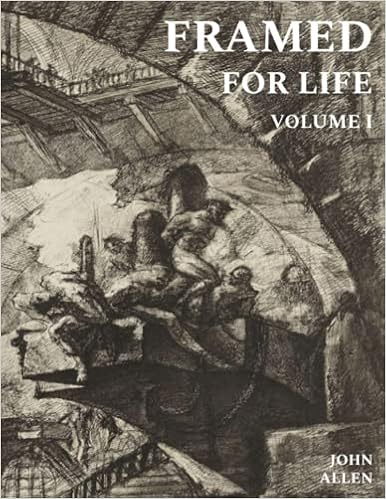
Framed for Life


The latest bit of media about my case came out a few weeks ago – a four-volume book, titled Framed for Life. The author, John Allen, whom I now, in the decade since he published the first book about my case, think of as a good friend, hopes to influence a readership made up of politicians and investigative journalists.

With a scalpel, Allen's multi-part book dissects my wrongful conviction, showing how Jackson County, Missouri, prosecutors (now-disgraced Amy McGowan, in particular) committed fraud on the court in their efforts to convict me of murder. The books not only expose facts of my trial that were overlooked by virtually everyone, they're also a scathing indictment of what one judge called Jackson County's "culture of corruption." Or so I gather; I can't comprehend more than a few words of them, here and there.

I have copies of the volumes, generously furnished by the author, and I'm in the process of reviewing them. The thing is, this is stuff that I've been over and over and over a hundred times, and can barely assimilate any more. It's as though the parts of my mind where information about my case, the 1997 death of Anastasia WitbolsFeugen, is stored have reached maximum capacity. MEMORY FULL, my brain might as well be saying. I even have a hard time talking about it; it incites an insidious kind of stress, the physical tells of which are twitchy eyelids, jaw and neck tension, and the occasional headache.

Nevertheless, I'm currently picking my way through Volume One of Framed for Life. It's slow going. This isn't because the book's a mammoth tome (it's actually quite thin) but because I can only take so much at a stretch before my tolerance hits its limit and I overload, unable to take in any more about perjury, withheld documentation, and lies, lies, lies, lies, lies.

It's interesting, if dismaying, to see old journal entries I made during the year I was held in the county jail before trial. I can still remember the splintery number-two pencil dancing uncomfortably in my hand, writing those thoughts in fear but under the somewhat protective spell of naivete. Those handwritten pages from half a lifetime ago – those I understand. Their language is unambiguous to me, the concepts they introduce are familiar in a visceral way.

I wish I could warn twenty-two-year-old Byron of the pitfalls awaiting him at trial, how stacked against him the deck is. But I can only sit reading, mute and impotent, as the travesty plays out on the page. Again.

How many more times will it, I wonder, before this is finally over. It gets so old. Or maybe that's just me, waiting for justice.

11 June, 2021

A Travesty at Twenty

The fact that I am a murderer is well established. You can learn from many sources about my three-day trial, about how a jury of my peers decided that I must be guilty of killing my friend Anastasia WitbolsFeugen, of shooting her in the head just to see what it felt like to end another person's life. Not just any murder, either. Those jurors found me guilty of murder in the first degree – a killing accomplished after some calculation, homicide committed after a period of cool deliberation. Those dozen people on my jury had the power, as all juries do, to define what thereafter is called the truth.

In the decades since, courts either found nothing procedurally unsound in my jury's verdict, or they otherwise declined to review my case. Because the courts didn't dispute it, the verdict stands. It follows, therefore, that the jury's opinion must be true. And here we are.

Saying "my jury" implies ownership. Nothing could be less accurate. I don't even remember "my" jurors' names. The same goes for "my" case. I lay no claim to the events leading to my imprisonment, and certainly not to the cause of Anastasia's death itself. The vast majority of those things happened without my participation, beyond my knowledge.

The Internet, the great democratizer, offers enough information on which to base an informed decision about everything from politicians to peanut butter brands, if you pick decent sources. Because such information is free, the group convinced of my innocence, the Free Byron Case campaign, is bigger than the group that believes I murdered my friend. Unfortunately, fifty thousand people could believe in my innocence; it wouldn't outweigh the hope of the handful who want me to die in prison. Nor would numbers below a certain threshold change the fact that a conviction – any conviction – is far easier to get than to shake off.

I've tried, believe me.

Wait, do you believe me? Check your preconceived ideas. Are you part of the "Keep Byron Case In Prison" group, hate-reading my blog because the all-consuming fires of righteous indignation in your heart are easier to stoke than your grief and guilt are to assuage? Emotion has to come out somehow. I forgive you your wrongs against me, but is this the healthiest way to live?

Even before my arrest and trial, you people just knew that I was guilty. And you refused to rest until my guilt was declared. A couple of you interviewed friends and acquaintances, searched my car in my driveway, took photographs of my vehicles, dug through my trash, pushed the case's investigators to more deeply scrutinize me, and probably took other steps that I'll never find out about. If not for you, the authorities might never have suspected me of anything but dressing oddly.

I write this in "my" cell in a maximum-security prison. The date listed for my earliest possible release, in the Missouri Department of Corrections database, is 99/99/9999. It might as well be the thirty-second of Octember. My sentence of life without parole will allow me to leave prison only on the day that employees of the county coroner wheel my corpse out on a gurney, bound for some cold storage vault, and points beyond. And although this is exactly what certain of you asked for, you remain restless and unsatisfied.

These words don't come from a place of malice; despite my reputation as a provocateur, in this post I want only to point things out and ask questions that spark radical honesty. I want you to consider what is meant by "fact," by "peers," by "truth." Certainty plays no part. Records of my case exists, but what do they say? Interpretation is required, but who can we trust to perform it? Contrary to the popular conception, justice isn't about right and wrong. It's about who can deploy a more convincing argument. If we dispute one court's ruling, which court do we trust to decide otherwise? And what do we do when that court's rulings are questioned?

Who thinks of corporations as people, following the Supreme Court's decision in Citizens United, which gave corporations the same rights as individuals? If I were exonerated tomorrow, cleared of wrongdoing by a court of law, I'd be released from prison and the fact of my conviction would be removed – stricken, erased, undone. It will be as though it never happened. Would my memories of these lost decades be wrong? And who'd accept my new status? Would your mind change about me, based on that decision? If you say yes, isn't that just letting others do the thinking for you? If you say no, then what would it take to change your mind? If you know, why wait? What's stopping you from changing it now? How committed are you to your ideas? From where do your thoughts about my guilt or innocence arise?

These aren't easy questions. What makes life most worth living doesn't benefit from asking easy questions. The hard ones are another story, and the ones you can't answer at all are the ones that best define you.

I'm an innocent man who's been locked in prison for twenty years. I was twenty-two on the day armed men in black body armor thundered into my bedroom to take me away at gunpoint. I haven't been home since. I'm now forty-three. Despite years and years of emotional trauma, I have neither nightmares nor panic attacks, lasting depression nor crying jags, disruptive compulsions nor fixed obsessions, outbursts of rage nor periods of withdrawal. I doubt anyone would fault me if I did. But in reality my mental health is quite good.

I wake up in the morning and make my bed. I dress. I meditate. I make a cup of black coffee. I eat breakfast in a loud dining hall, surrounded by myriad human beings, some of whom don't bathe, many of whom are ignorant of inside voices, and I don't hate them. At 8 o'clock I go to work. I love my job; I like my coworkers. We laugh a lot together and do good things that affect a lot of people, whether they recognize it or not. When I'm not at my job in the Media Center, I'm reading or writing. The people I love keep in regular contact. I'm very fortunate to have a lot of good, caring people in my life.

If you think I killed Anastasia WitbolsFeugen, you're mistaken. Yet I'm also unequivocally guilty. I'm a murderer who didn't kill anyone. Am I making myself understood? If so, how can you stand it? Answer the question!

29 January, 2020

The Ohio Risk-Assessment System Doesn't Work on the Innocent

The wing's loudspeaker blares, "Byron Case, bravo two-oh-seven, report to the caseworker's office." However much I'd like to ignore the interruption or put it off awhile, I drop the book I'm reading and go. It's just downstairs, after all, and shouldn't take but a minute.

Being called to the housing unit's caseworker's office isn't unusual. Caseworkers in prison wear many hats. Privileged mail, what comes from lawyers or the courts, gets shunted straight to the caseworker offices, to be opened and its contents verified in the presence of the addressee. The caseworkers' duties also include witnessing signatures and fingerprints on the appropriate form when a prisoner sends money from his institutional account – for mail ordering books, buying art supplies, paying court costs, making child support payments, et cetera.

The page this time is not for me to pick up a letter or sign a check but to take a questionnaire.

"Have a seat," the man says as I enter his tiny office. I note the Millennium Falcon poster hiding a couple of square feet of one pitted, gray concrete-block wall. Something tells me I won't get out of here any quicker if I weigh in on the perennial Star Wars debate over whether Han shot first. He squints at the packet of about twenty stapled-together pages in his hands. "This is gonna take us a while."

He tells me that the Missouri Department of Corrections is implementing the Ohio Risk-Assessment System, which the packet concerns, as part of its parole assessments. "Bear with me," he says, slipping his reading glasses on. "You're the first person I'm doing this with."

Parole assessments? Someone must've made a mistake. Because I have a first-degree murder sentence, I'm not eligible for parole. I volunteer what should be obvious: "Um, I've got life without."

He sighs, "Yeah, I know. They're making us do these on everybody."

Pages riffle. Someone recently burned popcorn in the office microwave. It's not even 10 AM; who the hell brunches on popcorn?

"Okay, tell me about your crime."

"What do you mean?" I don't want to be doing this in the first place. The presumption of guilt just adds to its offensive nature.

The caseworker's hand swivels on his wrist, as if he's loosening up for a video game tournament. "Just tell me how the crime took place."

"How much room have you got?"

"Summarize," he says, in a tone that sounds, surprisingly, like one of patience.

I give him the facts: that my girlfriend and I were hanging out with my friend Justin; that we went to pick up another friend, Justin's girlfriend, Anastasia; that Justin and Anastasia had been arguing a lot and resumed arguing the moment we picked her up; that Anastasia got out of the car while we were stopped at an intersection; that I never saw Anastasia again, but that after Justin later left our company he went back to meet her; and that the next morning a sheriff's deputy found Anastasia's body lying in a cemetery, shot in the face.

The caseworker has been scribbling notes in pencil while I talk. At no point does he show surprise, nor particular interest.

"How have you taken responsibility for your crime?"

"It's wasn't my crime, so I haven't."

"Okay...." He scribbles some more, then asks, "What steps have you taken to rehabilitate yourself during your incarceration?"

"I don't know about rehabilitation, since I don't think I was dehabilitated to begin with, but I'm always working to improve myself. I do a lot of writing, reading, mindfulness practice. I'm an analytical person by nature – you know, reflective. I think a lot about the kind of person I want to be in the world. I recently started daily meditation."

He looks up. "No programs?"

I know how remedial the DOC's programs tend to be, designed as they are around getting through to the uneducated, selfish, and hardheaded... when they're properly administered at all. A neighbor once took Anger Management and came back with a sheet of rebuses he said they'd been making the class do for weeks:


Years later, I signed up for a class that might actually teach me something. It didn't. I got a certificate for a class they never finished teaching. (I blogged about the tremendous disappointment of Mindfulness Training in 2015.) So I meet the caseworker's gaze, keeping in mind that he's just doing his job, operating under a particular limited mindset, not deliberately working to offend me, and answer him.

"No programs."

Scribble, scribble.

It goes on like this for a half hour. For years, I've said that I'm almost glad, in a perverted way, not to have a paroleable sentence, since it means I'll never be confronted by a panel of antagonistic board members who think they know the truth and are capable of accurately judging people's character. This ordeal of undergoing the Ohio Risk-Assessment System feels nearly as bad as I always believed seeing the parole board would. Will I have to do this all again next year? Shit, I hope not.

24 October, 2017

A Tragedy at Twenty: Justin Bruton

Twenty years after he blindsided everyone by sending a shotgun slug through his own skull, Justin Bruton is as much a cypher to me as ever, despite reams of police reports and the fact that there was a time, in the months prior to his terrible suicide, when I called him my best friend. Obviously, I didn't know what friendship really was.

Eighteen and socially handicapped, your "best friend" is the person who finally accepts you unquestioningly. Justin saw past my black-and-white screen-starlet makeup, conflation of funny ha-ha with funny strange, and adeptness at conversation equivalent to how well a three-year-old ballroom dances. He shrugged this stuff off and invited me to come throw powdered donuts at rich people. You know, what best friends do.

Look at the perpetual adolescents of Jackass, The Dudesons, and Can't Kill Yourself: lots of boys play rough. It could be that Justin wasn't trying to put out my eye when he embedded that blowdart in my brow from a few feet away. Maybe this was how he channeled his fraternal affection, through acts of minor violence. What to make, though, of his pain experiments, when he laughed in disbelief at my silent responses to various stimuli he administered — thumbtacks colorfully studding my forearm, hydrochloric acid drops eating the flesh of my open palm, electric shocks to wherever he could reach out and touch with his stun gun? Were these forerunners to the sado-motivational tactics of Tyler Durden, in Chuck Palahniuk's Fight Club, or were they nothing more than cruelty to a trusting younger kid?

What did I know about Justin? At the time, virtually nothing. I knew that he'd lived in Tulsa and come from money. He disdained familial meddling yet depended on his parents for literally everything. He had a sister, my age. He once dated a girl who seemed cool, the first and only time we met, but whose name I subsequently forgot. He'd been suicidal on multiple occasions and was prescribed Prozac for depression. He dug PJ Harvey, Nick Cave & the Bad Seeds, and French surrealist films. There was undoubtedly more to him, but this was all that he was willing to reveal.

Similarly, whatever his feelings about Anastasia, his girlfriend of maybe seven months, I was privy to only their external effects. The couple's countless arguments became almost normal, given his hot-and-cold affections, her fixed and potent passion. Justin never verbalized his feelings, for Anastasia or anything else of consequence. I'm unsure how much of that reticence was symptomatic of his unhappiness, and how much led him to collude with her to bring about their deaths.

So: Justin Bruton, question mark. Interested organizations with resources and authority far outstripping mine have looked into solving the riddle and come back empty-handed. His family won't talk, out of some sense of Southern propriety, embarrassment, fear, or snobbery — which doesn't help. The sole insight that I've gained since his death is that he'd been born in Texas. Thanks, Internet, for nothing.

Justin Bruton was my friend — or "friend." What's that even mean? Together we watched some great movies, had a few laughs, debated political and ethical systems, sang a few stupid songs, took memorable road trips, and drank too much coffee while daydreaming of lives with meaning. The way things ended up for me, though, leaves no doubt that our association was far from meaningless.

23 October, 2017

A Tragedy at Twenty: Anastasia WitbolsFeugen

Anastasia died at eighteen, twenty years ago today. She'd been a clever, spirited girl. In school she joined the National Junior Honor Society, Latin club, and academic competitions of all sorts. A couple of months before her untimely death, she started classes at the University of Missouri–Kansas City. The world had been her oyster.

A different version of the truth is less palatable.

Anastasia died at eighteen, twenty years ago today. She'd been a temperamental depressive for at least a year. In her diary and in e-mails to close friends, she romanticized death, expressed emotional volatility somewhat greater than typical teenage impulsivity, and fixated on a fickle boyfriend. For weeks before her seemingly inevitable death, she spiraled into a textbook example of suicidal behaviors, isolating herself, dropping out of college, and talking openly (and often) about killing herself. She didn't stand a chance in this indifferent world.

The dead have it easy — their reputations are projections of might-have-been, forever idealized, unburdened by their foibles or survivors' beliefs that anything but the best had been in store for the beloved deceased. The culture fetishizes potential. While those who die young remain for all time in grace, the living must forge our legacies through successes and failures — the actual.

Which is fine. Whitewashing who Anastasia WitbolsFeugen was wouldn't be terrible, just an anodyne comfort, except that another life hangs in the balance between her pristine reputation — Anastasia, the young light extinguished too soon — and the ugly alternative — Anastasia, the doomed soul. Mine is no longer young but had (and still has) potential at least equal to hers. By not allowing her to be seen from less-flattering angles, her eulogizers obscure the truth that contradicts the righteousness of my imprisonment.

Anastasia was my friend. We hung out in coffeehouses, discussing our naive ideals and cackling at life's absurdities. We went to movies together. We lent each other books that we each considered essential reading. We commiserated about shittiness and shared the happiness that kept us going. When she died, it was like no grief I'd yet known. I struggled to cope, to keep myself together in the aftermath. Even in that confused state, I clearly saw that the Anastasia portrayed by the funeral sentiments was a caricature, largely unrecognizable to many of us at the service. Frankly, she was no one special. The Anastasia we knew was complex, flawed, and passionate to a fault — a person we all thought eminently worth being friends with.

After two decades lived in the shadow of her death, having matured and made discoveries against which ordinary relationships are immune, I'm now less sure of my friendship with her. Personal documents seized during the authorities' homicide investigation showed me yet another facet of Anastasia. She lied about people behind their backs. She engineered squabbles between friends, probably for drama's sake. She had terrible self-esteem and vied for attention at every opportunity. Her flaws go on and on. She was, after all, only human.

Teenage relations, those gossipy, mercurial, emotionally heightened filters that distort one's world like the wildest Instagram effect — they don't even begin to explain why the night we parted ways struck me as both perfectly typical and utterly unexpected. Knowing what I now do is similarly befuddling. Was her death planned? If so, by whom — her or Justin, or by both, mutually? Either she wanted him, her flaky, intermittent love, to put her out of her misery, or she intended to do the deed herself with him looking on. Or, just as they decided one day to pack and move to New Orleans by the weekend, the two of them might've intended, with no plan whatsoever, to wing it, take a gun to a cemetery, one after the other welcoming oblivion.

So much for the pretty notion that there are no secrets between friends.

Ten years back, I wrote in this post about Anastasia's death, "the ever-widening wake of her death laps onward, continuing to rock and capsize in spite of the distance. Meanwhile, her memory on our horizon gradually melds with the glare of the sun." Pretty words for the gruesome results of teenage self-centeredness. I can't muster this kind of poetry for it anymore. Anastasia WitbolsFeugen died, but I'm the one who's rotting.

08 September, 2017

A Call for Inaction, Following Robert WitbolsFeugen's Indictment

According to MissouriCaseNet, Anastasia WitbolsFeugen's father, Robert WitbolsFeugen, is facing charges for statutory sodomy in Jackson County, Missouri. The incident these charges stem from allegedly took place in 2015. A lot of people in the Free Byron Case camp have believed for a long time that he has a history of child sexual abuse and are now relieved that "he finally got caught." My own opinion is different, and because it concerns a relevant, topical issue I'm dispensing with my usual policy of avoiding legal matters in blog posts. I want my supporters, the general public, and those "Keep Byron Case in Prison" people to know where I stand.

A friend recently called me the least angry person he knew, with the best reason to be angry. Of course this referred to my wrongful conviction for murder and how I move through life without the caustic bitterness that might eat a less levelheaded person alive. Kelly Moffett, the ex-girlfriend whose lie let prosecutors close a pesky three-and-a-half-year-old case, may deserve my hatred for the damage she's done, but I have (I might as well be blunt) nobler ideals. Kelly is mentally ill. The extent of her illness isn't for me to diagnose or discuss here, but it's an irrefutable fact, based on documentation and anecdotal evidence, that she's a sick woman. My belief is that Kelly should have intensive psychiatric treatment on an inpatient basis, as she's a danger to those around her and, as her behavior over the past decades has shown, to herself.

But what's Kelly Moffett got to do with Robert WitbolsFeugen's criminal charges? you ask.

Robert is unquestionably one of the reasons that I'm typing this post in a prison cell. It was Robert who harassed the Jackson County Sheriff's Department to close the case, then, when no immediate results materialized, started pointing the finger at me and my friends, whose goth mien — black clothes and hair, pale skin, makeup, and piercings — made us seem like potential subjects of interest in a case whose principals hung out in cemeteries, coffeehouses, and (maybe most pernicious) video rental stores. It was Robert who invented theories of cultish goings-on, to pique investigators' interest. It was Robert who hounded county and state officials well beyond a job offer from the Jackson County Legislature and the passage of Interim Senate Resolution Number CL3777, which begins, "WHEREAS it is with heavy hearts that the members of the Missouri Senate pause to recognize the life and lifetime achievements of a remarkable young woman, Anastasia Elizabeth WitbolsFeugen of Independence, Missouri." It was Robert who forced authorities into an apparent ethical bind over the case and engineered the political pressure to close the fucking thing ASAP.

I have every reason to want both Kelly Moffett and Robert WitbolsFeugen to suffer the kind of torture that's been inflicted on me because of their actions…but I don't.

I especially don't share the notion that Robert's criminal charges are anything more than a curiosity at this point. There was a lot of scuttlebutt about allegations of child sexual abuse — of neighbor kids, of Robert's own daughters — sparked by statements made during the Sheriff's Department investigation. Any truth in these allegations would slightly bolster the already-established belief that Anastasia was suicidal, the whole week before her death, in that breaking up with Justin Bruton forced her to move back in with the man who may have molested her for years — but this is speculative at best. Besides, the man hasn't even had his pretrial hearing yet, at which the admissible evidence will be discussed in court. With what I'm big enough to admit is my own smug piety, I want everyone who reads this to know that I believe Robert deserves the benefit of the doubt. He crusaded against it for me, but our criminal justice system is based on certain principles, one of which is the presumption of innocence. A person who stands accused of a crime must be considered innocent of that crime unless sufficient evidence is presented by the prosecution to eliminate all reasonable doubt. I believe in this right even more fervently because it was denied me and led to my being imprisoned for the rest of my life simply because I befriended two kids my own age whose problems were beyond their abilities to grow beyond.

Robert WitbolsFeugen is a profoundly damaged human being who's done despicable things. He's also, presumably, innocent. Please, everyone, let the justice system grind its way to a conclusion in this matter without interference. Overemotional activism has led to enough injustice already.

05 December, 2016

Awful, Contemptible, Foolhardy Hope

Hope is the best-smelling meal you've ever salivated over, which riddles you with intestinal parasites. Hope is the cutest girl in your third-grade class, approaching you at recess just to kick you in the nuts and run away giggling. Hope is the stingray you mistake for a sand dollar. Hope is the big, frosty orange-sherbet tub in Grandma's freezer, from which you scoop a bowlful and discover, too late, is frozen chicken fat. Hope is the beauty spot on your cheek that metastasizes.

You might've been surprised to read, in my September post about MTV's Unlocking the Truth, that the series had me "excited for the future," since I normally eschew such hopeful abandon. If you later scratched your head at the series finale, aware of what producers cut from the show, you'll understand now why my September enthusiasm turns my stomach.

Hope is the imprisoned innocent's daydream of freedom.

As a recovering pessimist, I nevertheless consider wide-eyed, credulous hope a failure to maintain perspective. My perspective was warped when I unquestioningly believed that, with access to all our information, Unlocking the Truth would at least mention certain witnesses, certain critical points, even if television's strict time constraints prevented lengthy discussion of them. As long as all of the information got out, I'd have been satisfied with whatever interpretation of it the series came to. The narrative only goes one way, so I naively waited, episode after episode, for them to show the rest of the picture.

The night of the finale, credits rolled, a Catfish rerun began, and I sat stock-still on my bunk, in the TV's flickering, trying to work out what I missed. I thought, That can't be it. But, somehow, it was.

Street demonstrations, benefit concerts, candlelight vigils, #FreeByronCase trending on social media, donations piling in to cover my lawyer's fees, mailbags bulging with viewers' expressions of solidarity, flurries of messages to the governor and tweets to @GovJayNixon — none of it happened. But, then, since Unlocking the Truth left out essential facts, and since Ryan Ferguson concluded that the evidence didn't establish guilt or innocence in my case, I was hardly surprised. Impassioned responses don't usually result from a shrug.

Then the election came and went, and I couldn't stop thinking about my pardon application, submitted to Governor Nixon in August of 2011 and still under consideration. Plenty of prisoners and parolees have filed and been denied in the five years since I filed that document and its fat appendix, setting out a pretty solid argument of innocence. The governor's legal advisor, after meeting with my people in 2012, seemed to believe that mine is a wrongful conviction, that I didn't murder Anastasia WitbolsFeugen. He must've told Governor Nixon the same, so why this delay?

Missouri has another highest officeholder now. Is Governor Nixon planning to leave my case untouched, a sticky wicket for his successor, Eric Greitens, to deal with? Or is he going to dignify my plea for freedom with an answer? With less than two months before the powerful Governor Nixon reverts to being plain ol' Jay, every day that passes adds weight to that question.

Since day one (that's 11 June 2001, as anyone paying attention already knows), I've maintained that I had nothing whatsoever to do with Anastasia WitbolsFeugen's death. It was true then, it's true today, and it'll still be true in another fifteen years, whether I'm locked in this box or living a life of rightful freedom. It'll be true no matter what stories Kelly Moffett tells, no matter how many distortions the Antibyron Clique posts online, no matter which of my personality quirks gets mistranslated, no matter who steps out of my undignified past to say what an asshole I was, no matter when (or if) the evidence of my innocence is finally shown to be incontrovertible.

Moreover, I'll keep saying it until the public, the Missouri courts, Governor Nixon, Governor Greitens, or whoever else has power enough to change my circumstances sees my innocence for the absolute truth that it is. That such a day comes is the one and only hope I'm willing to keep close to my heart, without regret, without embarrassment, without reservation, unflaggingly, for as long as it takes.

30 October, 2014

Some Thoughts on Last Week’s On the Case with Paula Zahn

The last couple of weeks have been strange ones. At first I thought it was just Octoberfeast — my annual candy-and-treat binge — coupled with the pre-Halloween lineup of holiday favorites on ABC Family. Last week, though, when I heard that On the Case with Paula Zahn announced their show about Anastasia WitbolsFeugen’s murder, I suddenly had something to point at and go, “Yeah, that’s what’s distracting me.” It’s as if I’d been pre-empting my regular schedule in favor of the absent-mindedness to come.

I had no idea the show was being filmed. You’d think a producer worth his or her salt would make at least a perfunctory effort to include the condemned man’s words, if for no other reason than to proclaim, like a carnival barker, Ladies and gentlemen: evil in the flesh! Thrill and gape, viewers, at the sinister visage of the Soulless Man! The perfect seasonal freak show, seventeen years (nearly to the day) of Anastasia’s grisly death. But they needed no interview, not really. Old photographs of the man as a boy, togged out in all his black-and-silver goth finery, were far more superficially tantalizing.

The outcome was predictable. Or so I’m told. The cable package to which Crossroads subscribes doesn’t include Investigation Discovery, and that might be just as well. A lot of my friends speculated that sitting through all the old talking heads — Anastasia’s emotional wreck of a father, the histrionic prosecutor, the ex-girlfriend whose vengeful lies cost me the rest of my life — more than by the surreal feeling of being talked about on TV, I’d be bothered by the sense of déjà vu harking back to my four-day trial, when the things that I thought most crucial to my defense were silenced by a misguided arbiter. At best, Paula Zahn’s show might’ve made me laugh for all its egregious faults and inaccuracies. (Since an ability to laugh at the badness of a thing is what carries me through the worst.)

Do I want to watch the show? Not especially. Would I, if it came on a different channel? Almost certainly. How might I respond if, hypothetically, I did watch the episode in question? By focusing renewed energy on my fight for justice... but only after another brief candy binge. I’m only human, after all.

23 August, 2011

On the Release of the West Memphis Three


"Are you sure?" I insisted. My neighbor Zach had just rushed to my cell door to relay what he'd seen on CNN. The West Memphis Three, jailed for eighteen years on dubious murder convictions, took an Alford plea and were being released. I abandoned the essay I was writing and hurriedly turned on my TV. Sure enough, there they were — Damien, Jessie, and Jason, dressed like human beings for the first time this century — giving a press conference.

"The one on the left looks a little like you," Zach said. I shushed him, not wanting to miss an instant. Though the networks would replay the clip for days, it never stopped appearing to me as surreal as a fever dream.

Zach had seen photos of me taken before prison. He knew about the media's fixation on my black clothes and eyeliner. He knew, also, that my friends and I used to talk about the West Memphis Three in the reverent tones typically used by the devout when speaking of martyrs. Onetime misfits in a small-minded trailer culture, the trio's persecution was as mythic as it was terrifying. If we teens who lived in an urban, allegedly enlightened environment (in the Midwest, I grant you) were yelled at and threatened on the street for dressing unusally, there was no doubt in our minds that black-clad youth in the American South had it many times worse. Of course we believed Damien, Jason, and Jessie were innocent. Arrest, trial, and conviction were simply legal extensions of the sort of bigotry my darkly dressed friends and I encountered all the time. It would have been difficult not to feel solidarity with those three strangers down in Arkansas, but I didn't hold much hope in their chances for release. Even as a naive teenager, my faith in the United States judicial system, and in people, was virtually nonexistent.

Then my two best friends died. Anastasia was murdered; Justin, her boyfriend, killed himself. Authorities suspected it was a murder-suicide. I knew the homicide investigation was going south when, in an interview, the lead investigator launched into the first of many inquiries into the couple's musical tastes, religious beliefs, and choice in clothing. One mutual friend suggested early on, "This case is going to turn into a witch hunt before it's closed."

And in a way, it did. I partly blame my wrongful murder conviction on the smear campaign that ensued. After my scorned ex took her lies to the authorities, years later, the jury was kept from hearing much of the sensational crap prosecutors wanted to introduce, but there was no shortage of effort on that front. Everything from my car's band-related bumper stickers to my offbeat sense of humor was dragged out, pre-trial. I even suggested during a recess that I detected disturbing echoes of the case of the West Memphis Three. My court-appointed attorney blinked at me from behind his thick glasses and asked, "Who?" He later obliged my worry after a great deal of cringe-worthy debate over the use at trial of the term goth, and I was at least granted a trial free of overt post-West Memphis Three, post-Columbine bias.

So there I sat, innocent yet imprisoned, watching footage of those I once pitied for unjustly living the slow death of the incarcerated. Cellphone snapshots of Damien and Jason's luxurious first night of freedom — Kobe burgers and a five-star hotel rooftop celebration — and of Jessie's family reunion swelled my heart as they stabbed it.

"Man," Zach said as we watched, "can you imagine?"

A happy photograph of Damien holding his wife, whom he married years ago, in prison, flashed across the screen. Before that day, they had scarcely before touched. I just stared. What an experience that all must be, scary and awesome and bigger than anything most people will probably ever know.

I finally mustered a reply: "Actually, I imagine it every single day."

11 June, 2011

A Travesty at Ten

My friend Anastasia was eighteen and ridiculously in love when the gun was brought up to her face and fired. She was weeks away into her first year at college, and dreaming of marrying her boyfriend, Justin. The shock of her ugly death was exceeded only by news, agonizing days later, that twenty-year-old Justin had shot himself in the head before investigators even learned Anastasia's name. There followed turmoil, and grief for both of them that words could never express.

But you know this story, don't you? Hell, you may have even read the book. So you know what came next: that in a sense my own life ended three and a half years later, when I was arrested, charged, tried, and found guilty of Stasia's murder — even though I had nothing to do with the crime. The epigraph on my metaphorical tombstone reads

BYRON CHRISTOPHER CASE
1978-2001
BECAUSE SOMEONE HAD TO PAY

Today I'm ten years gone.

Consider your own life a decade ago — where you were, what your days were like, how young you were. Consider the distance between then and now. Imagine next that it had all stopped then; imagine your past self exiled to a limbo where little changed and you experienced the passage of time only through the betrayals of your own body and the aging of those who graced your purgatory with their occasional (if transcendent) presence. Who might you have become in such a place? What thoughts there might've consumed you? At what point do you suspect you'd have collapsed under the weight of it all, a snap rending in two your bitter little heart? When, in other words, would you have broken?

Ten years gone. Three thousand six hundred and fifty-two days spent in the shadow of oppression, denied rudimentary comforts, and tortured by the threat that it will go on and on and on, to the end of me. Not one of these days has passed without my thinking, This has to end. Something must make it right. I am obsessed with the idea that truth and justice will eventually be done, never mind the universe full of evidence to the contrary.

With so much time passed since the awful events that set the stage for this miscarriage, I often have to force myself to remember the long, rusted chain of causality that brought me here. It would be easy to forget that my circumstances are entwined with that twin tragedy of half a lifetime ago — that I am sharing my friends' fate; that a lie is bound us beyond the grave, cruelly.

I vividly remember a dream I had around Day Two Thousand. I was in an empty old warehouse. Gaps between boarded windows let dust motes swim listlessly in streams of light from a setting sun, and I was calmly searching for an exit. Battered wood floors creaked under every footfall. Turning a corner, I happened on Justin and Stasia. They were standing in front of a towering window, peeking out at the world. They looked exactly as they had in life. By dream logic, I instinctively knew that they'd never actually died but come instead to that place to be together and young forever. I choked. Years upon years of sadness from their disappearance suddenly meant nothing, which was itself a kind of loss to mourn. I wanted to rush to hug them but was afraid. Would touching them destroy whatever allowed us to share that space, like trying to capture a soap bubble in dry hands?

"I've missed you," I told them, my face burning with emotions. "So much bad shit has happened since you left."

They looked at me strangely; though, not unkindly. They both spoke. "Who are you?"

"What?" The rejection was a sting. "It's me — Byron."

"You're not Byron," laughed Stasia. In the murk of our weird meeting place, her teeth shone.

Smirking in the way I'd almost forgotten he did, Justin adjusted his wire-frame glasses. "Yeah," he said, "Byron would never dress like that. Plus, I think he was taller."

"No, guys, it's really me. Don't you remember?"

They didn't. I tried desperately to convince them of who I was — that I needed them to come away with me, back to the outside world, to straighten everything out. Proof they were alive would save me from lingering death. Except they thought it was all a joke and laughed away my earnest pleas. The harder I pressed, the less they believed me. I awoke on my upper bunk in a dark cell and hugged my chest until morning, feeling as if my heart were a fractured vacuum tube about to implode.

Everyone has a limit on what they can bear. The trick is rebounding from collapse with a sense of purpose. I like to think I keep purpose foremost on my mind. Every day I wake up dreaming of the end. Every day I wonder how I might bring it about. Every day I focus on freedom. Every day I imagine a future in which every damned day doesn't begin and end locked inside a concrete box. I'm not even angry anymore at my ex, Kelly, the pathetic character whose lies put me here —Aesop taught us we can't begrudge the scorpion for stinging — I just want back what was stolen. I just want the bad dream to be over. I just want to live.

23 October, 2007

A Tragedy at Ten: Anastasia


A full decade now, and the ever-widening wake of her death laps onward, continuing to rock and capsize in spite of the distance. Meanwhile, her memory on our horizon gradually melds with the glare of the sun. Though the precision with which I do so has been dulled with time, I will not ever forget her. Even as we strive to hang on to those we have lost, remember them just as they were, it is a failing of our minds to truncate and generalize our every recollection until, eventually, all we are left with are a few hazy snapshots, some, if we are lucky, slightly more vivid than others.

This is what I remember most about her: her wide, white smile of rounded teeth; the way her narrow shoulders hunched as she laughed, when her head would dip slightly forward with the single, clear “Ha!” like a small dropped glass. Always so easy to laugh, but so stingy with it, like she were being taxed for each additional peal. I used to strain so hard to elicit more — a sustained chuckle, a bout of giggling, anything to get that laugh to roll, shimmering and high — but only infrequently did I succeed. Once, I can recall her laughing to tears, though I cannot remember just what I had said or done, merely that she’d sat there, on that sofa, holding her face and shrieking with glee as her eyes brimmed and overflowed. The moment was beautiful.

She was good at comforting. There was a night, when I was betrayed and my heart was broken, when she laid my head in her lap as I cried messy, heaving tears. Stroking my hair until I was done and out with them, she then kept watch as I slept with her dampened knees as my pillow and finally awoke brave enough to bear a lack of human contact. Never was it mentioned, nor did she remind me of the nurturing she offered, as though the whole evening had been nothing. The other friends lucky enough to have her soothing through piques of sadness must know the same gratitude I felt for that solace without strings — the only true kind.

She’d yearned to see Paris, New Orleans, the dangerous and dank corners of London. Old places held her in thrall with their storied decrepitude and, had she been the type to believe in reincarnation, I’m certain she would have fancied one of her past selves as an adventurous member of eighteenth-century France’s petit noblesse or a plucky Victorian socialite. Just beginning college, however, and working retail at a toy and novelty store meant her means were scarcely great; leisure travel was not to be readily had. Today, it is no feat for me to imagine her having occasion to indulge in those much dreamed-of excursions. When I think of her, she often stands in the British Isles, atop some weather-beaten hill by the sea, her fine, chestnut hair whipping over her face in salty gusts. Facing the wide, gray ocean, she stands alone and confident — the way we always hoped she would one day. But, for all its apparent dolor, the image is comforting to me in a way. I do not wish to remember her as I last saw her: a carved wooden doll in an ornate box. Her spirit was too bright for that, too lighted by potential.

However accidentally, hers is an indelible mark. Though most all of us who knew her will remain in our own ways grieving and angry for a time longer, we will still have those hazy snapshots to bring us some vestiges of happiness from the moments she illuminated our lives.