Showing posts with label books. Show all posts

16 December, 2025

Five Books I Read This Fall


Pagan Virtues: Poems is the 2020 collection by Pulitzer Prize-winner Stephen Dunn, as well as the first book of poetry I've read in a while. It opens with an older poem, "A Postmortem Guide (1)," containing these resonant lines: I learned to live without hope / as well as I could, almost happily, / in the despoiled and radiant now."

Who alive today doesn't understand what Dunn's scratching at here? (Or, to paraphrase another of his poems, published elsewhere, who isn't one, once?) What I like most about Dunn's work is its quality of everydayness. It's the work of a poet who's most interested in getting by. If poetry is an act of bearing witness, then Dunn succeed in what seems to be the most unobtrusive way possible, with quiet observations on moral positions, political alignments, our motivations to work, and other seeming mundanities. This isn't to say that he's dull or wishy-washy. Rather, Dunn at his best gives voice to our frequently inarticulate confusion and frustration with our "despoiled and radiant now."

That phrase expresses a very Buddhist sentiment, recognizing the beauty in what Zen master John Daido Loori called "the whole catastrophe"—i.e., life, the universe, and everything. Daido Roshi isn't featured in the Lion's Roar publication Deep Dive into Zen, but Norman Fischer, Guo Gu, Joan Sutherland, Geoffrey Shugen Arnold, Josh Bartok, Shinshu Roberts, Stephen Batchelor, and Judy Roitman are. Their writings on Zen Buddhism encompass the history, practices, and quirks of this 1,500-year-old lineage, and make this free e-book an engaging read for the practitioner or the curious reader alike.

The poet and writer Kapka Kassabova wrote three other titles about her travels throughout eastern Europe's Balkan region before Anima: A Wild Pastoral. I didn't read them. For that matter, I'd never heard of her before encountering a New York Review of Books piece about Anima, the last title in her so-called Balkans quartet about the hardscrabble livelihoods of rural people and the animals they live with in southeastern Europe. I'm not ordinarily one to seek out what one might call "adventure writing," but the review intrigued me. Anima seemed like something greater.

The book opens with Kassabova seemingly in search of some je ne sais quoi, hoping to inject more meaning into her existence. She anticipates fulfilling this quest by taking up with nomadic sheepherders in a high village "long, scattered, and empty," called Orelek. (Because, you know, she was in the neighborhood anyway.) Her description of the forbidding, mountain road to town—"hostile, as if someone had taken a sledgehammer to it to bar entrance—reads like a passage from a Gothic novel. It's a potent start. Kassabova writes a beautiful reverie, and Anima is replete with examples of that talent.

One thing that becomes clear from the start is that she's an incurably restless sort, peripatetic and prone to a poet's romanticization of hard living. This isn't to say that she seems to fetishize the dark-skinned shepherd, Sásho, with his sad history as a feral child, his "surprisingly good smoker's teeth," and his drunken bouts of grownup depression. The two of them share '80s comedies on a smartphone screen in a pasture and fall almost inevitably in love. It does sometimes feel like a fetish, though. More than once, I shook free of her captivating spell to consider how much of the book felt like an account, however beautiful, of the author's slumming?

The reader just has to remember that she's the medium through which this account reaches us, not the story itself. Anima is about humankind's relationship with nature and the poetry of living in balance. The mesmeric love that Kassabova has for the concept of equilibrium shows where her heart truly is, not with the ruggedly handsome Sásho but with the earth itself, with its incomprehensibly complex interconnectedness, with the often amazing simplicity of the lives led in harmony with it.

Early in his life, the Vietnamese Zen master Thich Nhat Hanh made interdependence a major focus of his teaching. He just called it by a different name. Interbeing: The 14 Mindfulness Trainings of Engaged Buddhism is his book outlining the tenets of the Order of Interbeing, which he founded after the Vietnam War, to strive for social justice in his homeland and beyond.

What he called "mindfulness trainings" were teachings compiled from multiple traditional sources in his effort to renew Buddhism for a new age. These fourteen precepts represent an expansion of the five vows that Buddhist laypeople sometimes take—to refrain from killing, from taking what isn't given, from speaking what isn't true and good, from ingesting intoxicants, and from committing sexual misconduct. The Fourteen Mindfulness Trainings incorporate not only precepts followed by Buddhist monks and nuns, but also the traditional Bodhisattva precepts undertaken by practitioners all over the world who want to transform suffering and injustice into peace and equity.

19 September, 2025

Six Books I Read This Summer

Short stories! Back in late June I ran across a collection of them by Kelly Link and was struck full in the face with a reminder of my love for the genre. Link's collection Stranger Things Happen is reportedly what Wikipedia contributors label slipstream fiction. I prefer the label "speculative fiction," which might be imprecise but at least isn't as outright douchey as "slipstream." Tomato, tomahto.

Link writes surreal little fairy tales—stories of the afterlife, pretty blonde space invaders, little girls with the power to disappear, spectral dogs, and much else. Oh, but now I'm making her writing sound less uniquely fantastical than it is. Some of it reads like a fever dream. Jonathan Lethem blurbed this book with great enthusiasm. Link clearly has a wonderful imagination and a gift for plainspoken perversion, traits that made Stranger Things Happen a pleasant summer read for this indoor-only weirdo.

I followed her contemporary takes on the age-old form with what I trusted would be a genuine classic of Victorian horror, The King in Yellow, by Robert William Chambers. It features ten stories that I was told all concerned madness and woe. The description says that the stories are linked by a fictional play entitled (what else?) The King in Yellow. I was drawn to this book as much for its purported creepiness as for its renown. Horror icon H.P. Lovecraft said it "really achieves notable heights of cosmic fear." Others obviously agree; The King in Yellow has been referenced in books, on TV, and in songs, videogames, and movies for 130 years.

It does start strongly, with stories of horror, dread, and overall unease, but suddenly lurches, around the halfway point, into four tedious, unrelated tales of French romance. I kept waiting for a connective thread to reveal itself. Neither the fictional play within the novel nor even the color yellow receives additional mention after "The Street of Four Winds." All of this makes me want to ask, "What the hell happened, Chambers?"

Such a promising start. Alas! The King in Yellow: two stars do not recommend.

My introduction to the humorist David Sedaris came from NPR's This American Life. Afterward, I was happy to find his occasional contributions to The New Yorker, after I took a subscription to the magazine. His very funny collection Me Talk Pretty One Day had come out a few years before that, but I didn't read it until this summer. It's pure early Sedaris. We might even go so far as to call it his Temple of Aphaia (a stately marvel of Greece's Early Classical period), except, you know, it's a book not a building, and makes repeated references to taxidermy and methamphetamine use. Hilarious!

No pun intended, but I found Sitting Inside: Buddhist Practice in America's Prisons, by Kobai Scott Whitney, to be an enlightening read. Whitney served a six-month sentence for drug charges, where his previously halfhearted Zen practice blossomed. He's now a spiritual leader in the Tien An tradition. In its array of related topics, his book breaks down the ways that Buddhism works (and sometimes doesn't) in prison's quasi-monastic setting. As Whitney writes in Chapter One, "Discipline, in its external form, is imposed by the very structure of prison, but sitting still in silence is so out of keeping with the chaotic, noisy atmosphere of prison that it takes great courage and cleverness to practice at all."

Whitney covers the history of Buddhism behind bars, from the earliest days of Buddhist prison outreach to the Constitutional battles that practitioners had to win before they were allowed to meditate together. I had no idea, before I read Sitting Inside, that it was a Buddhist whose lawsuit (Cruz v. Beto, in 1977) went to the US Supreme Court and opened the gates to prisoners' religious freedom. This book is intended for imprisoned practitioners, for the volunteers who visit them to teach and assist, and for readers curious about the great effort that prison practice requires.

Shunryu Suzuki's book Branching Streams Flow in the Darkness explores Buddhist practice via the Sandokai, a seventh-century work by Chinese poet Shitou Xiqian, that's become a tool of Zen in the modern world. A lot of contemporary practitioners recite its forty-four lines to remind themselves of the ultimate nature of reality. Suzuki was instrumental in bringing Buddhism (specifically, Zen) to the United States. Branching Streams Flow in the Darkness represents a series of talks he gave in 1970, which his students preserved in transcripts. He speaks digressively and incisively, in ways that are silly and profound. As far as I can tell, it's Zen, through and through—but what do I know? That's why it's called "practice."

Acknowledging ignorance in spiritual matters is all well and good, but feeling a cleverness deficit in other areas can be troubling. I experience mine when confronted with the writing of William Shakespeare. Like most people, I first ran afoul of the Bard's poetry in high school. I don't even remember the play, only that I gave up pretty quickly on his opaque Elizabethan elocution. When my book club elected A Midsummer Night's Dream to be our midsummer read, my first thought was, Well, shit.

I read it, though. We all did. Together. Aloud.

Specifically, I recited the parts of Bottom and Puck (aka Robin Goodfellow), and of the fairy queen, Titania—in a Monty Python–like lady voice. Keith read the lover á la Scarlett O'Hara, and Danny did silly voices for the fairies the whole way through. No one else hammed it up as much as the three of us did, but everyone managed to have fun with it. Without our silliness to guide me, I doubt I'd have been able to actually follow the play's dialogue and plot, as four interchangeable lovers run afoul of two feuding fairies and proceed to caper around the stage in demonstration of how "the course of true love never did run smooth."

How have I changed in the last thirty-odd years? Only in all ways. I still feel no particular desire to engage with Shakespearean drama on the page, but at least I have an open mind about it. I didn't even dissent when the club voted to start reading Titus Andronicus, come October.

Most recently, I read the curious Dana Spiotta novel Innocents and Others, a book about three women whose lives focus on seeing and being seen. It tells their story in somewhat experimental ways, through both traditional third-person narrative and first person "articles" written by the characters. I love this almost mixed-media style in fiction, and Innocents and Others used it to deliver a deeply satisfying convergence of three seemingly disparate narratives. On the strength of this book alone, I might have to venture deeper into Spiotta's work.

20 June, 2025

Four Books I Spent My Spring Reading


When the time came to choose what to read next, our book club facilitator suggested we pick up Alice McDermott's novel After This. He was teaching a course on Catholic literature at Saint Louis University and, with characteristic forthrightness, begged our mercy in selecting a book he was already teaching, rather than adding another book to his literary load. After This is a book he loves, he said, which sounded promising enough. Then he went on to say that it was the one book from the course that his students suggested he remove from next semester's syllabus. "They think it's boring," he said. Being the type of readers for whom such warnings arouse curiosity, we assented almost immediately.

This was my first encounter with McDermott. She writes beautifully at the level of the sentence, with prose rich in meaning without ever being ponderous. Plotwise, I can see why contemporary college students struggled with this book: they probably couldn't relate to the world it depicted. Spanning a period between the end of two wars, World War Two and Vietnam, After This has at its center an Irish-American family in search not of happiness—because wanting happiness, in these characters' deeply Catholic mindset, would constitute a kind of unseemly greed—but of simple contentedness. Just to be okay with how their lives are going seems to be their aim. Their saga unfolds episodically, in a series of vignettes, with years disappearing easily between sections. Its 277 pages flip past with almost a breeze.

Freed in May from an onerous work schedule, I did my best to make up for lost reading time, leaping straight into several books at once. Zen Flesh, Zen Bones is a collection of Zen and pre-Zen writings compiled by Paul Reps and Nyogen Senzaki in 1957. It includes texts previously published as 101 Zen StoriesThe Gateless Gate (called Mumonkon in the original Japanese), 10 Bulls (maybe better known as the ox-herding pictures), and an ancient Sanskrit text entitled Centering that emerged in India 4,000 years ago, more than two millennia before Bodhidharma famously brought Zen teachings to China. Unlike McDermott's novel, I took extra time with this book, ingesting it in small, meditative bites that never overwhelmed my ability to sit awhile with a given story, koan, or passage.

When Freedom Reads visited ERDCC a couple of years ago, I had to know its representatives' answers to two questions. First: what one book each of them read during their imprisonment most resonated with them. Then: what book they recommend for others in these circumstances. One response to the second question was The Sentences That Create Us: Crafting a Writers Life in Prison, edited by Caits Meissner. This essay collection was put out by PEN America a few years ago, forwarding the organization's mission to celebrate and elevate the literature of writers "whose voices have too often gone unheard or been ignored." The Sentences That Create Us collects inspiring pieces by justice-impacted writers—novelists, poets, essayists, journalists, screenwriters, playwrights, memoirists, and everything in between—to reveal how prisoners whose minds remain free can create a different kind of life through their writing.

Thich Nhat Hanh wrote about Zen the way he taught it: simply and with a directness that matched his subject. His book The Heart of the Buddha's Teaching: Transforming Suffering into Peace, Joy, and Liberation was probably intended to be an introduction to the practice, for readers who were not yet intimate with the Four Noble Truths, the Eightfold Path, the Five Aggregates, the Paramitas, and other essential Buddhist teachings. Even though I've been practicing this stuff for a while, its good to go back to basics every so often and get a refresher. With straightforward pronouncements like "The person who has no compassion in him cannot be happy," and "Twenty-four hours are a treasure chest of jewels," Thich Nhat Hanh once again proves himself a teacher worthy of his beautiful reputation.

I'm not really sure where my reading will take me next. It's been so long since I had enough downtime from work to read much of anything. A visit to the prison's library is in order—my first in almost three years. Who knows what I might pick up.

01 January, 2025

Two Books I Spent My Fall Reading


In the month of November, my book club chose to read The Plague, by Albert Camus, a book I last encountered seventeen or more years ago, in the 1948 translation. This new iteration, translated by Laura Marris in 2021, felt, for lack of a better word, punchier. Its language seems better suited to the philosophy that Camus espoused, downplaying some of the melodrama of that earlier version. The discussions we had in our meetings this season—about freedom, loneliness, religious belief, human nature, germ theory, bureaucratic inaction, the patron saint of wrongful convictions, Flannery O'Connor's opinion of Jesuits, and quite a few other scattershot topics—lent themselves to some very engaging Wednesday mornings.

Unstructured leisure time is at a premium in my life. The reading I get to do is split in several different ways. The New York Review of Books brings me joy, even though I take weeks to read a single issue and skip many of the political articles. The books waiting for my attention seem to increase in number weekly. (I've come to think of my to-read list as aspirational at best; I have e-book versions of several tempting texts and zero idea of when I might start any of them.) When I do get to pick out leisure reading, it's a special treat.

Recommended by a small host of writers whose opinions I trust, Anna Kavan's Ice proved to be an unsettling little novel. I bought Penguin's fiftieth anniversary edition, with a foreword by the writer Jonathan Lethem, and was floored. Kavan's hypnotic storytelling kept me rapt, chapter after chapter, as her horrific tale unfolded like a fever dream.

The book centers around one man's obsessive chase of a young woman—not motivated by love or even lust, but by an odious desire to possess. His quest leads him around a war-ravaged world on the brink of ecological disaster. Is it science fiction? Yes and no. The story takes place on earth, in a time very close to ours, but under the perpetual threat of "the ice," huge freezing shapes that will soon engulf and smother all life.

Despite the high concept at play, Ice is decidedly "soft" sci-fi, verging on Surrealism. Kavan gives us a phantasmal tale that doubles back on itself, revising as it goes, like a nightmare or a bad trip or a spell of amnesia. You think it's headed one way, until it picks up at another point, ignoring everything you just read. The girl dies, then she's alive again. Then something else is undone and done again, in a different way. Events aren't undone so much as un-done. Further confusing matters, the narrator's protean account continually shifts perspective. He describes impossible-to-know events and changes identities at the blink of an eye. The whole time, you hate him, but he gives you a window into this story that you can't help but stare through, mute and aghast. What a book!

In the months to come, I'll probably pick through a textbook, devour some Gothic horror, and ingest some philosophy—if I can make time amid my various commitments. Where there's a will, there's a way.

29 September, 2023

Synthetic Drugs and Books – What's the Connection?

The year was 2009 when the Missouri Department of Corrections finally reversed its longstanding position and allowed prisoners to receive books ordered by people on the outside. I wrote a blog post expressing my joy at the change and, in the years that followed, more than once called it one of the best things that the state ever did to improve the conditions of confinement for those in custody. Can I take back that praise

The DOC announced in its August "Friends and Family" newsletter that, effective 25 September (i.e., this past Monday), prisoners would no longer be allowed to receive books ordered by people on the outside. Books now need to be purchased by the prisoners directly, using a certified check from their institutional accounts. Any books sent to us by caring, considerate people out there must be mailed off, thrown out, or sent away with a visitor.

Since the world's largest retailer, Amazon, hasn't accepted checks since 2004, this limits prisoners' options. Having to order from smaller venders with limited stock and higher prices, although good for local economies, is a notable hardship for those of us who count our every dollar. It also means that people will feel less inclined to send prisoners gifts. The DOC itself tells people not to send prisoners money unless they feel confident about how it will be spent. Removing people's option to order a book likewise removes the personal touch, in the same way that some say gift cards do.

And here's a funny thing: no one saw fit to tell us prisoners about what's being called a "transitional operation procedure" until two days after it went into effect. I only heard about it from my mother, who subscribes to the Department's newsletter. In the days that followed the announcement, news sources, such as Kansas City's NPR station and the Kansas City Star, started reporting on it.

Just today I learned that used books are prohibited as well, reversing twelve years of departmental precedent. Thanks a bunch, fentanyl.

That's right. A supposed uptick in drug overdoses is being blamed on books by the Department. I'm not making this up. A DOC representative claims that parties unknown are lacing the pages of books, magazines, and newspapers with synthetic drugs that they mail to the facilities, leading to increased overdoses in prisons across Missouri. (There's also some question about whether the numbers are actually increasing, or just being more frequently reported. I'll leave that for journalists to determine.) How method of payment for the books might change this is unclear.

The only meaningful outcome of this "transitional operation procedure" is a limitation on the volume and frequency of prisoners' access to reading material of their choosing. We're limited to the number orders we can place each year and limited in the number of books we can have in our possession at one time. Before this ban, people could order a book for someone in prison once a year or once a week and never have it count against that prisoner's order limit, because an order is defined as something purchased with money from the prisoner's account. It was win-win: case managers didn't have to trouble themselves with processing orders, and, assuming the books didn't violate censorship guidelines, prisoners got whatever books they wanted.

This decree by the Departmental powers that be should be troubling on a number of levels. It's not about prisoners getting to read a limitless string of bestsellers. It's about the ability to choose how and what one learns while imprisoned. Books offer an effective means for achieving the fundamental change in thinking that most prisoners so desperately need. This ban severely limits the potential for that change. Exactly what kind of people is the Missouri DOC trying to create here?

The Department representative quoted in that KCUR article mentioned above said that facility libraries make plenty of books available. I call bullshit. There's a reason that, until last month, I hadn't visited the library at ERDCC in three years – and it wasn't COVID. I would argue that most of what are considered essential texts in education are missing from prison library shelves. For example, ERDCC's library has no titles by Noam Chomsky, Marshall McLuhan, Sigmund Freud, Susan Sontag, or Howard Zinn. I don't think there's a single nonfiction feminist text in the whole room. Nothing in queer studies, either. We do have a W.E.B. DuBois collection and a Ta-Nahisi Coates title, but not much else that might fuel a burn-off of someone's racist ideas.

In literature, the situation is even bleaker. There's some Nathaniel Hawthorne and dusty old Homer, but no Wallace Stevens, Ralph Ellison, Sylvia Plath, or Philip Roth. And forget about finding any daring, experimental, or milestone literary fiction more recent than about 1990. For a truly avid reader, the window offered on the world has become very small indeed.

There is a reason that Freedom Libraries are being installed in prisons all over the country and that numerous independent bookstores run programs that send free books to prisoners. They know both the power of books and the need for them. If only we could show the Missouri DOC.

22 September, 2023

Four Books I Read This Summer

Buddhism boasts a larger body of writings than any other belief system. Practitioners, of course, regard certain texts as more essential than others, and in Zen (called Ch'an in some other parts of the world), the most venerated of these are arguably the Prajna-Paramita Sutra, the Record Of The Transmission Of The Lamp, the Altar Sutra of the Sixth Patriarch, and Master Dogen's Shobogenzo. The Diamond Sutra represents a small section of the very long Prajna-Paramita Sutra, from which the renowned Heart Sutra also comes.

The translation of the Diamond Sutra that I read back in July is by Venerable Cheng Kuan, a Taiwanese monk ordained in Japan, who's lectured and taught in both America and Taiwan. His bio says he has a Bachelor of Arts degree in English, which makes it all the more puzzling that he would render this already challenging text the way that he has. Venerable Kuan chose to invent his own terms that he believes approximate those for which no direct English equivalents exist. It doesn't make for easy comprehension. Where most translators would use a term such as "sentient beings" to refer to all life forms, Venerable Kuan goes with the unusual, inexplicably capitalized "Mutibeings." Where other translators leave the title "Tathagatha" (one of the Buddha's ten epithets, meaning "one who has thus come" or "thus-comer") as-is, Venerable Kuan dubs the Buddha the "Thus-Adventist," a term I've never seen or heard used before. It's just weird. The frequency with which Venerable Kuan does this kind of thing makes reading his odd translation of the Diamond Sutra somewhat difficult. I'll have to give this one another go later, with a different translator's rendering.

Using more natural language but focusing on a similarly incomprehensible premise is The Shapeless Unease, a delirious, haunting, beautiful memoir by Samantha Harvey. The book covers a yearlong period during which Harvey suffered crippling insomnia. You could call her experience a nightmare if that word didn't land too painfully far from the truth. This book is a wonder. The author's literary product is no mere procedural, that follows her means and methods of seeking relief. In another writer's hands, this might've ended up a blandly straightforward account of not being able to sleep and getting increasingly frustrated with that fact. Instead, Harvey brings a discursive, poetic flair to the matter, making this memoir a must-read.

From Act II, Scene Seven, of As You Like It come the famous lines

All the world's a stage And all the men and women merely players: They have their exits and their entrances, And one man in his time plays many parts

We know them even if we're not well versed in the Bard's work, and many of us recognize that even in Shakespeare's time the idea of humankind as a great acting troupe wasn't particularly original Ol' Billy just said it prettily. Until the mid-1950s, however, no one seems to have ventured a systematic look at selfhood through this particular lens. Enter Dr. Erving Goffman, stage right, wearing a perfectly nice bowtie, to deliver his monograph The Presentation of Self in Everyday Life, the third book I read this season.

Goffman's sociology text takes the metaphor made so famous by Shakespeare's play to its logical extreme, positing that, in what he calls "Anglo-American society," selfhood is an imputed image based on a character played within a given field of action a result of a given situation, not the cause of it. He goes into great and often amusing detail to illustrate the point, citing studies, anecdotal evidence, and historical precedent. I liked how closely Goffman's conceptual framework aligns with the Buddhist idea that inherent selfhood is an illusion. I found a lot to appreciate about Goffman's study, in fact, and read much of the book with a knowing smirk intended for an audience of myself alone.

I wonder for whom I was performing when I agreed to partake in another round with the prison's book club. Our previous book was a short story collection by local writer (and super nice guy) Ron A. Austin. This time we went big, tackling the Richard Pevear and Larissa Volokhonsky translation of Fyodor Dostoevsky's The Brothers Karamazov. Not only did I read this version once before, about ten years ago, I also tried to read the not-especially good Constance Garnett translation a couple of years before that. After that initial reading, this translation became my favorite work of Russian literature more unruly than Tolstoy's tedious Anna Karenina, more soul-stirring than Solzhenitsyn's harrowing One Day in the Life of Ivan Denisovich.
Considering how busy I am, reading a dense 800-page novel and going to biweekly meetings to discuss it may seem foolhardy. It's too much fun to say no to, though. Our book club is a collaborative project between Saint Louis University and XSTREAM Media. SLU's Prison Education Program supplies the books, and XSTREAM broadcasts every meeting on TV, in an effort to generate more interest in reading. The University sent a professor to lead the club meetings for The Brothers Karamazov, which made for an even richer experience that I was happy to be a part of. Our often lively discussions made decent television, too.

27 June, 2023

Two Books I Read This Spring

In the first chapter of Walter de la Mare's 1922 novel Memoirs of a Midget, the female narrator says, "It is true that my body is among the smaller works of God." (A journalist, we are told, once wrote this about her.) She adds, "But I think [the journalist] paid rather too much attention to this fact."

Indeed, Memoirs of a Midget runs from front to back with that sentiment. It imagines the life of a little person and her closest associations. The title today sounds outdated; at worst, even offensive. Such is the fate of a lot of literature that's fortunate enough to survive into subsequent centuries. Moving past the wording of the book's title, though, I found a lovely, bittersweet, compassionate story that treats its narrator's minuscule stature as secondary to the point that she's a complicated person with a deep inner life. Yes, Memoirs of a Midget encroaches at times on the borderlands of twee, owing mostly to its sentimentality characteristic of a lot of books of its time but it never quite goes over the edge. I'm glad I took the recommendation of the New York Review of Books on this one.

Toiling over the works of John Berryman for months gave me an appreciation for the poet, as well as for the origin of the Nick Cave lyric, "Bukowski was a jerk; Berryman was best / He wrote like wet papier mâché / but he went the Hemingway / weirdly on wings and with maximum pain" (from the excellent song "We Call upon the Author"). This is not to say that I enjoyed what I read, but I respected it.

The volume that I combed, Collected Poems, 1937-1971, edited and annotated by Charles Thornbury, brings together what I can only call the lesser work of this tortured, enraptured soul. It includes Berryman's collections The Dispossessed, Sonnets to Chris, Homage to Mistress Bradstreet, Love & Fame, Delusions etc of John Berryman, as well as excerpts from Short Poems, His Thought Made Pockets & the Plane Bukt, Twenty Poems, and Poems
a veritable Berryman trove. Conspicuously absent is The Dream Songs, which won him the Pulitzer Prize. Thornbury writes that he omitted that work because Berryman didn't personally select and arrange that collection. I'm skeptical. Thornbury's introduction employs a quote from the poet Elizabeth Bishop, in which she writes of Berryman, "I have been struggling with these sonnets many beautiful lines but I do find him difficult." If Thornbury intended to (as I suspect he did) emphasize how challenging this work can be, avoiding Berryman's most read, highest-awarded, and, arguably, most respected work makes good, strategic sense. Accordingly, this collection feels at times like a test. Berryman owes a debt to Shakespeare, and his reliance on form and frequent use of bardic language give his poems a trying air of fustiness. I get the most out of him when he seems to try the least hard. In spite of how stuffy the fourteen-line structure can feel in other poets' hands, Sonnets to Chris, the 117 sonnets written for his mistress over the course of just six months, seem to mark Berryman at his most relatable, probably because the sonnets expose his humanity amid a torrid extramarital affair he was having at that time. I won't likely be reading the fantasies or children's books of Walter de la Mare. If I read anything more by John Berryman it'll be his much-lauded Dream Songs (and that probably not for several years). These high-flying books have put me in the mood for some very grounded nonfiction.

21 March, 2023

Five Books I Spent My Spring Reading

Ever since my high-school girlfriend read the conceptually unique 1884 novel Flatland: A Romance of Many Dimensions, it's been on my radar. I finally got around to reading Flatland during an afternoon lockdown this spring, exactly thirty years later. Some things just take a little time. Flatland's author, Edward Abbott Abbot, stretched readers imaginations and redoubled their perspectives with this whimsical piece of speculative fiction about the life of a square in a two-dimensional plane of existence. The square first theorizes then, suddenly and for no apparent reason, receives proof that a third dimension exists. He's visited by a sphere, a being with foreknowledge about the future, who speaks to the square about a matter of great import for every dimension of reality, hinting at, yet never revealing, a grand prophesy on the eve of coming to pass. He pulls the square into three-dimensional, one-dimensional, and, finally, single-pointed space, thereby blowing the narrator's flat mind. However, when the square returns to his native Flatland and reveals his knowledge to its rulers, he's judged a heretic and jailed. After its breezy beginning, Flatland grims things down significantly in its latter half, leaving me wondering what, if anything, Abbott intended as the message of this puzzling little novel.

Decidedly less ambiguous in its intent was the The Relive Box and Other Stories, by T. Coraghessan Boyle. Good ol' T.C. rarely disappoints. With stories focusing on illegal immigrants, ethically dubious technology, and so-so parenting, Boyle's all over the map with his subjects, but never unclear about what his stories are saying. I loved rereading some of these stories from The New Yorker and Pushcart Prize collections where I first encountered them, and those that I never read before made reading this book a bit like eating a box of assorted chocolates diverse, but always delicious.

I read Boyle's contemporary prose in a traditional format, but I turned to the e-book reader on my tablet to read (somewhat ironically) humanity's oldest known work of literature. The library of free public-domain texts offered includes An Old Babylonian Version of the Gilgamesh Epic on the Basis of Recently Discovered Texts, compiled and annotated for the Yale Oriental Series of Researches, published in 1920 by professors Morris Jastrow Junior and Albert T. Clay. It's a long title for a short work, but maybe this ancient epic deserves a bit of pomp. My primary interest in Gilgamesh fell on how it bears the indisputable marks of one tale pasted onto another, even older story
that of Enkidu, a primitive savage who's tamed and domesticated by a sophisticated, worldly woman. (Literature's very first meet-cute!) This edition features a translators' introduction that points to numerous seams where the story of Gish, its hero, was likely grafted onto that of Enkidu which didn't diminish but, rather, increased my fascination with the work. I had conceived of starting a book club here at the prison a while ago, but it was my friend and coworker Luke who suggested that we proposition the Saint Louis University Prison Education Program to supply us with books for it. SLU does so much here, but the representatives and faculty are always welcoming of suggestions as to how they might do even more. A book club seemed like the perfect thing. We wrote a formal proposal to SLU and the ERDCC administration, requesting permission to video-record the meetings and show them on TV, and the University took care of the rest. Our first iteration met three times to discuss the story collection Avery Colt Is a Snake, a Thief, a Liar, by Missouri writer Ron A. Austin. SLU, where Austin teaches, supplied us with fifteen free copies. I'd be lying if I claimed that there's any way I would have picked this book up, otherwise. Its comic-inspired cover seemed too hodgepodge, and the mention of an MFA degree in Austin's bio made me wary. The graduates of MFA programs too often turn out blah, tedious, undifferentiated fiction. Austin's was hardly that. These linked, often harrowing stories, with their shared, put-upon protagonist, Avery, served as windows into a community (i.e., North Saint Louis) that I never might've otherwise glimpsed. Many of them are also pretty entertaining. The discussions held in our book club's three meetings made for a really engaging experience. I can hardly wait for the next title! Meanwhile, I turned again to my e-reader and read F. Max Muller's translation of The Dhammapada: A Collection of Verses Being One of the Canonical Books of the Buddhists, published, in 1881, as Volume X, Part I, of Oxford's Sacred Books of the East series. Orientalism was en vogue in Britain at that time, and this translation from Pali was probably an effort to cash in on the national fixation.
The first Buddhist texts were inscribed on palm leaves 2,300 years ago, roughly two hundred years after the Buddha's death. Fortunately, early Buddhism's emphasis on repetition to preserve the teachings (total memorization of the Dhammapada is common among Buddhist monks) means that we can be pretty confident in the verisimilitude of what's been preserved. Translations of the Dhammapada the original teachings of the Buddha that came after this one probably succeed in putting finer points on the language than earlier versions. For instance, I question Fuller's use of "law" for what later translators call "dharma" or "teachings," and of "church" for the untranslated "sangha" (a group of dharma practitioners). But I doubt anything egregious enough to lead a reader astray slipped into Fuller's translation. At least, it comports with my understanding of Buddhist concepts, which is what matters.

It's worth noting that several people have sent me books within the past few months
Valarie V., my mother, and Kristy H. and that I'm grateful for the generosity and thoughtfulness they showed in ordering me literature they knew I'd love. Prison is prison, however, and I still haven't received them. I do have a grievance pending against the prison's mail room, the black hole into which many people's books seem to fall. One guy in my wing had a book show up eleven months after Amazon reported it delivered. No explanation was given.
I have these e-books on my tablet, at least, to keep me mentally engaged until the literary cavalry arrives. Expect to see my thoughts on some century-old texts in the next reading list I post, but please wish me luck that I'll finish it out with those missing titles by Angela Carter, John Daido Loori, and Kazuo Ishiguro!

21 December, 2022

The Only Book I (Tried to) Read This Fall

Just a few visits to this blog will tell you that I appreciate a good, heavy read. (Maybe this is why a lot of visitors here at pariahblog.com are librarians.) I like my books in the way that Second Amendment nuts like their guns with stopping power. The material doesn't have to be difficult, but it should engage my intellectual faculties somehow. I believe that a truly worthwhile book enlarges my world, or at least changes my perspective in some way. Even so, every couple of years I'll take up a volume that really tests my literary mettle. This tendency has been called masochistic by some, but I prefer to think of it as ambitious.

On to Infinite Jest. David Foster Wallace the man, the myth, the legend built his contentious reputation on this doorstop of a book. Was Wallace a bloviating bro or a mad literary genius? The MacArthur Foundation awarded him a grant, so one could argue that the latter applies, but legions of disgruntled, even disgusted readers shouldn't be ignored. Infinite Jest, his dispiriting 1996 novel of the near future, is considered Wallace's magnum opus. Yet, if you type this partial search phrase into Google: "Why is Infinite Jest...," auto-complete will suggest several revealing options. These are reason enough to question the position of Infinite Jest indeed, of Wallace himself in the literary canon.
The mid-'90s in American literature seem, in retrospect, to be the autumn years of the straight, white, upper-middle-class, cisgender male enfant terrible. Into this scene dropped Infinite Jest, which immediately won a reputation for being an unlikeable, not to say unreadable book. Implanted by the controversy, a simmering desire to read it grew within me the year of its publication, when critics everywhere leapt from their chairs to spar over its literary merit. I was young and ignorant; I believed that any book with such power to polarize readers had to be worth checking out. When I went to the public library, however, other, more arresting books invariably caught my eye. Fast-forward twenty-five years. Wallace is long dead by his own hand. A forty-four-year-old me finally gets his hands on Infinite Jest and is totally stoked. Imagine, then, the disappointment of this anti-sports fanatic at finding that 60% of the book relates, directly or indirectly, to tennis. It's narrative chronology is a mess, too. I'm cool with nonlinear storytelling, but this book garbled "plot" is something else altogether. I gave it an honest go. For three months I strived mightily to get through just the first quarter of the book. I refused to give up. Greater books had failed to best me. Despite hating every page, I read Leo Tolstoy's Anna Karenina. Battling its often-incomprehensible style, I read Alan Moore's Jerusalem. I even read the entirety of James Joyce's Ulysses, for crying out loud! There was no way that Infinite Jest could keep me from finishing it. Except I really couldn't finish it. In truth, I barely made it past page 200, where a narrative about Tiny Ewell's revelations at Ennett House on concentration, tattoos, addictions, cockroaches, acceptance, angels, et cetera delivered the killing blow. I was beaten. I know Infinite Jest offers biting criticism of consumer culture, trenchant commentary on the nature of mental disorders, and a conspiracy of Canadian wheelchair assassins, but I just couldn't muster enough give-a-shit to get that far.
I spent three months forcing myself along, only to fall to the side of the road, gasping for breath. Desperate for an antidote to Wallace's mentally imbalanced self-seriousness, I pulled up some pulpy Philip K. Dick stories on my tablet's e-reader and read those a far more enjoyable way to spend an afternoon.

22 September, 2022

Five Books I Read This Summer

This summer was good to me; I didn't pass out from the heat, I wasn't bitten by any bugs, and I only got sunburned once. I even carved out a little time, between work and sleep, to read. What's more, the things that I read were of a particularly good variety.

When I learned from The New York Review of Books a few months ago that David Shields had published a new book, The Very Last Interview, reading it right away felt like an imperative. Twelve years ago, his much-praised literary "manifesto," Reality Hunger positively blew my mind. Critics said that The Very Last Interview was the best thing he'd written since. I haven't read anything Shields wrote in those intervening years, but I suspect they could be right.

Similarly to how Shields "wrote" the chapters of Reality Hunger by collaging snippets of other authors' work (flying in the face of what I once considered originality), he compiled The Very Last Interview from questions other have asked him during what seem to be downright torturous interviews. The result is a fascinating, surprising work that examines the nature of notoriety, the responsibility of the interviewer, and the narrow power of inquiry.

Albeit with less fervor, I also wanted for quite some time to read Toni Morrison, especially her debut novel, The Bluest Eye, about young Pecola Breedlove, a black girl who wishes more than anything else to have blue eyes. From its first scintillating pages, I understood myself to be setting off into a dangerous work of literature. No wonder Morrison caught the world's attention! She renders with uncomfortable closeness the details of poverty and decrepitude in which, in mid-century Ohio, several poor black families live. Where I expected a somewhat domestic book told straight, Morrison tipped me right over with her gorgeous, fluid prose. I could scarcely set The Bluest Eye down. When I did, feeling fairly bruised and battered by its unsettlingly beautiful ending, there was little in the way of cozy resolution on offer. All I can see fit to say is that Morrison clearly earned every bit of the praise she received.

Turning from the past to the future, I reached next for another 2022 release, a wonderful, unexpected gift from Emily C., who evidently pays keen attention to the titles of books that I mention in passing. In the hands of a less skillful author, the title of Olga Ravn's The Employees: A Workplace Novel of the 22nd Cenury (translated from the Danish by Martin Aitken) might be a giveaway of the big story within this small book. Not in Ravn's. What we have here is an expertly written, quietly experimental work of what I'll call literary sci-fi.

In a nonchronological series of numbered reports, the employees of an unnamed organization take turns detailing their interactions with several alien objects aboard the spaceship on which they work. The reports are anonymous. Some are as short as a single sentence. They document, in chilly, disconnected corporate fashion, degrading morale among the ship's human and synthetic workers, until the situation ultimately moves past the point of no return. Ravn's The Employees is space-faring speculative fiction not quite like any other I've read, and I want more.

It's a shame that The Bloody Chamber and Other Stories, by British fantasist Angela Carter, didn't feel quite so unique. Until her death in 1992, Carter wrote a breed of high Gothic fiction that lingered in murky dungeons and in the high, crumbling towers of damp castles. What she seems to have been known for was more her substance than her style. It was arguably Carter who first returned fairy tales to their dark roots, retelling the familiar stories of Snow White and Red Riding Hood with unsettling, sometimes nightmarish twists. The Bloody Chamber, from 1979, offers versions of "Bluebeard," "Puss-in-Boots," and multiple different takes on "Beauty and the Beast," each of which infuses the dry old stories with blood and other bodily fluids, and in doing so renders them sometimes all but unrecognizable.

It's Carter's style that I had a hard time with. The first paragraph of one story here, "The Erl-King," contains this sentence about late October, which typifies how she wrote: "There were crisp husks of beechmast and cast acorn cups underfoot in the russet slime of dead bracken where the rains of the equinox had so soaked the earth that the cold oozed up through the soles of the shoes, lancinating cold of the approach of winter that grips hold of your belly and squeezes it tight." Such ornate verbiage, like the impassable brambles surrounding Sleeping Beauty's castle, impeded my getting into these stories. I read them all, though, and found plenty to admire in this writer's ideas and her willingness to do what poets have always done: make it new.

After reading a couple of Franny Choi's pieces in The New Yorker and Poetry, I sought out her debut collection, Floating, Brilliant, Gone, with only the vaguest idea of what lay in store. The book contains one of those poems, "To the Man Who Shouted 'I Like Pork Fried Rice' at Me on the Street," Choi's response to a man who apparently accosted her on the street with a racist, sexually provocative remark. It's a strong poem, a thoughtful, witty rejoinder to a particularly odious brand of cretinism. I wish the rest of the collection were half as provocative. A dismaying percentage of Floating, Brilliant, Gone is given over to work that feels like juvenilia stuff that I imagine a younger Choi toiling over in great earnest after completing her geometry homework; stuff quite similar to what I committed to a purple crushed-velvet notebook that, mercifully, posterity didn't deem fit to preserve. Choi clearly has talent and a level of introspection that can serve a poet well, and I hope that this first published collection served her well on her journey to grow as an artist and human being.

21 June, 2022

Three Books I Read This Spring

"What is the meaning of Bodhidharma coming from the West?" This question has been posed by Buddhist teachers to students in the Zen tradition for 1,500 years. It's a koan, a question unanswerable by intellectual means, designed to short circuit a student's questing mind and bring them one step closer to the essence of being.

Bodhidharma was the First Patriarch of Ch'an Buddhism (which we in America call Zen) Buddhism. He was a redhead of royal birth, either Indian or Iranian, who likely traveled the Silk Road to teach his "wall-examining" style of Buddhism in Northern China. During the country's T'ang Dynasty, Buddhist practice typically involved the endless study of texts and recitation of mantras. Bodhidharma's teachings took a more direct approach, de-emphasizing intellectualization and focusing instead on seated meditation. He taught practice over theory.

A short biography makes up part of The Bodhidharma Anthology: The Earliest Records of Zen, a deceptively small book containing the world's first writings about Zen's first teacher. Jeffrey L. Broughton's translation, which I read in April, took a little while to read, even though I skipped the many appendices. Ironic that a text eschewing complexity and one's intellectual grasping at Buddha's teachings should be loaded with scholarly whatnot. Still, this is the stuff of history; I paid it the attention it deserves.

Translation is such an underappreciated (not to say invisible) art. Like almost any car part, you usually don't notice it's there unless it goes bad. Broughton's translation ancient Tibetan and Sanskrit reads well. The contemporary poet John Ashbery's impactful translation of Arthur Rimbaud's surreal masterpiece, Illuminations, reads altogether differently.

Before the ever-generous Emily C. sent me this version of Illuminations as a gift, it had been on my wish list for years. That often happens with books recommended by other writers and poets recommend but no one else understands the relevance of. Rimbaud is truly a poet's poet. We envy the freedom he found within his chosen forms. Even his life was poetic. He published his first work at seventeen, after traveling with the older poet Paul Verlaine to Belgium, where the two had a torrid love affair. Then Verlaine shot Rimbaud during a quarrel and the young man returned to his family farm to convalesce. Thereafter, he basically gave up poetry altogether and died, at age thirty-seven, in the Horn of Africa, done in by a tumor on his knee.

Rimbaud's original French on the facing pages of this version of Illuminations allows the reader to sit, sounding out bizarre poems in a language one hardly understands, until, as the poet (via Ashbery) writes, "A white ray, falling from the top of the sky , wipes out this little bit of theatricality."

Comparatively, there are books that don't age well, and Tom Robbins's Jitterbug Perfume is one of them. I remember several Robbins titles on my dad's bookshelf, when I was a kid – Skinny Legs and All, Even Cowgirls Get the Blues, Half Asleep in Frog Pajamas. Their titles alone were sublimely ridiculous; I had no idea what kinds of stories they foretold. Then I came to prison and decided to see what had so clearly interested my father. Jitterbug Perfume is the fourth Robbins book I've read, and it's by far my least favorite.

Basically, Jitterbug Perfume concerns the quest for eternal youth by a couple of ancient narcissists. One is a former king of a pre-European tribe; one is an Indian widow from an undescribed mid-level caste. Along the way, they meet the Greek god Pan, go to prison, narrowly escape being burned alive by superstitious townsfolk on numerous occasions, become embroiled in the perfume business, and dress up for Mardi Gras as giant beets. I expected silliness, but the sexism and casually racist garbage that ran through the novel didn't pass muster. I finished reading it mostly just to avoid thinking of myself as a quitter.

22 March, 2022

Four Books I Spent My Spring Reading

A lifelong bookworm, it's become my pattern in recent years to forego reading in favor of tending to the business of life. Still, somewhere between Buddhist practice, Gavel Club responsibilities, work hours, researching and writing a suicide-prevention video, sleep, essays and blog posts, personal correspondence, and keeping up with the periodicals that I subscribe to, I manage to carve out a little time for reading books of all sorts.

It might be easy to assume that poetry, given its short form, could squeeze in whenever a busy person like myself could spare five minutes. Maybe they're right. Maybe I just give poems too much elbow room. When I read a poem, I never stop after its first read-through. I usually give it three or more reads, two of them very slow, to peel away the layers and gain a better understanding. Cultivating the right mood for the experience helps with my comprehension and appreciation of the work.

Like otherworldly spirits, the poems of Belarusian poet Valzhynia Mort rose with grim faces from her recent English collection, Music for the Dead and Resurrected, to meet me. This was the first poetry collection I'd read in a while. It came as a gracious gift from Emily C., and it didn't disappoint. Mort writes with what feels like the collective grief of her family's last three generations. With this collection she seemingly becomes a poetic planchette that her ancestors use to spell messages from beyond the grave. Several times Mort (what a fitting name!) summons the voice of a deceased relative to relate a wartime anecdote. Her poems read like lived history through a dark lens. While my inept description makes them sound ghoulish, the poems in Music for the Dead and Resurrected are in fact hauntingly tender, a beautiful requiem for those who've gone before.

Poetry elevates and enlarges my life, but sci-fi is one of my truly great loves. Jeff VanderMeer's Area X: The Southern Reach Trilogy is sci-fi of the finest sort. A strange phenomenon has taken over a small region of coastal land in what might be Florida, exterminating all human life while allowing animals and plants to flourish. An organization known as the Southern Reach sends in periodic research missions. Partly because all of them result in death or madness, I was reminded of H.P. Lovecraft's stories, especially those tying in with his Cthulhu mythos. Make no mistake, Area X is dark. The jacket copy calls it "almost unbearably suspenseful," which is 100% true. At many times I just wanted it to be over – not because it wasn't any good but because VanderMeer delights the reader with revelations while withholding even more. I desperately wanted answers; I got some.

My friend and coworker Paul had seen the movie based on Area X's first book, Annihilation. After I loaned him my copy of the trilogy he maintained a vision of Natalie Portman as the twelfth mission's biologist until the story took a particular, very dark turn. "I can't help thinking of her eyes!" he said, after he read one particularly haunting chapter. We got a lot of enthusiastic discussions about how crazy effective we found VanderMeer's storytelling, about terrestrial life forms, and about the absence of attention to the natural environment in most science fiction.

If sci-fi is one of my greatest loves, fantasy was one of my first. I still turn to the genre, usually when drudgery stupefies my day-to-day. A couple of story collections sent from a stranger, Jordan S., served as tonic during a recent slog. I don't know why you chose these particular books from my wish list, Jordan, both with their beastly titles, but thank you.

The first of them was North American Lake Monsters: Stories, by Nathan Ballingrud. Hulu subscribers might recognize this title from the credits of a show called Monsterland. I've never seen it. A positive review from a trusted source attracted me to the book, which turns the monster story on its head by shifting the focus from creatures to the people whose lives are affected by them. In the title story a former prisoner finds himself unable to relate to his edgy thirteen-year-old daughter, especially in light of her reaction when a huge slimy thing beaches itself on the shore near their cabin. In "The Monster of Heaven," a couple's rocky married life slips further into dysfunction when they place a sickly, mute humanoid creature in their dead son's bedroom. Ballingrud's are basically stories about human life and its messiness, with the occasional werewolf. I think the collection's a bit hit-and-miss, but the not-great stories aren't bad and the good stories are quite good – an overall win.

The other book Jordan sent was Fierce Creatures, a harrowing collection by Brandon Taylor. While not fantastical in any way, these heavily physical stories of everyday people occupy significant mental space – that is, psychological territory – to an almost overwhelming degree. Conversations between lovers, parents, and family members turn on a dime, and characters' minds rattle and shudder like a wooden roller coaster. Everyone in Fierce Creatures seems uncertain, unstable. I'll just say that if Taylor's noteworthy fictions represent what interactions are like for real-life neurotypical people, I'm relieved to have the brain that I do.

21 December, 2021

Six Books I Spent My Fall Reading

There's a little story that goes along with the first book I read this season. My mother, wanting to contribute to literary well-being, ordered The Art of Intimacy: The Space Between, by Stacey D'Erasmo, from the section of my Amazon wish list that includes books on writing. Weeks later, I still hadn't received it. I joked with Mum that whoever inspected the package on its arrival probably saw that word, "intimacy," and assumed they were holding a sex manual. We had a good laugh.

Then Mum called the prison and learned from someone in the institution's mail room that The Art of Intimacy really had been flagged as potential violator of censorship guidelines. The book was "under review," proving yet again that assuming the absurd is often a very sane way of coping with reality.

D'Erasmo's little book was eventually cleared, and I read it with gusto. Her argument is that simple, standalone phrases, such as I love him, aren't automatically meaningful. Nor is merely adding names sufficient. "In order to feel the weight," D'Erasmo writes, "we sometimes have to use a mirror, a distorted image that will make the 'true' image appear. She claims that we grow closer through distance, through a gap of time or space or context across which we are somehow better able to apprehend a connection than if that which we seek were directly at hand."

Those words resonated with me. My world (or my concept of the world, which, it can be argued, amounts to the same thing) is largely defined by its distance – from those I love, from activities that most enjoy, from involvement with society at large. Yet I feel an intimacy with the world. I've often been asked how. I never had the words to explain. In her writing here, D'Erasmo exposes the necessity of separation in feeling close to something or someone. The space makes it possible.

An altogether different perspective on space (and time, and basically everything else) came from Buddhist philosopher David R. Loy's Nonduality: In Buddhism and Beyond. The author points out the similarities and differences between several Eastern ontological systems, including Tibetan Buddhism, Hinduism, Sankhya-Yoga, Advaita Vedanta, Taoism, and Mahayana Buddhism (of which Zen is a part), before briefly discussing aspects of mystical Christianity – all in service of his argument that they share comparable concepts of nonduality. Along the way he cites a veritable who's-who of philosophy: Plato, Plotinus, Nietzsche, Heiddeger, Hegel, Kant, Derrida, Spinoza, Eckhart, Descartes, Wittgenstein, Suzuki, and others.

The premise of nonduality, essential in Buddhism, is basically that the subject is the object, and vice-versa. All is one. There is no inside and no outside. (Leonard Cohen wrote a nice poem about this, which was also about a lady friend's vagina.) In every pair of opposites, each contains the other: in emptiness, fullness; in darkness, light; in birth, death. It's that simple. And that complex.

Nonduality began life as Loy's doctoral dissertation. It's not-so-catchy original title was Nonduality: A Study in Comparative Philosophy. Unsurprisingly, it reads a lot like the scholarly paper from which it evolved. It took me a while to read. Like oases in the desert, flickers of the poetic kept popping up amid the dry bits, particularly when he quoted Zen Master Dogen. But the words from the book that most deeply struck me were Loy's: "We look for compulsion in the world and therefore find it, because freedom explains nothing and gains us nothing."

Satisfying in their own way were the linked stories in Sherwood Anderson's classic collection Winesburg, Ohio. By accretion they take on greater significance, greater weight, as the reader slowly approaches an intimacy with the town and its inhabitants. In that way, Winesburg, Ohio is a lot like the Spoon River poems of Edgar Lee Masters. Both books are of a type; the fictional characters who populate them get under your skin. You share something with them that can't be communicated. That, or they speak to you in a visceral way, which says, I am not real, but I am most assuredly human.

It was thanks to the kindness of Kristie H., a fellow book lover whom I don't even know, that I was able to finally read Winesburg, Ohio. I'm grateful for the other book she ordered for me, too, Dance, Dance, Dance, by Haruki Murakami. It's the seventh Murakami title that I've now read, a sequel, of sorts, to A Wild Sheep Chase. Here too appears the nameless, mostly aimless protagonist. Here too appears the (correction: here too appears a) Dolphin Hotel. Here too appears the Sheep Man. It was a far more mystifying, more entertaining read, for me, than The Wind-Up Bird Chronicle was. I apologize to no one for saying so.

Dean Young's voice in Elegy on Toy Piano is similarly unapologetic. This collection of his often-surreal poems dates from the dawn of the millennium but bears a few elements that seem to anchor it to an even earlier period. Among these are references to VCRs, AIDS medication, and Fritos, a corn chip whose popularity, I'm sure, peaked in 1994.

Some poetry has a shelf life. At their best, though, Young's poems feel timeless and, if not universal, then at least specific to a point that I'm able to comprehend them. In this collection, I especially love "Alarm Clock," which takes what the reader thinks is a familiar subject and turns it on its side a few times before righting it again, a divertissement before setting the table.

"Alarm Clock"

     I felt like a raven going on revelation alone.
     Deep forest I was in deep forest chased.
     In my mouth-hole an alarm clock.
     I couldn't stand the ticking.
     The earliest I ever set one was 3 for an airplane,
     4 for a pill, 5 to write fast without thinking
     but generally I do without.
     Orpheus, in disgust, threw his alarm clock
     into the river where it went on ringing.
     Time is honey so the clock buzzes.
     Naked beside me! Naked beside me!
     Da Vinci's sketch of an alarm clock –
     still not fully understood.
     Voice command.
     Croak coax.
     The wind blows the curtains
     making it easier for ghosts to appear.
     Clank of the lightning factory, clank
     of the leopard's leash.
     There is no pleasure like leaving
     before dawn in last night's clothes.
     Light snow or thick dew in the grass –
     no one's passed this way before.
     The note you left needed only a few words,
     no explanation where lies could creep in.
     Your eyes, blinked clear, won't squint or glance off,
     it's the stars that turn their faces away.
     He or she is or is not the one you love
     and you cannot stay. The dark
     turns to mist and the mist cannot stay
     but for once there's no need for alarm.
     You're getting a good head start.
     Maybe the world isn't made of dust.
     Maybe you won't make another mistake.
     You're as young as you'll ever be.

Valeria Luiselli's Lost Children Archive came (thanks to Kristie H. for this great read as well) heaping with accolades and awards. It was among the New York Times Book Review's Ten Best Books of 2019 and a bunch of other best-ofs, and I get why. Luiselli writes here in a formally inventive style, framing her book with an atypical family road trip set against the silent epidemic of disappearances by Mexican children at the US border. In this way she makes the impersonal very personal. I enjoy reading books by BIPOC writers with strong voices, like Luiselli's, because they permit me, a white, cisgender, middle-aged male, to visit another body for a while and come closer, by however small a degree, to understanding other humans' lives.

13 September, 2021

Six Books I Read This Summer

The season started in March, with a book my mother sent me, When This Is Over: Pandemic Poems, by Ralph James Savarese, an Iowa poet. I picked through its contents slowly, wondering at my disconnect from the world. The same happened after 9-11, when I listened to countless news radio broadcasts, failing to fully appreciate the immensity of what was being discussed. Because in September of 2001, I was locked in a cell and facing my own zero-sum existential battle, media coverage of the Twin Towers tragedy had a slight whiff of overreaction – a scent to which I'm deathly allergic. Savarese's pieces in When This Is Over similarly overtaxed my empathic algorithm. My response was less "So what?" than "Too much, too soon." Because several of his autobiographical poems mention his son, who is, as I am, on the autism spectrum, I hope he'll understand my stance and be forgiving of it.

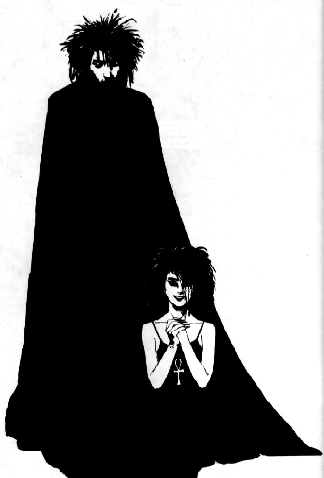
For me, The Sandman Omnibus, Volume III, by renowned British SF writer Neil Gaiman, constituted a conclusion twenty-four years in the making. I started reading his gorgeous, lush Sandman graphic novels in 1997, when my friend Stasia loaned me what was then the entire run. The series ran for a while longer, spinning off several excellent tie-in miniseries, such as Death: The High Cost of Living and Sandman: The Dream Hunters, in the process. By the time Gaiman wrapped it all up, in the six-part Sandman: Overture, I'd moved far enough away from the world of comic books that even this award-winning literary work couldn't draw me back to the fold.

Now, however, I've made time enough to read the entire cycle through. As she did with the previous two dictionary-sized hardcover volumes, the ever-generous Emily C. sent me Volume III as a gift. And what a marvelous gift they've been! Like visiting old friends, from Martin Tenbones to Mad Hettie. No spoilers here, but I will say that the ending satisfied immensely, even as it left me in thrall to Desire and Despair.

Different forms of those presented themselves when I read the Framed for Life, Volume 1, Volume 2, and Volume 3/4, the latest exculpatory endeavor by John Allen, who also wrote the series of Skeptical Juror books, beginning with The Skeptical Juror and the Trial of Byron Case. Although he wrote that particular text before meeting me, we've since become friends. Subsequently, he's had ten years to research and refine the most thorough, logical narrative of the case of Anastasia WitbolsFeugen's death, and my wrongful conviction for her supposed murder, yet. Framed for Life isn't for casual readers. It represents a systematic synthesis of data organization, information gathering, experimentation, and the author's obstinate willingness to raise a few hackles at the Jackson County Prosecutors Office, which these books show conspired to convict me, as well as many others (i.e., Theodore White, Richard Buchli, Ricky Kidd, et alii), with perjurious testimony, withholding and altering evidence, and generally being amoral shits. These weren't easy reads for me (see my "Framed For Life" post from mid-August), but I'm glad I made myself read them anyway.

Master Ma's Ordinary Mind: The Sayings of Zen Master Mazu Daoyi, by Fumio Yamada (translated by Nick Bellando), a Japanese Zen teacher, enriched my life at a rate of one saying per day. When I finished with that book, The Zen Sayings of Homeless Kodo, by Kosho Uchiyama and Shohaku Okumura, and edited by Molly Delight Whitehead, footed the bill. Both books offered straightforward teachings and commentary, but the latter did so from the perspective of three generations of teachers, beginning with the eponymous Kodo Sawaki, who died in 1966. The teachers in that book piggybacked off Kodo's words – and each other's. Imagine a posthumous correspondence with a parent and a grandparent. (Zen Buddhism is big on lineage and refers to one's teacher as one's dharma mother or father.) Both offered worthy insights.

For the literary gifts mentioned here, and for everything else that you do for me, thanks again, John, Emily, and my dear Mum. I appreciate all of you so much.