Showing posts with label Albert Camus. Show all posts

01 January, 2025

Two Books I Spent My Fall Reading


In the month of November, my book club chose to read The Plague, by Albert Camus, a book I last encountered seventeen or more years ago, in the 1948 translation. This new iteration, translated by Laura Marris in 2021, felt, for lack of a better word, punchier. Its language seems better suited to the philosophy that Camus espoused, downplaying some of the melodrama of that earlier version. The discussions we had in our meetings this season—about freedom, loneliness, religious belief, human nature, germ theory, bureaucratic inaction, the patron saint of wrongful convictions, Flannery O'Connor's opinion of Jesuits, and quite a few other scattershot topics—lent themselves to some very engaging Wednesday mornings.

Unstructured leisure time is at a premium in my life. The reading I get to do is split in several different ways. The New York Review of Books brings me joy, even though I take weeks to read a single issue and skip many of the political articles. The books waiting for my attention seem to increase in number weekly. (I've come to think of my to-read list as aspirational at best; I have e-book versions of several tempting texts and zero idea of when I might start any of them.) When I do get to pick out leisure reading, it's a special treat.

Recommended by a small host of writers whose opinions I trust, Anna Kavan's Ice proved to be an unsettling little novel. I bought Penguin's fiftieth anniversary edition, with a foreword by the writer Jonathan Lethem, and was floored. Kavan's hypnotic storytelling kept me rapt, chapter after chapter, as her horrific tale unfolded like a fever dream.

The book centers around one man's obsessive chase of a young woman—not motivated by love or even lust, but by an odious desire to possess. His quest leads him around a war-ravaged world on the brink of ecological disaster. Is it science fiction? Yes and no. The story takes place on earth, in a time very close to ours, but under the perpetual threat of "the ice," huge freezing shapes that will soon engulf and smother all life.

Despite the high concept at play, Ice is decidedly "soft" sci-fi, verging on Surrealism. Kavan gives us a phantasmal tale that doubles back on itself, revising as it goes, like a nightmare or a bad trip or a spell of amnesia. You think it's headed one way, until it picks up at another point, ignoring everything you just read. The girl dies, then she's alive again. Then something else is undone and done again, in a different way. Events aren't undone so much as un-done. Further confusing matters, the narrator's protean account continually shifts perspective. He describes impossible-to-know events and changes identities at the blink of an eye. The whole time, you hate him, but he gives you a window into this story that you can't help but stare through, mute and aghast. What a book!

In the months to come, I'll probably pick through a textbook, devour some Gothic horror, and ingest some philosophy—if I can make time amid my various commitments. Where there's a will, there's a way.

20 June, 2020

Fourteen Books I Spent My Spring Reading


Brace yourself. My reading, these past three months, was intense. Most of it was nonfiction. At one point, though, I started reading Dostoyevsky's The Idiot, which is reportedly among the great Russian novelist's most esteemed works, and passed page 183 before realizing that the book wouldn't move past the sitting room. I love Dostoyevsky's other works — The Brothers Karamazov, Crime and Punishment — but the mannered doings and misunderstandings of prerevolutionary Russia's upper class, which seem to comprise the entirety of The Idiot's plot, reminded me a little of Anna Karenina, a book that tortured me for 800-plus pages. I was not going to live through that again.

Buddhist works, with their often repetitious nature, sometimes plod along, but at least I feel like I'm growing when I read them, rather than just growing moldy.

Consider Paticcasamuppada: Practical Dependent Origination, an interpretation that I can definitely get behind. The Buddhist concept of dependent origination (also called "dependent arising," "interdependency," or any number of variations on this, based on who's translating Paticcasamuppada, a Pali term), refers to the Buddha's realization of the origins of suffering. In this book, Buddhadasa Bhikku cites ancient Pali sutras to boldly dispute the common Buddhist belief that one complete "turning of the wheel," an individual's attainment of enlightenment, takes three lifetimes. In plain English, he argues that reincarnation is a mythical remnant of the Hindu culture amid which Buddhism arose. He writes that this misunderstanding can be traced back to a mistranslation of the Pali word for "birth" that happened two millennia ago, circa 300 CE. To support this theory, Buddhadasa quotes multiple canonical passages attributed to the Buddha, but, really, the argument comes down to this: because Buddhist belief holds that there is no self, inherent being, or soul, what can be said to continue on after bodily death? Buddhadasa suggests that we "die" and are "reborn" with every moment, a marvelous flow of conditions stretching on and on, for as long as we do — you know, life.

The Soto Zen perspective in Grace Schireson's memoir, Naked in the Zendo: Stories of Uptight Zen, Wild-Ass Zen, and Enlightenment Wherever You Are, offered still more for me to enthusiastically engage with. Dr. Schireson's practical anecdotes, spanning her three decades' teaching and seven decades' living, are often deceptively simplistic. Her account of a Japanese teacher and hippie student's interaction at one particular retreat left me awed. Her story of a stray tomcat that terrorized her own feline friends inspired me as a small example of perfect magnanimity. Naked in the Zendo is a thin book that's much, much larger on the inside.

America in the 1960s was just being introduced to Buddhism, and, midway through that decade, Philip Kapleau returned from thirteen years of Zen training in Japan to compile The Three Pillars of Zen: Teaching, Practice, and Enlightenment as an introduction to the practice for Westerners. His book is still considered Zen's most influential English-language text, next to Shunryu Suzuki's Zen Mind, Beginner's Mind (which I really want to read). Kapleau delves into esoterica, including practitioners' self-reported kensho (budding enlightenment) experiences, which Westerners probably ate up because they saw Zen as a mystical practice from an exotic place. Eventually those seekers probably fell away as they learned that Zen is actually a pragmatic, subtle thing quite at odds with their expectations. Alongside transcriptions of once-secret dokusan teacher-student interactions, however, The Three Pillars of Zen does offer sound, detailed practical instructions for developing skillful meditation practice. For all the book's shortcomings, it did answer a lot of my questions. It just raised even more.

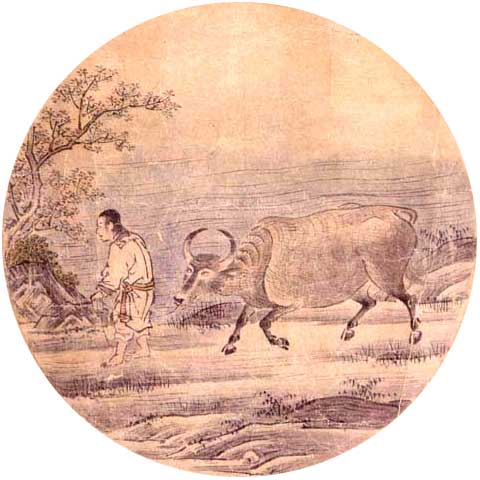
After that, I read Riding the Ox Home: Stages on the Path of Enlightenment — essentially a short picture book by John Daido Loori.


The ten Ox-Herding Pictures (that's Scene Five, above) and their accompanying poems are considered a 500-year-old map to how one develops in Buddhist practice. The ox here is a metaphor for enlightenment. Daido Loori presents his usual clear, concise commentary at each step. The overall effect is inspiring for anyone engaged in Zen practice.

I also appreciated Daido Loori's overview in The Eight Gates of Zen: A Program of Zen Training. This book details the ways of the monks, trainees, and students at Zen Mountain Monestery, which Daido Loori founded and where he taught until his 2009 death. The Eight Gates of Zen addresses Zen practice with the author's typical poetic perspective. I loved his writing, as well as the helpful appendices that included a zazen checklist, lists of liturgies that readers can employ, and a long list of recommended reading organized by level of depth and complexity, so that anyone, from newcomers to more advanced students, can locate suitable material.

The question of why I don't claim M. John Harrison as my favorite SF writer is complicated, and it came up several times as I read his gorgeous little novel Signs of Life, a gift from the kind Constance M., whose acquaintance I'm very glad to have made. (Thanks again, Connie.) Harrison's deep characterization, in works whose prose rivals fine literary novels, sparks an emotional attachment that few other writers are capable of engendering. Signs of Life almost made me weep with its narrator's longing and frustration. That character's difficult, complex friendship with an erratic sociopath, and unrequited love affair with a moon-eyed dreamer seem to doom him from the start, and the book's all the more engaging for this. It bears mentioning, too, that the great majority of Signs of Life reads nothing like sci-fi. There were moments when I wondered how it got labeled as genre fiction at all. The answer comes late, and almost subtly. As for not considering Harrison my favorite, it comes down to pure unfamiliarity. Maybe once I read everything else he's done....

In The Buddha's Dream of Liberation: Freedom, Emptiness, and Awakened Nature, James William Coleman, cofounder of the White Heron Sangha, in San Luis Obispo, California, examines the Samdhinirmocana Sutra, the Sutra of the of the Explanation of the Profound Secrets. This sounds like what cloaked figures in a 1970s Hammer Films production might use in black-magic rituals; it's actually a breakdown of the three turnings of the wheel of dharma, on which Buddhist teachings are based.

The first turning was the Buddha's introduction of the four noble truths (that life has suffering, that the cause of suffering is craving/attachment, that there is a remedy to life's suffering, and that that remedy is the noble eightfold path). The second turning was the Buddha's revelation that he, in fact, had nothing at all to teach anyone. The third turning was the Buddha's clarification of the apparent contradiction between the first and second turnings, by describing awakened (small b) buddha nature, which is the ultimate realization and embodiment of the dharma. Coleman's book, The Buddha's Dream of Liberation, gives a concise, comprehensible, and seemingly comprehensive unpacking of these tricky concepts.

Albert Camus might best be known to college undergrads as that dude who wrote about an Algerian man who's shot dead on the beach for no reason (that novel being his first, The Stranger). The COVID-19 pandemic prompted a slew of noncollegia readers to buy his novel The Plague. I'd already read some Camus in years past, both fiction and non-, and thought this period of social isolation was as good an excuse as any to join the mob — as it was translated by Stuart Gilbert. Other than being a little musty, with outmoded spellings and euphemisms, there's a lot here to identify with. I wrote a little on this subject in an April blog post on prison quarantine, so I won't retread that ground here. Suffice it to say that the novel is quite good, regardless of how one reads it — or in what proximity to a pandemic.

Almost inevitably, I circled back around to John Daido Loori. His Cave of Tigers: The Living Zen Practice of Dharma Combat deepened my understanding of Zen, with transcriptions of real teacher-student encounters at Zen Mountain Monastery. Despite its name, "dharma combat" is a nonviolent encounter in which students face their teacher in public one-on-one exchanges that demonstrate their understanding of Zen. Because they defy dualistic, linear thought, these exchanges might seem confounding, mysterious, profound, or even asinine to an outsider. They struck me as all of those, at different times, but I came away feeling much more aware within my practice.

Plainspoken talks by Charlotte Joko Beck, at the Zen Center of Los Angeles, make up Everyday Zen: Love & Work. Beck's teaching style was straightforward, no-nonsense, and lacking the inscrutable qualities others teachers' lessons often have. She didn't talk much about enlightenment, the precepts, or koans. Instead, she was interested in conveying the essential nature of practice, usually in the form of sitting zazen. As the book's title implies, there are no esoteric teachings here; this is Zen for daily living, because Zen, after all, is daily living.

Zen Training, by the Japanese lay practitioner Katsuki Sekida, answers fundamental questions about the methods and philosophy of Zen, from the physiologies of sitting and breathing, to working with the koan Mu and comprehending the levels and varieties of consciousness. There's even a whole chapter on laughter. Sekida left little out, and his modern approach, while methodical, affords just the right amount of flexibility. This book would kick-start any logical thinker's Zen practice. Quite a bit here also enriches the existing practice of one who lacks a teacher.

After coming to the US in 1959 to teach, Shunryu Suzuki became an influential figure in the development of American Zen Buddhism. His Zen Mind, Beginner's Mind, mentioned above, is considered a cornerstone English-language text on the subject. Branching Streams Flow in the Darkness: Zen Talks on the Sandokai collects his lectures about the 1,200-year-old Chinese poem, the Sandokai, by the great Zen master Sekito Kisen. The wisdom found in the poem earned it the status of Zen scripture. Monasteries around the world regularly chant it, and its final couplet ("I respectfully urge you who study the mystery, / do not pass your days and nights in vain.") is often written on the wooden board that's struck to signal the beginning of group meditation. Meanwhile, Suzuki's affable teachings guide readers through the poem, line by line, to help us understand, and maybe penetrate, its layers of meaning.

Finally, in the mood for some silliness, I picked up the Tom Robbins novel Fierce Invalids Home from Hot Climates. Although I distinctly recall the comic novels Jitterbug Perfume and Even Cowgirls Get the Blues sitting beside brainier fare on my father's bookshelf, I didn't read Robbins until the year before last. I was amused, once I did. And I zipped through the 445 pages of Fierce Invalids Home from Hot Climates this week. It amused me, but I don't necessarily recommend it. Some books are like that. This one's about a degenerate Buddhist ex-CIA "errand boy" who eats his grandmother's parrot while under the effects of a powerful hallucinogenic drug in Peru, ends up wheelchair-bound by a shamanic curse, seduces his underage stepsister, and, on a mission to Iraq for an American gunrunner, falls in love with an excommunicated expatriated middle-age French nun — one hell of a trip, for sure.

20 April, 2017

The List: Reading January through March 2017


Alicia Martin, from the artist's Biographies series

By the generosity of Veronica S., John A., Kristin S., and, as always, my extraordinary, incomparable Mum, I swam, delighted, in the flood of books that poured in at the start of the year. And what a selection! Many came off my Amazon wish list and were guaranteed to please, but more than a few surprises ensured that my reading went in unusual directions. (A confession: I put my best into reading that volume of history and the little book on spelling oddities, and failed miserably. Even my wide-ranging tastes have limits.) Finishing with each of the books listed below, I got such a thrill from sliding a finger along the spines of those yet unread, musing over which would most satisfy the particular literary craving felt in that moment, and finally selecting the exact right one. I don't get that luxury often. When I do, I savor it like something I may never get again.

* * * * *

John Stuart Mill, Utilitarianism
No philosophy seems to come about except in response to, or building off of, a preexisting one, and Mill's utilitarianism is no exception. His mentor, the English jurist Jeremy Bentham, is best remembered (by someone, I assume) for his Introduction to the Principles and Morals of Legislation, probably a real page-turner in its day. Bentham developed utilitarianism, but Mill refined it. Originally published serially in Fraser's Magazine for Town and Country, Mill's Utilitarianism is densely written, even for its era, the 1860s. We can probably blame this as much on its high-minded subject matter as on Mill's intellectualism, itself attributable to his father, who raised him in the strictest homeschool environment, isolated from other children, spoken to exclusively in Greek, and taught the principles of logic as life guides.

In a nutshell, utilitarianism, the "Greatest Happiness Principle," holds that what is moral comes from that which is determined to provide the greatest happiness to the greatest number of people. Because it demands situational morality, not hard rules carved into stone tablets, Christians in particular took issue with utilitarianism. Mill countered their assaults by writing that even Christians' objective sense of wrong and right can only be as firmly adhered to as their belief demands: "The question, Need I obey my conscious? is quite as often put to themselves by persons who never heard of the principle of utility, as by its adherents. Those whose conscientious feelings are so weak as to allow of their asking this question, if they answer it affirmatively, will not do so because they believe in the transcendental theory, but because of the external sanctions." Amen.

T.S. Eliot, The Waste Land and Other Poems
Course curricula at Autodidact University (student body: me) are intellectually rigorous, with a strong a priori bent — meaning that the reading lists are killer. Nowhere are these lists more voluminous than in AU's English Department. Poets, from Kazim Ali to Dean Young, make up a good twenty-five percent of the names in them, and Thomas Stearnes Eliot loomed well above most. The man's work is canonical.

Wonky meter and erratic rhyme abound in this selection (a Signet Classic edition) of early poems. Even after multiple readings of "The Love Song of J. Alfred Prufrock," the simple profundity of lines like "I have measured out my life with coffee spoons" moves me. The title work, Eliot's ostensible masterpiece, however, is too fussy. His 1922 publication of "The Waste Land" featured no addenda, yet when he published it in book form, pages on pages of end notes appeared, clueing readers in on every biblical and operatic allusion, translating its French, German, and Latin lines, and generally presenting the work as pedantry rather than poetry. I'm not against poems that resist immediate comprehension — far, far from it! — but give me Eliot's straightforward ''Do I dare / Disturb the universe?" any day, over the closing lines of "The Waste Land":
Poi s'ascose nel foco che gli affina
Quando fiarn uti chelidon — O swallow swallow
Le Prince d'Aquitaine à la tour abolie
These fragments I have shored against my ruins
Why then Ile fit you. Hieronymo's mad againe.
Datta. Dayadhvam. Damyata.
Shantih shantih shantih

Dylan Thomas, Adventures in the Skin Trade and Other Stories
The poet renowned for "Do Not Go Gently into That Good Night" also had a way with prose. He might've finished the wry, wild picaresque novel that he intended ''Adventures in the Skin Trade" to be, but for his 1953 death — as good a reason as any to quit writing. The other stories on offer in this collection of gems are polished beauties. I told friends, in the midst of my reading, that you could frame almost any sentence from the book, hang it on your wall, and appreciate it as a work of art unto itself. This was no exaggeration. Thomas was known for agonizing over his word choices. At the level of the story, his religiosity is present but unobtrusive. Most obvious is his consummate humanity, the dovetailing of his mythology and mystery with lots of depravity and "the terrors of the flesh."

Julie Otsuka, The Buddha in the Attic
In the early 1900s, first-generation immigrants from Japan — Issei — joined the American laborer class, picking the produce that Mexicans, Filipinos, Hindus, Koreans, Blacks, Okies, and Arkies, en masse, couldn't. Prosperous prewar appetites were hard to sate. Japanese "picture brides" left home on ships, lured stateside by misleading letters and photos from prospective husbands whose promises of luxury and prestige, opportunity and abundance, proved false as soon as the mail-order brides stepped onto land and met their new mates — not captains of industry but migrant workers. And you thought the liars on MTV's Catfish were cruel! The Buddha in the Attic fictionalizes these truths and, in doing so, makes them real. In my ignorance of history I'd assumed that only American men wooed Asian brides to the US. The chorus of voices in Otsuka's novel reveals another story altogether, an overwhelmingly cruel, sad one, then tells of what happened next, as World War Two erupted and these hard-working, long-suffering women were wronged yet again. This book offers the kind of history lesson that I find most effective: no arbitrary dates, no names of faceless so-called heroes, just human stories, raw and relentless.

Albert Camus (Justin O'Brien, translator), The Myth of Sisyphus and Other Essays
In an absurd universe without what Camus called "eternal values," can meaning be found, or are we all just what the nihilist say: pointless nothings, deluded that we actually exist? (I pick some cheery stuff, don't I?) Camus was attuned to the questions of existential futility; his every work of fiction drips with ennui. The long-form philosophical essay lending this collection its title asks why conscious people in this incomprehensible universe, being aware of our human limits, exist without hope but nevertheless go on existing rather than commit suicide. What is the role of hope? Of the supernatural balms of gods and prayers? Of aesthetics? After concluding with those heaviest of concerns, Camus turns tour guide. Sensory-rich essays about his hometown of Algiers, the country of Oman, the city of Tipasa, are philosophical ruminations in disguise — the best kind. I'd willingly play Theseus to his Ariadne any day, following the labyrinthine passageways along which he lays his thread, whether they be the stone-and-mortar variety or the kind that's as intangible as thought. Either makes for worthy adventure.

Ellison Rooke, Once-a Ponce-a Time… and Other Bean-isms
How many six-year-olds have collections of their quotes published? My friend's daughter, Bean, is the only one that I know of. Considering that she's the source of nuggets like "pretty please, with pepper on top," "how's your meatball doin' in that oven," and (one of the world's best-ever exclamatory phrases) "bust my brains," you can understand why.

Ben Marcus, Leaving the Sea: Stories
This man writes characters the way that Rolls-Royce makes cars — meticulously, in a spirit of polished ostentation, with what can only be called sumptuous interiors. A few of these stories were originally published in The New Yorker, where I recognized Marcus's amazing skill for rendering third-person narratives as intimate mental excursions. His protagonists are deeply flawed; they're often out-and-out failures. Many of them you can't possibly like. Still, thanks to how Marcus ensconces the reader inside his characters' fucked-up minds, you find yourself won over, a party to their struggles, with a vested interest in their well-being, time and time again. Reading Leaving the Sea is like a crash course in empathetic responses: afterward you feel sore and fatigued, but the bruises are totally worth it, considering the ride.

William Golding, Lord of the Flies
Nostalgia is what drives some to revisit fondly recalled books. Others want to re-experience the mood those books evoked the first time through. Still others, experimentalists, are curious about which aspects of the books they'll perceive differently after so many years. My freshman year in high school, over two decades ago, I read only about half of Lord of the Flies. What stopped me from finishing is now a mystery. Until February of 2017, I never went back to that isolated island with its imaginary beastie, its intermittent fire, its near-feral tweens running amok. What I found was Golding's lush prose, and that the beast in man is still very much at large. Plus ça change, plus c'est la même chose.

Peter Turchi, A Muse and a Maze: Writing as Puzzle, Mystery, and Magic
Certain essays (the best ones) have a power. They transform their subject, like a magic trick, from something recognizable, into a fascinating never-before-seen abstraction that you suddenly want to turn every which way, inspecting for other angles that might reveal its secrets. A Muse ana a Maze performs this sleight-of-hand with the craft of writing, particularly literary fiction-writing, by inviting readers to play at puzzles, riddles, and thought experiments that, as Turchi reveals with a flourish, share vast common ground with the creation and appreciation of fiction. Erudite yet accessible, with eye-pleasing art throughout, this is an endlessly recommendable book, perfect for lit lovers at both ends of the process, who relish fresh perspectives.

Jeffrey Eugenides, Middlesex
Without resorting to sensationalism, like a lesser writer might, Eugenides tells a tale — a family history, really — from the perspective of a middle-aged man with 5-alpha-reductase pseudohermaphroditism, born to second-generation American immigrants a girl. Like its narrator, Cal/Calliope, the novel manages to be both one thing and another, conversational and complex, epic and intimate, funny and tragic. This really is a stunning work of fiction, and it makes me intensely curious to see whether his debut, The Virgin Suicides, approaches a similar level of excellence.

Wilkie Collins, The Dead Alive
Legal thrillers aren't my thing. Precedent-setting works of fiction, on the other hand…. Published in 1874, The Dead Alive is among the first in the genre that would achieve ubiquity in airport bookstores and on suburban nightstands, in addition to being based on the United States' earliest recorded case of wrongful conviction. Collins was a popular mystery writer. In other words, The Dead Alive is no great literary achievement. Evidently the last 143 years haven't seen the genre evolve beyond an idle diversion. As a historical tidbit, though, this brisk little novel holds up well enough and brings to readers' attentions the dire flaws in Western jurisprudence — flaws that also, discouragingly, remain much unchanged by time. The modern-day reader will be forgiven if she comes away from Collins's book impacted less by its plot than by the persistence of injustice in our system of criminal law.

Curt Vonnegut Jr., Player Piano
Peeking through the cracks in this bland tale of one man's ennui in a retro-futurist dystopia of boredom, the satirical specialist Vonnegut would become (Player Piano is his first novel) was the only thing holding my interest to the end. The punch-card machines he envisioned conquering the American job economy, although not far from the realm of prophecy, now seem like quaint speculations from the era of Formica and malt shops. The real bar to enjoyment here is the heavy-handed praise, weighing down every other page, for "the two greatest wonders of the world, the human mind and heart." Ten years later, in the 1960s, Vonnegut gave us Cat's Cradle and Slaughterhouse-Five, so at least there's that to be grateful for.

Ira Levin, Rosemary's Baby
Around Halloween, Roman Polanski's film version of Rosemary's Raby usually airs as part of some cable network's seasonal lineup. I watch it every year, if I can. Never had I felt compelled to check out the novel on which it's based, though. Having read so many stilted, inartfully written horror novels I'm basically wary of the whole damn genre. (And genre fiction in general, truth be told.) What surprised me, when the novel happened to fall into my hands, was how faithful the film version is to its source material. Whole paragraphs of dialog made it onscreen. The unspoken elements found their way there, too — a cinematic rarity. It's nearly word-for-word. Only the novel's final scene, in which Rosemary discovers the shocking truth about little Andy, runs a smidgen longer, with just a daub of additional color, than the one in the movie. In it you can almost see Levin's grin as he toes that finest of lines between horror and hilarity.

06 May, 2014

The (Belated) List: Reading January Through March 2014


Unidentified Photographer, Student, c. 1960

Friends and strangers sent me so many books to read this quarter that I barely kept from running into the wall that is the prison’s personal-property limit. I consistently had a stock of books in my cell, waiting patiently for my attention. It was a great two and a half months of reading. Then I went to the Hole for thirty days, a circumstance that cut me off all but entirely and kept me from posting this list in the usual timely fashion. But now I’m back on track and need to thank the people who generously supplied most of the titles below: John A., Sarah L., Chris Steadman and the Freethought Books Project, my dearest Mum, and Tom Wayne at Prospero’s, hands down the best bookstore in Kansas City, Missouri.

* * * * *

Umberto Eco, (Alastair McEwen, translator), The Infinity of Lists
I get so few opportunities for intellectual stimulation and aesthetic pleasure. This anthology, companion to a 2009 exhibit of the same title at the Louvre, provided both. It’s a gorgeous collection of artwork and literary excerpts from throughout the history of Western civilization, curated by Eco in a thoughtful essay on the myriad forms of that deceptively humble tool, the list.

Every glossy page of this startlingly hefty book is a feast for the eyes and brain, accounting for all kinds of lists, from visual lists (Heironymus Bosch’s Garden of Earthly Delights and Andy Warhol’s Campbell’s Soup Cans) to lists of things of innumerable quantity (the gods in Hesiod’s Theogeny, the Greek armies in Homer’s Iliad, the moon’s fantastic sights in Ariosto’s Orlando Furioso), to sacred lists (the Catholic litanies, the begets in the Gospel According to Saint Matthew, the Song of Solomon) and profane ones (Paradise Lost’s demonic hierarchy, slaughterhouse atrocities in Berlin Alexanderplatz, sixteenth-century bum-wiping options in Five Books of the Lives, Heroic Deeds and Sayings of Gargantua and His Son Pantagruel), to fantastical lists (Aristotle’s De Mirabilibus), to practical lists (the Ten Commandments), to lists of treasures (the holy-relic inventory of the Saint Vitus Cathedral in Prague), to lists of curiosities (the Wunderkammern — cabinets of wonders), to chaotic hodgepodges that don’t even resemble lists at a glance but resolve into them when considered in a greater context. What a marvel!

Albert Camus (Justin O’Brien, translator), The Fall
A novel replete with irony and mordant wit, in which, strictly speaking, nothing happens. Yet The Fall moves swiftly through the monologue that forms it, to a calculated conclusion that doesn’t leave an impression so much as apply a red-hot brand to the reader’s mind — the sentence for its verdict on modern man. Even more so than The Stranger, the infamous novel Camus published eleven years earlier, The Fall is a stunning piece of literature.

Bill Henderson (editor), 2013 Pushcart Prize: Best of the Small Presses
The Pushcart Prize is the high water mark for small, independent literary magazines and presses. Nominations come in from many hundreds of editors each year and the competition is stiff. I admit to entertaining a little fantasy of winning one myself someday. Meanwhile, I was happy to have this 500-page collection of last year’s winners — essayists, writers of short stories, and poets alike, including such personal favorites as Karen Russell and Joyce Carol Oates. The creativity and intelligence on display in this anthology is impressive. I’m going to have to start reading these every year.

Howell D. Chickering Jr. (translator), Beowulf: A Dual-Language Edition
Probably originating from the eighth century CE, Beowulf is the oldest of all the great English poems. Even those who haven’t read it have encountered some form of the legend of Beowulf, the Scandinavian warrior prince. The tale of his heroic battles with fell creatures is one with enduring appeal. Demons, dragons, and death make for good story elements in any century — if you want proof, check the numbers for that CGI-animated Hollywood version of Beowulf that was released several years ago. I knew the basics from a prose retelling I read in elementary school, but it’s one thing to get the CliffsNotes version of a masterpiece, another altogether to dive into the sprawling bombast of this poem in something close to its intended form. (I say close because the poem was meant to be recited aloud by a bard. Me, I’m fresh out of bards at the moment, so this translation had to do.)

What adds so much value to this particular edition of Beowulf is Professor Chickering’s extensive annotation, before and after the poem itself, which gives historic, syntactic, and semiotic information that aids the contemporary reader’s understanding. One tidbit I picked from these was the connection and influence Beowulf had on J.R.R. Tolkien’s renowned tales of Middle Earth. Greatness begetting greatness.

Christopher Steadman, Faitheist: How an Atheist Found Common Ground with the Religious
What was I doing watching The O’Reilly Factor? The host’s an antagonistic blowhard, less interested in meaningful exchanges with guests than with promulgating the Fox News narrative as stridently as possible, and I think the reason viewers tune in to his show is the same as draws people to boxing and martial arts events: to watch some poor sod get beaten down. But when I saw the caption ATHEISTS ATTACK! in that angry red of which Fox News is so fond, I had to stick around to root for O’Reilly’s guest, Christopher Steadman, the Assistant Secular Humanist Chaplain at Harvard University, and hope against a verbal beating.

Faitheist is Steadman’s memoir about his journey from Christian Evangelist to atheist, and about the interfaith work he subsequently undertook, bringing people together, no matter their religious beliefs or disbeliefs, in the spirit of greater good. It wasn’t quite what I expected when I wrote my letter to him, congratulating the young man for holding his own against Angry Bill. Not only is this fairly intimate glimpse into Steadman’s struggles with religion, it’s arguably more candid on the subject of his homosexuality. A confounding pair of issues for a youth to grapple with, and so an interesting read that adds a fresh, much-needed Millennial voice to the religious-conversion memoir genre (into which my initiation, nearly twenty years ago, was Dan Barker’s very good Losing Faith in Faith).

I do wish his final chapter had included more ideas for forging quality interfaith relations; although, most of the book’s readers, unlike me, will have access to the Internet and be able to visit Faitheist’s website for lists of those, if they’re interested.

George W.S. Trow, Within the Context of No Context
”Look at the girl smile!” writes Trow in this ruthlessly truthful essay on the Media Age. “The more she smiles, the more certain it is that she represents something trivial, something shocking, or something failed.”

Falsity, pseudo-intimacy, indiscretion, agglomeration, schadenfreude, impermanence — all qualities that Trow attributes to contemporary culture, and even though the latter half of this books was first published in 1980, when TV was still the dominant fixture of empty lives, it continues to resonate, maybe more powerfully than ever.

Writing about the “I like Ike” slogan used in the 1952 presidential campaign, Trow isolates the empty language that a nation embraced: “From ‘like,’ all you could see was other Americans engaged in the processes of intimacy. This was a comfort.” But he might as well be referring to Facebook, where like has been rendered meaningless by users’ implicit agreement that it means anything at all.

Roland Barthes (Annette Lavers and Colin Smith, translators), Writing Degree Zero
My friend and occasional student in the insane, indecent pursuit of writing, Zach (whose blog can be read here), slumped in the doorway of my cell, hands shoved deeply in the pocket of his worn navy blue hoodie. I sat, my back to the desk. We were talking books. When he asked what I was reading just then, I pivoted to pull from inside a narrow cubbyhole the slim volume that is Writing Degree Zero. I held it up for him to read the cover.

“What is it?” he asked.

I held up a finger and turned to a page I’d read shortly before he showed up to converse. “Just listen: ‘It may be said that the whole movement of mathematical flow derives from an explicit reading of its relations. The language of classicism is animated by an analogous, although of course less rigid, movement: its “words,” neutralized, made absent by rigorous recourse to a tradition which dessicates their freshness, avoid the phonetic or semantic accident which would concentrate the flavor of language at one point and halt its intellectual momentum in the interest of an unequally distributed enjoyment. The classical flow is a succession of elements whose density is even; it is exposed to the same emotional pressure, and relieves those elements of any tendency towards an individual meaning appearing at all invented.’ I mean, why do I read this stuff? Semiotics is such tedious bullshit, and yet I keep subjecting myself to books like this.”

“That gave me a headache,” Zach said, pushing his glasses up to massage the left side of his head.

I laughed. “So I see.”

“It just came out of nowhere,” he said, still rubbing his temple. “Damn.”

“You’re serious?”

“Hell yes, I’m serious. This shit hurts!” He took the glasses off altogether and started knuckling the aggrieved spot. After a moment, when he quipped that he was having an aneurysm, I knew that he was fine. I also knew how I would review my experience reading Writing Degree Zero.

“Well,” I said, “there’s my review for the blog: This book made my friend’s head hurt. I’ll just recreate this little scene — you at my door, me sitting here, reading aloud from an almost fifty-year-old book on modern French literature.”

“Do that,” said Zach, recovered from his neurological event. “It won’t be helpful for your readers, but —”

I finished his sentence. “But neither will this book.”

Nicholson Baker, The Mezzanine
A lunchtime trip up an office building’s lobby escalator — sure, why wouldn’t that work as the entire plot of a riveting novel? And yes, The Mezzanine is a difficult book to set down. Specifically because Nicholson Baker centers this novel (a thinly veiled memoir, I’m sure) around such a mundane setpiece, he’s able to engage in page upon page of brilliant, complex associations, in which his musings on shoelaces, brands of shampoo, LPs, shirt buttoning, milk, footnotes, paper towel dispensers, the number of times each year people rethink specific thoughts, workplace etiquette, and drinking straws go far beyond the point you’d think they, as subjects of deep contemplation, could possibly withstand. Baker has a keen eye, and his unrelenting inquisitiveness brings forth insights about the modern world that generally sit right under people’s noses. I’m not surprised that his name isn’t more widely recognized; it takes guts to look at things this closely and report honestly about what you see, because truth never sells very well.

Umberto Eco (Alastair McEwen, translator), The Book of Legendary Lands
In 1899, an American named Cyrus Reed Teed put forth a theory that the sun, moon, and stars are not heavenly bodies as we believe, but are in fact visual effects caused by our living inside the Earth, on its concave crust, like standing on the interior of an enormous beach ball. Hollow Earth theories were relatively common in Teed’s day, but his evolved into a sect that claimed to have scientifically verified the concavity of Earth’s surface using an instrument they called a “rectilineator.” Teed’s followers called themselves Koreshan Unitarians, and they were serious about this stuff. When their founder died in 1908, they believed (presumably because he told them so) that Teed’s body was imbued with certain properties that would prevent it from rotting, so they left it laying out on display for a while, until it became obvious that at least one portion of their belief system was in error.

Florida was where the Koreshans “proved” the inside-outness of our planet, and, regardless of how wrong the sect was, Florida instituted the Koreshan State Park in 1967, nearly sixty years after Teed’s death, in the city of Estero. I’ve been there. Today it’s called the Koreshan State Historic Site — a nice stretch of lush greenery, one part of which is occupied by a little building overseen by a docent who’s only too happy to tell you all about the Koreshans and show you the cutaway model of our hollow world, its continents curling up at their edges as if someone spilled water on them and left them out to dry without weighting them down flat.

The social and psychological factors of why people believe weird things interest me to no end. The Book of Legendary Lands is a tour of places once widely believed to exist: Atlantis, the islands of Homer’s Odyssey, the realm of Prester John, the Antipodes, Ophir, Taprobane, Utopia, the Austral Lands, Shambhala, Saint Brendan’s Isle, Camelot, the Earthly Paradise, Ultima Thule, Montsalvat, Mu, Schlaraffenland, Christianopolis, Hyperborea, and others that I’d never heard of before, plus our hollow Earth — all of which lived in the wishful thoughts and dreams of countless of our forebears. Of a kind with Eco’s previous literary cornucopia, The Infinity of Lists (see my review above), The Book of Legendary Lands offers hundreds of glorious full-color plates of artwork, maps, film stills, and photographs distributed among its nearly 500 pages — more than enough to stroll through and get delightfully lost in.

Robert M. Pirsig, Zen and the Art of Motorcycle Maintenance
Hats off to Pirsig, a schizophrenic who underwent electroshock treatment, for writing about his philosophical journey into madness in such a way as to capture the attention of tens of thousands of inquiring, questing readers. This book was recommended to me, with great enthusiasm, many times over many years. I didn’t even know until last year that it’s a novel. But as a novel I find it thin. And although it’s thought-provoking, the philosophy it seeks to forward is hit-and-miss. The most pressing question Zen and the Art of Motorcycle Maintenance leaves me asking is anything but profound: how an essay about one man’s East-meets-West philosophy, tacked on to the framework of a lackluster father-son bike trip, became a bestseller not merely raved about but profoundly loved.

W.S. Di Piero, Tombo
The fifth title in McSweeney's poetry series, this volume’s slimness belies its beautiful content. Di Piero’s poems sparkle with lexicographical gems, like rhinestones on a hard-luck nightclub singer’s slinky dress, and they sing the same songs of yearning.

Jean François Arouet de Voltaire (Richard Aldington, translator), Candide
Tragicomic melodrama wasn’t what I expected from a vaunted philosopher like Voltaire. His classic naïf-in-the-world adventure of vicissitudes piled atop ill fortune is a highly recommended weekend read. The coincidence of this being the last book I read before everything went sideways for me is noteworthy.

Larry McMurtry, Boone’s Lick
Neither an erroneous conclusion to this quarter’s reading nor a book I wanted to read, this blah western passed a few hours of time in the very bad place I had the displeasure of occupying for the latter half of March and first half of April. If you read my previous post you’ll understand the draw of this terribly un-Byronic book.