Showing posts with label M. John Harrison. Show all posts

20 June, 2020

Fourteen Books I Spent My Spring Reading


Brace yourself. My reading, these past three months, was intense. Most of it was nonfiction. At one point, though, I started reading Dostoyevsky's The Idiot, which is reportedly among the great Russian novelist's most esteemed works, and passed page 183 before realizing that the book wouldn't move past the sitting room. I love Dostoyevsky's other works — The Brothers Karamazov, Crime and Punishment — but the mannered doings and misunderstandings of prerevolutionary Russia's upper class, which seem to comprise the entirety of The Idiot's plot, reminded me a little of Anna Karenina, a book that tortured me for 800-plus pages. I was not going to live through that again.

Buddhist works, with their often repetitious nature, sometimes plod along, but at least I feel like I'm growing when I read them, rather than just growing moldy.

Consider Paticcasamuppada: Practical Dependent Origination, an interpretation that I can definitely get behind. The Buddhist concept of dependent origination (also called "dependent arising," "interdependency," or any number of variations on this, based on who's translating Paticcasamuppada, a Pali term), refers to the Buddha's realization of the origins of suffering. In this book, Buddhadasa Bhikku cites ancient Pali sutras to boldly dispute the common Buddhist belief that one complete "turning of the wheel," an individual's attainment of enlightenment, takes three lifetimes. In plain English, he argues that reincarnation is a mythical remnant of the Hindu culture amid which Buddhism arose. He writes that this misunderstanding can be traced back to a mistranslation of the Pali word for "birth" that happened two millennia ago, circa 300 CE. To support this theory, Buddhadasa quotes multiple canonical passages attributed to the Buddha, but, really, the argument comes down to this: because Buddhist belief holds that there is no self, inherent being, or soul, what can be said to continue on after bodily death? Buddhadasa suggests that we "die" and are "reborn" with every moment, a marvelous flow of conditions stretching on and on, for as long as we do — you know, life.

The Soto Zen perspective in Grace Schireson's memoir, Naked in the Zendo: Stories of Uptight Zen, Wild-Ass Zen, and Enlightenment Wherever You Are, offered still more for me to enthusiastically engage with. Dr. Schireson's practical anecdotes, spanning her three decades' teaching and seven decades' living, are often deceptively simplistic. Her account of a Japanese teacher and hippie student's interaction at one particular retreat left me awed. Her story of a stray tomcat that terrorized her own feline friends inspired me as a small example of perfect magnanimity. Naked in the Zendo is a thin book that's much, much larger on the inside.

America in the 1960s was just being introduced to Buddhism, and, midway through that decade, Philip Kapleau returned from thirteen years of Zen training in Japan to compile The Three Pillars of Zen: Teaching, Practice, and Enlightenment as an introduction to the practice for Westerners. His book is still considered Zen's most influential English-language text, next to Shunryu Suzuki's Zen Mind, Beginner's Mind (which I really want to read). Kapleau delves into esoterica, including practitioners' self-reported kensho (budding enlightenment) experiences, which Westerners probably ate up because they saw Zen as a mystical practice from an exotic place. Eventually those seekers probably fell away as they learned that Zen is actually a pragmatic, subtle thing quite at odds with their expectations. Alongside transcriptions of once-secret dokusan teacher-student interactions, however, The Three Pillars of Zen does offer sound, detailed practical instructions for developing skillful meditation practice. For all the book's shortcomings, it did answer a lot of my questions. It just raised even more.

After that, I read Riding the Ox Home: Stages on the Path of Enlightenment — essentially a short picture book by John Daido Loori.
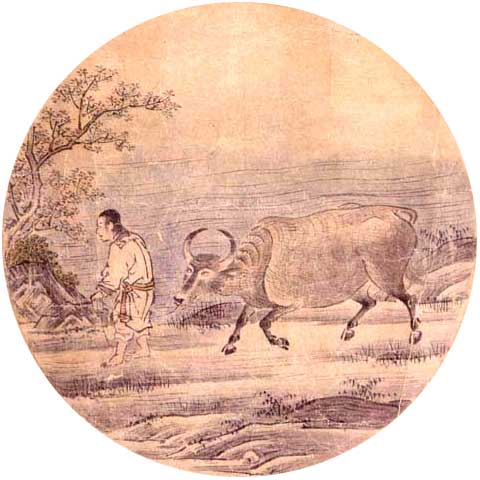


The ten Ox-Herding Pictures (that's Scene Five, above) and their accompanying poems are considered a 500-year-old map to how one develops in Buddhist practice. The ox here is a metaphor for enlightenment. Daido Loori presents his usual clear, concise commentary at each step. The overall effect is inspiring for anyone engaged in Zen practice.

I also appreciated Daido Loori's overview in The Eight Gates of Zen: A Program of Zen Training. This book details the ways of the monks, trainees, and students at Zen Mountain Monestery, which Daido Loori founded and where he taught until his 2009 death. The Eight Gates of Zen addresses Zen practice with the author's typical poetic perspective. I loved his writing, as well as the helpful appendices that included a zazen checklist, lists of liturgies that readers can employ, and a long list of recommended reading organized by level of depth and complexity, so that anyone, from newcomers to more advanced students, can locate suitable material.

The question of why I don't claim M. John Harrison as my favorite SF writer is complicated, and it came up several times as I read his gorgeous little novel Signs of Life, a gift from the kind Constance M., whose acquaintance I'm very glad to have made. (Thanks again, Connie.) Harrison's deep characterization, in works whose prose rivals fine literary novels, sparks an emotional attachment that few other writers are capable of engendering. Signs of Life almost made me weep with its narrator's longing and frustration. That character's difficult, complex friendship with an erratic sociopath, and unrequited love affair with a moon-eyed dreamer seem to doom him from the start, and the book's all the more engaging for this. It bears mentioning, too, that the great majority of Signs of Life reads nothing like sci-fi. There were moments when I wondered how it got labeled as genre fiction at all. The answer comes late, and almost subtly. As for not considering Harrison my favorite, it comes down to pure unfamiliarity. Maybe once I read everything else he's done....

In The Buddha's Dream of Liberation: Freedom, Emptiness, and Awakened Nature, James William Coleman, cofounder of the White Heron Sangha, in San Luis Obispo, California, examines the Samdhinirmocana Sutra, the Sutra of the of the Explanation of the Profound Secrets. This sounds like what cloaked figures in a 1970s Hammer Films production might use in black-magic rituals; it's actually a breakdown of the three turnings of the wheel of dharma, on which Buddhist teachings are based.

The first turning was the Buddha's introduction of the four noble truths (that life has suffering, that the cause of suffering is craving/attachment, that there is a remedy to life's suffering, and that that remedy is the noble eightfold path). The second turning was the Buddha's revelation that he, in fact, had nothing at all to teach anyone. The third turning was the Buddha's clarification of the apparent contradiction between the first and second turnings, by describing awakened (small b) buddha nature, which is the ultimate realization and embodiment of the dharma. Coleman's book, The Buddha's Dream of Liberation, gives a concise, comprehensible, and seemingly comprehensive unpacking of these tricky concepts.

Albert Camus might best be known to college undergrads as that dude who wrote about an Algerian man who's shot dead on the beach for no reason (that novel being his first, The Stranger). The COVID-19 pandemic prompted a slew of noncollegia readers to buy his novel The Plague. I'd already read some Camus in years past, both fiction and non-, and thought this period of social isolation was as good an excuse as any to join the mob — as it was translated by Stuart Gilbert. Other than being a little musty, with outmoded spellings and euphemisms, there's a lot here to identify with. I wrote a little on this subject in an April blog post on prison quarantine, so I won't retread that ground here. Suffice it to say that the novel is quite good, regardless of how one reads it — or in what proximity to a pandemic.

Almost inevitably, I circled back around to John Daido Loori. His Cave of Tigers: The Living Zen Practice of Dharma Combat deepened my understanding of Zen, with transcriptions of real teacher-student encounters at Zen Mountain Monastery. Despite its name, "dharma combat" is a nonviolent encounter in which students face their teacher in public one-on-one exchanges that demonstrate their understanding of Zen. Because they defy dualistic, linear thought, these exchanges might seem confounding, mysterious, profound, or even asinine to an outsider. They struck me as all of those, at different times, but I came away feeling much more aware within my practice.

Plainspoken talks by Charlotte Joko Beck, at the Zen Center of Los Angeles, make up Everyday Zen: Love & Work. Beck's teaching style was straightforward, no-nonsense, and lacking the inscrutable qualities others teachers' lessons often have. She didn't talk much about enlightenment, the precepts, or koans. Instead, she was interested in conveying the essential nature of practice, usually in the form of sitting zazen. As the book's title implies, there are no esoteric teachings here; this is Zen for daily living, because Zen, after all, is daily living.

Zen Training, by the Japanese lay practitioner Katsuki Sekida, answers fundamental questions about the methods and philosophy of Zen, from the physiologies of sitting and breathing, to working with the koan Mu and comprehending the levels and varieties of consciousness. There's even a whole chapter on laughter. Sekida left little out, and his modern approach, while methodical, affords just the right amount of flexibility. This book would kick-start any logical thinker's Zen practice. Quite a bit here also enriches the existing practice of one who lacks a teacher.

After coming to the US in 1959 to teach, Shunryu Suzuki became an influential figure in the development of American Zen Buddhism. His Zen Mind, Beginner's Mind, mentioned above, is considered a cornerstone English-language text on the subject. Branching Streams Flow in the Darkness: Zen Talks on the Sandokai collects his lectures about the 1,200-year-old Chinese poem, the Sandokai, by the great Zen master Sekito Kisen. The wisdom found in the poem earned it the status of Zen scripture. Monasteries around the world regularly chant it, and its final couplet ("I respectfully urge you who study the mystery, / do not pass your days and nights in vain.") is often written on the wooden board that's struck to signal the beginning of group meditation. Meanwhile, Suzuki's affable teachings guide readers through the poem, line by line, to help us understand, and maybe penetrate, its layers of meaning.

Finally, in the mood for some silliness, I picked up the Tom Robbins novel Fierce Invalids Home from Hot Climates. Although I distinctly recall the comic novels Jitterbug Perfume and Even Cowgirls Get the Blues sitting beside brainier fare on my father's bookshelf, I didn't read Robbins until the year before last. I was amused, once I did. And I zipped through the 445 pages of Fierce Invalids Home from Hot Climates this week. It amused me, but I don't necessarily recommend it. Some books are like that. This one's about a degenerate Buddhist ex-CIA "errand boy" who eats his grandmother's parrot while under the effects of a powerful hallucinogenic drug in Peru, ends up wheelchair-bound by a shamanic curse, seduces his underage stepsister, and, on a mission to Iraq for an American gunrunner, falls in love with an excommunicated expatriated middle-age French nun — one hell of a trip, for sure.

23 March, 2018

Fifteen Books I Spent My Winter Reading

Not that I believe in making New Year's resolutions, but I want 2018 to be the year I finish writing the novel that's often seemed doomed to languish in its folder since I started it, accidentally, in late-2012 (ack!). With resumption and completion of that project in mind, I hit the research materials early. Although somewhat dated, Elaine Sciolino's Persian Mirrors: The Elusive Face of Iran gave me a better grasp of contemporary Iranian culture than any other source I'd found. (Thank you, Mum, for sending it.) Then I boned up on matters survivalist and scavenger-related, using generously given birthday funds: Emergency, by Neil Strauss, and the fascinating true story of one man's twenty-seven-year hermitage in Maine, Michael Finkel's The Stranger in the Woods.

Breaking from this nonfiction jag, I tried to savor the novels sent to me by Lana C. three months back (which I mentioned in my fall reading overview). Books this good are hard to read sparingly. The Course of the Heart, a gorgeous metaphysical fantasy by the masterful M. John Harrison, whose work in SF never fails to leave an indelible impression on me, was quickly followed by Jesse Ball's compelling How to Set a Fire and Why. Ball has written so many surreal, dreamlike novels that this one's more straightforward story line surprised me…but not by any means in a bad way.

Man's Search for Meaning, Viktor E. Frankl's Holocaust-survival-account-cum-existential-philosophy-treatise, validated many thoughts I've had about my life and how I share it with others. The Viennese psychiatrist's therapeutic method was familiar, in a way. Are all imprisonment experiences ultimately alike, psychologically speaking? Do those of us subjected to unjust sequestration have the same fixed number of possible responses? It certainly looks that way. But how inspirational Frankl's book is, just the same!

My friend John always sends me the sorts of uber-geeky books that no one else would. This time around, it was Far from the Madding Gerund and Other Dispatches from Language Log, by Mark Liberman and Geoffrey K. Pullum. The long-defunct blog on linguistic concerns from dangling modifiers to hierarchical ontologies (you know, all the fun stuff) now exists only in part, in this paperback collection of posts that will interest virtually no one…except John and me. So, thanks for the gift, John.

The Vanishing American Adult, by prolific tweeter Senator Ben Sasse, of Nebraska, wasn't quite what his BookTV interview last year led me to believe. I expected a general-interest book of philosophy on living well and fully; I got a set of suggestions for parents hoping to inculcate character and a sense of meaning in their teenagers' lives. Still, the senator's greater points about what gives life substance and richness remain valid. Tidbits from his book fed into later thoughts that I had about how best to spend time, and about my visceral fear of squandering the minutes of my precious days.

A measure of my adulthood was temporarily relinquished for what came next. If you read my post on being an eternal and unabashed comic-book fanboy, then you can imagine the fun I had when I finally got to read the first Cerebus collection, by Dave Sim. There was an aura of legend surrounding the comic even in the mid-'90s, when my collecting peaked. This past December, the fortieth anniversary made my foray into the barbarian aardvark's realm kind of timely. Book One collects the first twenty-five issues — a two-and-a-half-year run — enough to see the art improve, the characters evolve, and a comprehensive world of magic and absurdity take shape. It was entertaining in a very different way from Daisuke Sato and Shouji Sato's zombie manga, Highschool of the Dead, loaned to me by Bobby and the Grub. (Astute readers will recall these wingmates of mine, from when I blogged about their handmade holiday-themed hanging heads, in last year's installment of "Halloween in the Hoosegow." They're into all kinds of nerdy shit, obviously.) It was my first manga and required some explaining. You read manga backward, I already know, because they're translated from Japanese, but a few quirks of the genre had me asking questions. For instance, why the fixation on enormous breasts?


Roberto Bolaño's 2666 (translated from the Spanish by Natasha Wimmer) started out, "The Part About the Critics," like a dry cough. Some of this was comparative, I admit. It's worlds apart from the graphic novels above. But by degrees 2666 developed into a full-blown fever. My patience and resolve to turn all 900 pages were rewarded with a modern masterpiece that's by turns brutal, tender, baffling, and trenchant. Another translation, Coda: A Novel, is René Belletto's sixty-nine-page experimental work that, in my opinion, Alyson Waters needn't have wasted her prowess with the French language on. The book's basically a mélange of suspense, absurdist comedy, existential intrigue, and familial melodrama. Like I say about so much French cinema, Ça ne me plaît pas.

And finally, because short-form SF is a mode of a genre I'm apparently incapable of ever tiring of, I finished off the season with a couple of fat collections, the Al Sarrantonio-edited Redshift: Extreme Visions of Speculative Fiction and the phenomenal duo of David G. Hartwell and Kathryn Cramer's Year's Best SF 17. The former was more of a mixed bag — maybe this is why it was a one-off anthology, rather than a series like the latter — but both carried me through the damp and dreary days of a waning, lackluster winter's end. Alternate history, extraterrestrials, interdimensional travel, near-future dystopias, the Singularity, and so on and so forth — all the themes and more. Imagining futures. There are worse ways to start a year. 

09 July, 2013

The List: Reading April Through June 2013

The time I’ve had for reading, these past months, has been less than what I’ve managed in the previous three years, due to my return to the prison workforce, and yet the number of books I read this quarter is basically the same as it always is. Strange. I guess this means I have to stop complaining about how little free time I get. 

A few of the books below were ones I wanted to read for years. I was able to place a largish order with Amazon, thanks to a long-overdue refund from a certain well-known literary quarterly that somehow never figured out how to fulfill my subscription beyond a single issue. The (pricy) subscription had been a gift, so I figured the money returned by said quarterly would be most fittingly spent on other reading material. My wish list is now a little shorter. My literary life is now a little richer.

Here are the titles that have occupied me since April. 

* * * * *

Rob Ziegler, Seed
I wish it were possible to blame my disappointment with this book, Ziegler’s debut novel, on high expectations. After reading several positive reviews in Locus, then, for two years, anticipating how good it was going to be, only a phenomenal book would’ve held up, and Seed is, at best, mediocre.

Even without my overinflated sense of its literary merit, however, I’d have been sorely let down. To read the summary on its (well-designed) cover is to mistake Seed for an “idea” book about ecological disaster in a future in which extreme genetic modification — of foods and higher forms of life alike — is commonplace. The story does start out promisingly well, with shades of Cormac McCarthy’s The Road, but somewhere around the point where the reader is introduced to Satori, the living, breathing city that manufactures the titular seed for a starving nation, everything wanders off into cheesy sci-fi action as various parties converge, some in rebellion, some for communion, each wreaking its own brand of havoc on the deaf, dumb, blind Satori, about which it’s impossible to care.

Add to this farrago a slew of weird quasi-homophonic typos (such as pour where it should read pore, peaked instead of peeked, and upbraided rather than abraded) that make me wonder if the manuscript was dictated and the book’s credited editor, Russ E. Lockhart, literally phoned it in. Seed germinates no small resentment in the fertile soil of this reader’s mind. 

Kevin Brockmeier, The Illumination
A defining characteristic of literature is its subtlety — deft introduction of ideas where lesser works would just bludgeon their readers heads, a modicum of ambiguity over which the readers can muse to arrive at conclusions about the text that are personal and, in this way, far more special than if the author had, as happens in most genre fiction, simply shoved it all at you, shouting, “Here, here’s my story!”

The Illumination imagined by Brockmeier in this group of interconnecting but, in a way, solitary chapters is an unexplained phenomenon: the sudden radiance of light from every cut, bruise, broken bone, and sickness the world over. Ulcers glow silver in people’s mouths, torn ligaments sparkle like a red-carpet burst of paparazzi camera flashes, leukemia casts luminous auras around its sufferers, self-inflicted cigarette burns shimmer like nighttime stars on the forearms of troubled souls. But the light and its causes are incidental to Brockmeier’s purposes here, a mere backdrop on which to project his beautiful exposition on the ways our pain defines us and our relationships.

Kenneth Goldsmith, Uncreative Writing: Managing Language in the Digital Age
In the face of unprecedented amount of digital text, writing needs to redefine itself in order to adapt to the new environment of textual abundance. If we think of words as both carriers of semantic meaning and as material objects, it becomes clear that we need a way to manage it all, an ecosystem that can encompass language in its myriad forms. No matter what we do with language, it will be expressive. Uncreative writing is a postidentity literature.

The poetry world has yet to experience its version of Pop Art — and Pop Art happened over fifty years ago In spite of the many proposed alternative uses of language (concrete poetry, language poetry, FC2-style innovative fiction, etc.), writing in the popular imagination has by and large stuck to traditional, narrative, and transparent uses, which have prevented it from experiencing a kind of Pop Art-like watershed. But then the real question emerges: why? Things get tricky when we try to nail down exactly what literary appropriation is. Once those formal decision are made, there are ethical issues to consider. Does it matter if poets write their own poems anymore or is it good enough for a computer to pen them for them?

In a time when the amount of language is rising exponentially, combined with greater access to the tools with which to manage, manipulate, and massage those words, appropriation is bound to become just another tool in the writers’ toolbox, an acceptable — and accepted — way of constructing a work of literature, even for more traditionally oriented writers. The Web functions both as a site for reading and writing: for writers it’s a vast supply text from which to construct literature; readers function in the same way, hacking a path through the morass of information, ultimately working as much at filtering as reading.

Sculpting with text.

Data mining.

Our task is simply to mind the machines. Ironies abound. The future doesn’t look promising for us as creative entities.

[Note: I composed this entirely by cribbing text from the book, typos and all. It seemed the only fitting thing to do, given the subject matter.]

Jesse Ball, The Curfew
With his surreal debut novel, Samedi the Deafness, Ball mesmerized me using a spell of simple yet evocative prose. With his second, The Way Through Doors, he led me through a waking dream. Now, with The Curfew, he has given me a puppet show.

Of course the book is not only that. The story begins as an intimate portrait of a man and his eight-year-old daughter, who eke out their happiness despite the murders and disappearances being carried out by secret police in the city of C. The father is an epitaphorist (Ball’s characters often have interesting, unheard-of professions), composing messages for the graves of the departed — fitting, for a man whose mastery of the violin is mooted by the government’s ban on music. Once he dares to venture out after dark, when “GOOD CITIZENS PASS THEIR NIGHTS ABED,” the daughter copes with her concerns by performing a puppet show with the neighbors in whose care she is left, a puppet show of such intricacy that its characters’ very thoughts are made visible and “mice” — ants to which tufts of fur have been glued — scurry at their feet.

This glancing attention to marvelous details is one of my favorite things about Ball’s writing. Another is that he doesn’t trouble himself with cohesive narratives, those meddlesome trivialities that are definitive beginnings, middles, and endings. He admits as much on page four, in the voice of an anonymous narrator:
I shall introduce this city and its occupants as a series of objects whose relationship cannot be told with any certainty. Though violence may connect them, though pity, compassion, hope may marry one thing to another, still all that is in process cannot be judged, and that which has passed has gone beyond judgment, which leaves us again, with lives and belongings, places, shuttling here and there, hapless, benighted, discordant.
Replete with quiet tragedy, love, and simple beauty, The Curfew may not quite match the success of Ball’s previous fictions; though, his alert prose and talent for… not necessarily storytelling but rendering moments made this book a pleasure to read.

Nikolay Gogol (Ronald Wilks, translator), The Diary of a Madman, The Government Inspector and Selected Stories
I was surprised, upon finally reading this collection by the Russian literary great, to find a quality that doesn’t generally spring to mind when thinking about nineteenth-century Ukraine-born authors: humor. Gogol had a firm grasp of the absurd, and, even while his writing verged on Realism, with lavish attention paid to what were often the minutest details of affect or place, he saw the ridiculousness of so may situations around him, the scaffolding on which he built all of his tales.

In his story “The Nose,” a mid-ranking civil servant awakens one morning to find his nose missing from his face, naturally assigning blame to his drunkard barber, and bounds through the city, searching for the absent appendage, only to encounter it, personified and dressed in a government uniform that signifies an even higher rank than his own, praying in a church. The nose later appears inside the hot roll being eaten for breakfast by the aforementioned barber, who, horrified, throws it in a river only for it to later reappear, without explanation, on the face of the civil servant to whom it belonged.

In “The Overcoat,” a man saves and scrimps to buy himself a coat to replace the one he’s worn nightgown-sheer, only to have the luxuriously tailored garment torn from his shoulders by a couple of muggers. The man falls ill from stress and grief, then dies. An urban legend soon arises, telling of a ghost going around Saint Petersburg, ripping off gentlemen’s coats.

It could be that I’m an unlearned simp for failing to see how “The Overcoat” deserves critics’ designation as the finest short fiction in all of Russian literature. I thought “The Nose” was a good deal more artful, also more entertaining. But for what unevenness I found in this selection of Gogol’s short works (the content is mainly stories; “The Government Inspector” is a clever play), each piece does stand on its own as a fine glimpse at what brought the author his reputation for greatness.

M. John Harrison, Viriconium
From satiric nineteenth-century Russian lit, I dived right into this contemporary British sci-fi/fantasy, craving escape of a drastic sort. China Miéville, another author who deals in genre-bending fantastical novels (and whom I quite admire), calls M. John Harrison an “anti-science fiction writer” — an ambiguous designation that nevertheless fits to a tee. The only other book of Harrison’s I’d read before this was his stunning, complex quantum masterpiece, Light, that rarest of books that inspires a reader to think of its author in terms of favorites, before ever reading anything else from the writer’s oeuvre. Viriconium, a collection of novellas and short stories, displays all of the qualities that I so loved about Light, while taking an entirely different tack with them. Continuity throughout is faint to nonexistent, and each of the tales offers a different take, sometimes meditative, often adventuresome, on the fluid existence of the endless city, Viriconium, in “a world trying to remember itself.” There’s escape here aplenty. Where Light was pure sci-fi, Viriconium swathes its science-fictional elements in the baroque garb of much fantasy, rich and thick, and sets the stories in a fluctuating future so far distant from now as to make myth of the lost sciences of a long-dead age.

J.G. Ballard, Crash
Sexual fetishists who get off on car crashes. To say this is what Crash is about would be accurate, in the crudest possible way, just as would be describing Orwell’s 1984 as being about a guy who’s just after some privacy. Okay, so the 1996 screen adaptation of Crash, moodily directed by James Cronenberg and starring the period’s go-to guy for sexual deviance, James Spader, overran with auto(mobile)eroticism. The book’s an altogether different story. Although sex suffuses nearly every page of this novel, none of it’s sexy.

Ballard is apparently known for being critical of modern technology’s increasing prominence as a bridge to human relations, so, in Crash, affairs abound without a single deep connection being forged. The style of his writing matches this clinical attitude, not least when the first-person narration provided (conveniently enough) by a character named James Ballard turns to musing about a life-changing automobile accident:
I was surprised by how much, in my eyes, the image of the car had changed, almost as if its true nature had been exposed by my accident. Leaning against the rear window of the taxi, I found myself flinching with excitement toward the traffic streams on the Western Avenue interchanges. The flashing lances of afternoon light deflected from the chromium panel trim tore at my skin. The hard jazz of radiator grilles, the motion of cars moving towards London Airport along the sunlit oncoming lanes, the street furniture and route indicators — all these seemed threatening and super-real, as exciting as the accelerating pintables of a sinister amusement arcade released on to these highways.
and climaxing coolly in this later scene with his wife, when the couple stops on a deserted service road:
When I put my arm around her shoulders she smiled briefly to herself, a nervous rictus of the upper lip which exposed her gold-tipped right incisor. I touched her mouth with my own, denting the waxy carapace of pastel lipcoat, watching her hand reach out to the chromium pillar of the quarter window. I pressed my lips against the bared and unmarked dentine of her upper teeth, fascinated by the movement of her fingers across the smooth chrome of the window pillar. Its surface was marked along its forward edge by a smear of blue paint left by some disaffected production-line worker. The nail of her forefinger scratched at this fretline, which rose diagonally from the window-sill at the same angle as the concrete ledge of the irrigation ditch ten feet from the car. In my eyes this parallax fused with the image of an abandoned car lying in the rust-stained grass on the lower slopes of the reservoir embankment. The brief avalanche of dissolving talc that fell across her eyes as I moved my lips across their lids contained all the melancholy of this derelict vehicle, its leaking engine oil and radiator coolant.
Ballard’s portrait of emotionally stunted people turning to more and more extreme proxies for meaningful connections is scathing and adroit, and as cold as shattered glass.

William Gibson, Zero History
The last title in the Blue Ant trilogy — three novels like tech-geek catnip, involving the covert bleeding-edge endeavors of intrepid multiplatform mogul Hubertus Bigend (you’ve got to love Gibson’s names). It’s as satisfying a summer read as its predecessors, Pattern Recognition and Spook Country, and perhaps more so for wrapping up with almost-forgotten characters and subplot points from the previous books in that glib manner Gibson geeks like myself revere him for.

But. The world is forever changing. Yesterday’s futures, all but the most prescient ones imagined, become nothing more than curios, quaint relics of the naive periods that birthed them. The cyberpunk masterpieces that began Gibson’s career in the 1980s, full of wetware data ports, brand-name bionic implants, and Yakuza enforcers hot on everybody’s trail, were very much of their time. The tomorrow depicted in the Blue Ant books could literally be tomorrow, when the gee-whiz gadgetry is a kludged line of Java or a stolen DARPA project. There is an iPhone in almost every hand. Am I the only fan who wishes Gibson would turn his attention back to a future more faraway? SF is risky business — predicting the future always is — but that risk is what makes it more fun. Bill, please give your readers back their distant dystopias full of exotic tech. If we want to see what tomorrow’s London, Los Angeles, or Vancouver will be like, there’s this wondrous machine called an airplane….

Neil Gaiman, The Ocean at the End of the Lane
A man returns to his childhood hometown, in rural England, to attend a funeral, and makes startling discoveries about an unremembered past. It’s an old trope, sure, but Neil Gaiman, masterful storyteller that he is, makes it new with the elements of fantasy for which he’s so renowned.

Just as the neighbors’ duck pond, described by The Ocean’s nameless narrator, is a good deal larger than it seems, and the trio of weird women on whose land it sits are actually much, much, much older than they look, this slim book contains quite a bit more than it at first seems. A deft exploration of a meek young boy’s existential frustrations, and a tale of fell childhood adventure that isn’t for children at all, The Ocean at the End of the Lane is easily my favorite Gaiman title since his excellent American Gods. No mean feat, that.